When to change Range Rover Sport differential oil
Land Rover Range Rover Sport
Land Rover Range Rover Sport•
•11 views
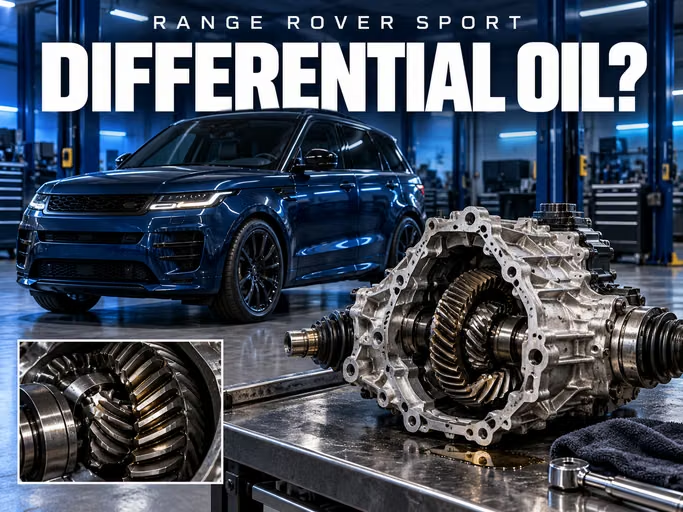
Editorial illustration. The differential cutaway and enlarged detail are conceptual, not a repair diagram. Select the oil and service procedure for the unit actually fitted.
Range Rover Sport differential oil should be changed according to the service plan for the particular vehicle. A leak, water contamination or repair calls for an additional assessment. There is no single interval covering every Sport: the L320, L494 and L461 use different driveline arrangements, and the rear differential may have an electronically controlled locking mechanism. Identify the unit before selecting its oil or replacement interval.
This article covers the front and rear axle differentials. The transfer case and automatic transmission have separate servicing requirements. It explains how to find the correct schedule, why a 75W-90 label is insufficient, and which symptoms need investigation. The factory examples below apply only to the documents and vehicle versions identified alongside them.
Identify the differential fitted to your Sport
Have the VIN and model year ready when booking the service. First registration and model year may differ, so a registration date alone is an unreliable way to select technical information. Engine output is also insufficient: vehicles with similar engines can have different driveline equipment and rear differentials.
The official iGuide provides a VIN search to align owner information with the vehicle specification and market. Selecting the model and year manually can display optional equipment that your car does not have. The workshop must then use the applicable repair instructions for the detailed draining, filling and quantity checks.
| What to establish | Why it matters |
|---|---|
| L320, L494 or L461 generation | A different generation’s service schedule and fluid requirements do not automatically apply. |
| Front or rear differential | These are separate units with their own filling requirements. |
| Open rear differential or electronic locking | The friction mechanism may require a specific fluid formulation. |
| Hybrid version and factory specification | The Sport name alone does not establish lubricant compatibility. |
| Replacement differential or aftermarket locking equipment | The actual installed unit and modification instructions must be considered. |
Why the differential has its own oil
The final drive transmits torque to the wheels, while the differential allows the two wheels on an axle to turn at different speeds during a corner. Its oil protects gear teeth and bearings and helps carry away heat. The total quantity is relatively small, so the size of a stain on the ground is a poor guide to how much attention a leak needs.
Engine oil and automatic transmission fluid do not replenish the differential. A service record saying “transmission serviced” does not confirm that both axle units received fresh oil. An informative invoice identifies each unit, the product used and the work performed. This is particularly useful when a vehicle has passed through several owners and workshops.
Understanding e-Diff and ETM
These terms appear in documentation for electronically managed rear differentials. Their locking function involves a friction mechanism, making lubricant behaviour relevant to more than gear protection. Two oils with the same viscosity can behave differently in that mechanism.
Do not identify a locking differential solely from the terrain-mode display or a seller’s description. Ask the workshop to confirm the factory configuration and the actual unit. If the differential has been replaced, compare its identification with the repair paperwork; the original VIN specification may no longer tell the whole story.
Finding the correct replacement interval
Use the service plan for the model year, market and driveline configuration. Locate the differential-oil entry rather than borrowing the engine-oil interval. Where both elapsed time and mileage are specified, whichever comes first determines when the work is due. Inspecting for leaks during routine servicing remains a separate task.
The 2011 model-year Range Rover Sport maintenance table illustrates the distinction. Rear locking-differential oil changes are marked at 120,000 km or 60 months, then at 240,000 km or 120 months. Front and rear non-locking axle oil is listed at ten years, with the corresponding mark at 240,000 km. These are examples from one schedule, not a universal Sport interval.
For an L494 or L461, request the vehicle’s own maintenance requirements. An older L320 service booklet does not establish the deadline for a newer car. Likewise, the general dashboard service countdown is not a chemical assessment of each differential’s lubricant. The absence of a dedicated warning does not remove scheduled maintenance or inspection requirements.
When to discuss earlier servicing
Land Rover’s regular-maintenance guidance identifies arduous use and dusty, wet or muddy terrain as reasons for more frequent attention. Deep wading can justify an immediate assessment even after a recent service. That guidance does not set one shortened differential-oil interval for every model.
Tell the workshop about towing, sand driving, sustained climbs and off-road use. An earlier preventive change can be agreed around these conditions. Record it as an individual recommendation if it differs from the factory plan. A blanket suggestion to change every 40,000–60,000 km does not explain its suitability for a particular vehicle or operating pattern.
When the service history is unknown
Start with an inspection and any available invoices. If previous changes cannot be documented, agree an initial service after confirming the correct lubricant. Investigate a whine, judder or leak first: changing the oil without examining the complaint may remove useful evidence while leaving the fault unresolved.
Record the date, mileage, condition of the drained fluid and the new product. Identify the serviced differential separately. This gives future maintenance a clear starting point. If a seller says that all fluids have been changed, request the itemised invoice; work on the gearbox or transfer case does not establish that either differential was included.
Choosing the correct differential oil
Select a lubricant against the full requirement for the installed unit. SAE identifies viscosity, not every performance characteristic. Labels such as “synthetic” or “for four-wheel drive”, and a general API category, are also insufficient. Electronically controlled locking systems can require particular friction properties.
The Range Rover Sport handbook LRL 10 02 62 151 contains the following recommendations. They show why a single model name is insufficient even within one handbook. Before ordering, the workshop should establish that the document applies and check any current approved product replacement.
| Unit in the cited handbook | Recommended product |
|---|---|
| Front differential | Castrol SAF-XO |
| Rear differential without locking | Castrol SAF-XO |
| Rear differential with electronic locking | Castrol BOT 720 |
| Hybrid rear differential with electronic locking | Castrol BOT 720B |
These are entries from a particular L494 handbook edition, not universal recommendations for the L320, L461 or every hybrid. A letter suffix matters. Similar names do not establish interchangeability, and a newer replacement product needs confirmed suitability for the relevant unit.
If an alternative is proposed, ask for lubricant-manufacturer documentation showing the necessary application or specification. A verbal claim that it works in every axle does not explain the choice. Adding a friction modifier yourself is also inappropriate: the finished lubricant already has a defined additive formulation.
How much oil is required
Obtain the quantity from the repair procedure for the particular differential. Figures can differ between a routine drain and refill and a completely dry unit. Residual oil can remain during normal servicing, so a dry-fill figure should not automatically become the replacement dose.
Avoid ordering on the assumption that each differential takes one litre. The workshop needs the exact configuration, required quantity and filling method. A measured-fill procedure should not be replaced with the familiar practice of filling to an opening’s lower edge. Where a level-opening check is specified, its stated conditions must be followed.
Confirm whether new plugs or seals are required; these may not be supplied with the oil. The pump and container must also be clean. Residue from another lubricant or dirt on the equipment can contaminate a correctly selected product. Finish with a leak check and an accurate record of what was installed.
When an oil change is not enough
A noise from the rear of the vehicle does not prove that the differential is responsible. Tyres and wheel bearings can produce similar humming, while mountings and other driveline components can cause knocks. Describe whether the symptom occurs under acceleration, on overrun, after warming up or during a slow turn. Cabin noise alone is insufficient grounds for replacing a differential.
▪ Fresh oil around the input flange, halfshaft outlets, plugs or housing joints calls for locating the source and checking the fill.
▪ A new whine under load, cornering judder or a knock when torque changes requires diagnosis before routine servicing.
▪ Water, significant emulsification or large metal particles in drained oil requires an assessment of the unit.
▪ Report driveline warnings together with any change in behaviour and the conditions in which they appeared.
Rear e-Diff judder on certain L494 vehicles
JLR technical communication SSM75898 addresses low-speed cornering knock or judder, including the 2019 model-year Range Rover Sport L494 with the 5.0 AJ133 P8 S/C engine. Following diagnostic confirmation, it specifies two drain-and-refill operations with a drive between them, plus mounting checks. This is a complaint-specific action, not a routine requirement for every Sport oil change.
The absence of a fault code does not by itself rule out a problem. The workshop should verify applicability and current instructions rather than repeat isolated bulletin steps. If fresh oil does not resolve the symptom, or the improvement is temporary, investigation should continue. Lubricant cannot restore damaged bearing surfaces or gear teeth.
Leaks on newer vehicles
Communication SSM76208 concerns leakage around differential pinion seals and includes the 2023–2024 model-year Range Rover Sport. The published instruction required technical assistance before dismantling. For a similar leak on an L461, ask the workshop to check the current VIN-specific process. The communication does not establish that every vehicle in that period has the fault.
Checks after wading
After deep wading, tell the workshop about the conditions and duration of immersion. Suspected contamination calls for checking the oil, seals and differential ventilation. Replacing fluid while leaving the entry route unresolved risks a repeat problem. A small sample without a milky appearance does not guarantee that the entire fill is clean. An underbody impact also warrants inspection of the housing and mounts.
What to check when booking the service
Agree which units are included and what the quoted price covers. The following sequence helps an owner assess the service. The technician must obtain exact tightening torques, plug requirements and filling instructions from the applicable procedure in the TOPIx technical system.
- Confirm the differential type and lubricant. Where there is a complaint, diagnose it and retain fault information and symptom details before draining.
- Inspect the housing and seals, support the vehicle correctly and clean around the plugs. Check access to the prescribed filling point before removing the old oil.
- Collect the fluid in a clean container and assess contamination. Water or unusual particles should prompt agreement on the next steps rather than automatic completion of a routine change.
- Refill using the unit’s instructions, renew the specified single-use parts and observe tightening requirements. Do not introduce an arbitrary flushing chemical or additive.
- Check for leaks and assess the result. Record the product, quantity, date, mileage, serviced unit and any outstanding findings on the invoice.
The quotation should distinguish oil from other work. Seal replacement, noise diagnosis, underbody protection removal and servicing the second differential may be separate items. Compare prices only when the scope is equivalent. A low headline price for an oil change may omit necessary consumables.
Does every change require flushing
Do not independently add a chemical flush to routine maintenance. If water or metal particles are present, determine the next action after inspection. Repeated drains using the correct lubricant under a technical instruction differ from introducing a solvent. The reason for contamination must also be addressed to prevent recurrence.
Can topping up replace a repair
Topping up does not correct a leak. Establish the source of the loss and identify the existing lubricant first. Mixing products at random is inappropriate when the current fill is unknown. A significant leak or accompanying noise calls for diagnosis and safe transport advice, rather than repeatedly adding small amounts and continuing to drive.
Questions to ask before buying a used Sport
Request records for both differentials, details of replacement units and previous leak repairs. Ask about towing and water crossings. When comparing current offers, assess service evidence alongside mileage. Fresh oil before a sale does not replace an inspection on a lift or investigation of symptoms during a road test.
Conclusion
Range Rover Sport differential servicing starts with identifying the generation and installed unit. Check its own schedule, confirm the lubricant and establish the drain-and-refill quantity. Water contamination, leakage and new noise deserve attention before the next routine service. An itemised invoice makes the maintenance history useful and provides a sound basis for planning subsequent work.