


How much horsepower does the BMW X6 xDrive35d have?
BMW X6
BMW X6•
•6 views

Editorial illustration. The first-generation BMW X6 is represented approximately; colour and equipment may differ from a production vehicle.
The first-generation E71 BMW X6 xDrive35d* produces 210 kW, equivalent to approximately 286 metric horsepower or 282 mechanical horsepower, and 580 Nm of torque. Despite the 35d badge, its diesel engine displaces 2,993 cc. A search for an “X6 3.5 D” therefore usually concerns the three-litre 35d, rather than a 3.5-litre engine.
* xDrive is BMW’s all-wheel-drive designation; E71 is the first-generation X6 model code.
That distinction matters when comparing used vehicles. Changing a single letter can change the fuel type, while similar bodywork can conceal different powertrains. This article explains the early diesel’s factory output, the units used to describe it and the figures that belong to other versions. Modern X6 models and cars with modified engine software are outside the original specification discussed here.
What output did BMW quote for the X6 35d?
The original X6 launch information lists 210 kW at 4,400 rpm* and peak torque of 580 Nm between 1,750 and 2,250 rpm. BMW also quoted 0–100 km/h in 6.9 seconds and a top speed of 236 km/h for the xDrive35d. These are factory figures published in 2008.
* rpm means revolutions per minute, the unit used to describe engine speed.
Engine output and acceleration describe different things. Output is a powertrain characteristic; acceleration concerns the complete vehicle, including its mass, transmission and tyre grip. A factory rating does not guarantee that every surviving used example will reproduce the original acceleration time today. It provides a baseline for comparing versions, rather than a measurement of the individual car being advertised.
Why do some sources show 286 horsepower and others 282?
The difference can come from units. Converting 210 kW gives approximately 286 PS or 282 mechanical hp*. Those numbers describe essentially the same output after rounding; they do not establish two separate engine calibrations. English-language specifications sometimes use the word horsepower without making the underlying unit clear.
* PS is metric horsepower, approximately 735.5 watts.
** hp here means mechanical horsepower, approximately 745.7 watts.
Conversion factors appear in the NIST unit tables*. Kilowatts offer a useful common reference when comparing documents. A difference between 282 and 286 should not automatically be interpreted as power lost through wear or gained through tuning. Establish the measurement unit before trying to explain the apparent discrepancy mechanically.
* NIST is the US National Institute of Standards and Technology.
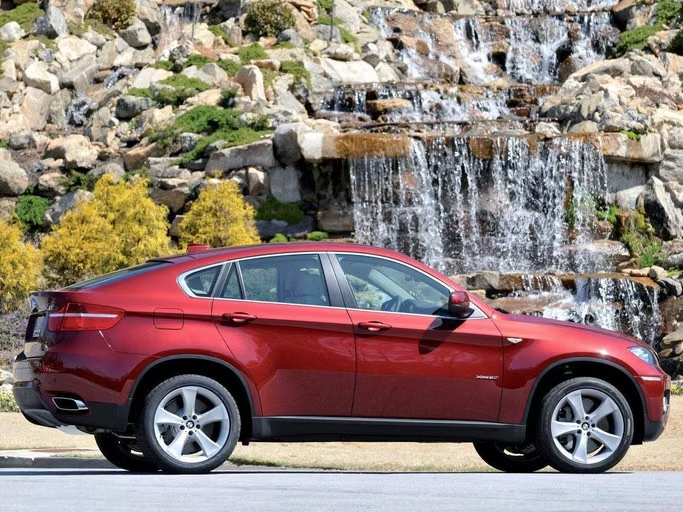
First-generation BMW X6 E71, shown in petrol specification. The shared body shape does not establish the diesel 35d’s powertrain. Explore this generation.
Does the 35d badge mean a 3.5 litre engine?
No. The badge should not be read as an exact displacement figure. This 35d has six cylinders arranged in line and an engine capacity that rounds to 3.0 litres. The letter d identifies the diesel version. The similarly named 35i is a petrol model, so substituting one letter for the other changes the relevant specification.
For example, an advertisement headed “X6 35d 3.5” but marked as petrol contains conflicting information. It does not demonstrate the existence of a special variant. Factory identification and vehicle documents should resolve the discrepancy. A badge on the tailgate is not sufficient evidence on its own: exterior parts can be replaced and advertisement fields can be entered incorrectly.
What does 580 Nm tell you about performance?
Peak torque arrives well before peak power. That helps explain the diesel’s character: substantial engine torque is available at comparatively low engine speeds. However, engine torque alone cannot rank the acceleration of different cars. Torque at the wheels also depends on the selected gear, transmission ratios and drivetrain losses.
The original X6 range used a six-speed automatic transmission. Consequently, an early factory-standard 35d described as having an eight-speed automatic needs clarification. The appearance of its electronic selector cannot settle the question. Similar controls do not prove that two cars use the same transmission, particularly when advertisements mix specifications from different production periods.
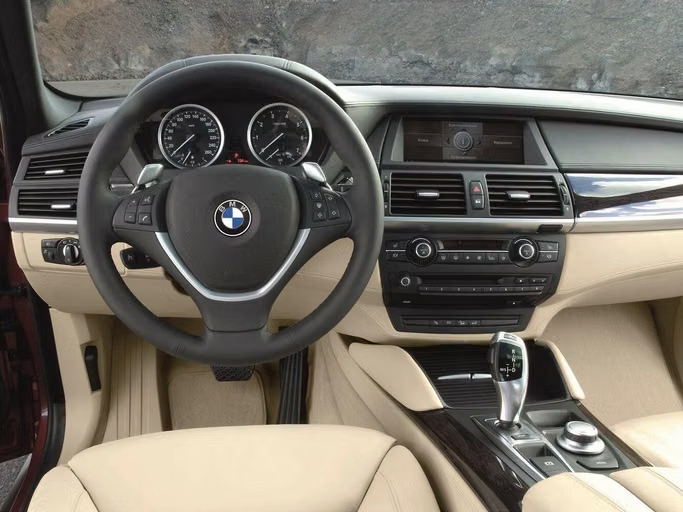
An early BMW X6 E71 cabin in petrol specification. The selector’s appearance does not confirm the number of gears or engine variant. View the generation’s interior.
How does the 35d compare with the early 30d and 35i?
A useful comparison needs a common date. In the 2008 launch specification, the diesel 30d had 235 metric horsepower and 520 Nm, while the petrol 35i had 306 metric horsepower and 400 Nm. Their quoted 0–100 km/h times were 8.0 and 6.7 seconds respectively. These figures apply to those early versions, not to every E71 carrying the same badge.
The 35d therefore had more engine torque than the 35i, yet BMW quoted slightly quicker acceleration for the petrol car. This illustrates why comparing complete specifications is more useful than choosing the largest number in an advertisement. More torque does not automatically mean more power or better overall acceleration.
Where does the 306 horsepower diesel figure come from?
The revised 2010 range introduced the xDrive40d with 225 kW, equivalent to approximately 306 metric horsepower. BMW’s October 2010 specification collection lists the diesel versions as 30d and 40d. The later figure should therefore not be assigned to an original factory-standard 35d without explanation.
First registration is not always the same as production date. Cars around a model change should be identified through their exact factory specification and documents. The number 306 alone cannot even identify the fuel type: it appears for both the petrol 35i and the later diesel 40d. Version and production period provide the necessary context.
Does the factory output prove a used car’s condition?
No. Factory output describes the original configuration; an individual used car’s condition is a separate matter. If a seller claims substantially more power than standard, establish where the number comes from: a factory document, an estimate after a software change or a dynamometer measurement. These are different forms of evidence and should not be treated as interchangeable.
Engine power must also be distinguished from power measured at the wheels. Transmission losses sit between the two, and a universal correction should not be applied to every car or test facility. When comparing current offers, separate factory variants from claims about modifications. Paying extra for additional output makes sense only when the claimed result and the changes behind it are properly documented.
What should buyers remember about X6 35d horsepower?
For the early BMW X6 xDrive35d, the starting point is 210 kW, approximately 286 metric horsepower and a three-litre diesel. References to “3.5 D”, 306 horsepower or an eight-speed automatic require the version to be clarified. Accurate identification makes comparisons of price, performance and modifications far more meaningful.


