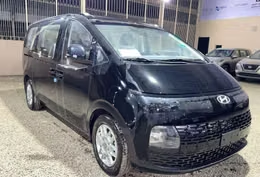
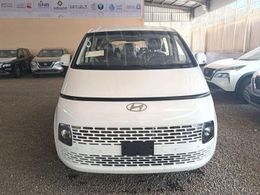
يوضح الرسم البياني ديناميكيات متوسط سعر الطراز في سوق السيارات المستعملة خلال العام الماضي. تساعدك هذه البيانات على تقييم جدوى الشراء وتوقع القيمة المستقبلية للسيارة.
قد تختلف الأسعار على AUTO.AE عن تكلفة البيع الفعلية. تستند البيانات إلى قاعدة بياناتنا من السيارات المباعة والإعلانات الحالية. للحصول على تقييم دقيق، استخدم أداتنا.
When to Replace Hyundai Staria Brake Pads and Rotors
Replace Hyundai Staria brake pads and rotors according to their condition, after measurements and inspection of the assembly. The same mileage can produce different wear on a family minivan, passenger shuttle and cargo van. Full loads and frequent stops increase braking demands, so operating conditions matter alongside distance travelled. This article covers the Hyundai Staria US4 series. The specifications page on hyundai-uae.com lists 3.5 MPi versions with different seating layouts, front-wheel drive and an eight-speed automatic. Imported vehicles may have different powertrains. Before ordering parts, confirm the VIN, build date, engine, drivetrain and parking brake type; the model name alone does not establish kit compatibility. In brief. Measured wear and defects determine pad and rotor replacement. Confirm the Staria specification and parking brake actuator. With frequent stops and full loads, track wear through measurements instead of using mileage alone. How to Select Staria Brake Components Start with the VIN and factory specification. Identify whether the vehicle is a passenger minivan or cargo van and cross-check part numbers. Seating capacity helps identify the version but does not, by itself, prove that brake components differ or interchange. On modified vehicles, also check the identification of the calipers and rotors actually fitted. For rotors, check diameter, working thickness, height and mounting dimensions. For pads, confirm shape, part number, axle and caliper compatibility. Rear brake selection must also account for the parking brake actuator. Wheel diameter alone cannot establish pad or rotor interchangeability. Wagon and Premium passenger versions. Confirm the specification using the VIN. Van cargo versions. Check fitment for the particular vehicle. Imported versions. Verify the engine, drivetrain and original market specification. Modified brakes. Select parts for the components actually installed. Why Mileage Does Not Set a Mandatory Replacement Point Use your vehicle’s inspection schedule and the findings from each check. A service interval does not mean new pads are required at every visit. Ask for lining and rotor thickness to be recorded for each wheel: comparing measurements helps reveal accelerated or uneven wear. Have new symptoms investigated before the next scheduled service. When Replacement Is Necessary The workshop should explain why each component needs replacement. Pads are assessed for remaining friction material, integrity and contamination; rotors for thickness, surface condition and geometry. A serviceable rotor does not necessarily need replacement with every pad set. However, adequate thickness does not make cracks, damage or geometry outside the permitted limits acceptable. The lining has reached its wear limit, separated, suffered damage or become contaminated with oil or brake fluid. The rotor has worn to its minimum permitted thickness or has unacceptable cracks or damage. Runout or thickness variation exceeds the specification and cannot be corrected by an approved method. Binding or a leak has damaged components; the cause must be addressed alongside replacement. Do not postpone diagnosis of metallic grinding. If the pedal sinks, fluid leaks, a wheel smokes, the vehicle pulls strongly or braking deteriorates noticeably, stop safely and arrange assistance. Do not investigate a fault through repeated hard braking. Key rule. Replace pads as an axle set and rotors as an axle pair with new pads. Front and rear axles do not necessarily need repair together. Correct binding and leaks alongside replacement of damaged parts. Measurements to Request from the Workshop The technical explanation on bremboparts.com identifies minimum rotor thickness as MIN TH. Take measurements at a minimum of four points and compare the lowest reading with the fitted component’s limit. The outer wear lip must not distort the result. A specification for one Staria rotor cannot be transferred to another axle or variant. Why Both Inner and Outer Pads Need Checking Looking through a wheel usually reveals only part of the assembly. The inner lining may wear faster than the outer one if caliper movement is restricted. Check both pads in every caliper, compare sides on the same axle and inspect the piston, slides and dust boots. Replacing linings while leaving binding unresolved will expose the new set to uneven wear too. Accounting for Shuttle Operation For a Staria used for transfers or passenger transport, keep a record of measurements for each wheel. Log the date, mileage, remaining lining thickness and rotor findings. Changes of driver or route can alter the rate of wear, so the life of the previous set is no guarantee for the next one. Before a long journey with a full load, have the brakes checked, especially when little usable lining remains. Symptoms to Describe to the Technician Explain whether noise occurs after parking, with light pedal pressure, after warming up or on a descent. State whether vibration is felt in the steering wheel, pedal or body. Pulsation during ABS activation does not establish a rotor defect; persistent vibration under ordinary braking needs diagnosis. No dashboard warning does not establish sufficient lining thickness either. If Noise Appears After Service The noise and vibration checks on bremboparts.com cover rotor seating on the hub, caliper condition and fitting hardware. Start by checking assembly, runout and free pad movement. Fitting another kit without identifying the cause may not solve the problem. After repair, obtain bedding-in advice for the components actually installed. What Accelerates Wear and Increases Heat Load numerous stops during transfers and urban deliveries; repeated heavy braking from high speed; repeated braking and long descents with passengers or cargo; a binding caliper or a parking brake that does not fully release; oil or brake fluid contamination of the linings; damaged dust boots and restricted slide movement; incompatible parts or fitting errors. Observe the permitted gross vehicle weight and loading requirements for your Staria version. On descents, use the transmission mode specified in the vehicle instructions and avoid holding the brake pedal continuously. When stops are frequent, leave enough following distance for smooth deceleration. Hot weather alone does not set a replacement interval: component condition and proper operation determine the work needed. Why Parking Brake Type Must Be Confirmed The Staria Premium brochure on hyundai-uae.com lists an electric parking brake with Auto Hold. Do not assume that every Staria has this equipment: the workshop must identify the actual actuator before rear axle service. With EPB, follow the specified procedure, including service mode where required. After assembly, check holding, complete release and the absence of faults; never force a piston back without accounting for its design. Pre-Replacement Checklist Before approving replacement, ask to see the wear or defects. Record measurements for each wheel, the permitted limits and the reason for repair on the job sheet. If wear is uneven, specify the work needed to address its cause separately. ☐ Confirm the VIN, engine, drivetrain and brake specification. ☐ Describe noise, vibration, pulling and changes in pedal travel. ☐ Check dashboard warnings and the causes of faults. ☐ Inspect the inner and outer pads in every caliper. ☐ Record rotor thickness and minimum permitted values. ☐ Where vibration occurs, check runout and thickness variation. ☐ Inspect calipers, hoses, slides and dust boots. ☐ Confirm part numbers and required fitting hardware. ☐ Confirm parking brake type and the rear brake service procedure. ☐ Verify braking and obtain bedding-in instructions. Common Service Mistakes ordering only by the Staria name and registration year; replacing individual pads or a rotor on just one side of an axle; judging every lining by the visible outer pad; machining a rotor without checking permission and final thickness; scheduling replacement solely by the life of the previous set; leaving a leak or binding unresolved after fitting new parts. Important. If fluid leaks, the pedal sinks, a wheel smokes, the vehicle pulls strongly or braking deteriorates sharply, stop safely and seek assistance. Do not continue driving with faulty brakes. Conclusion Replace Hyundai Staria pads and rotors when wear reaches its limit or unacceptable defects are found. Check both linings in every caliper, rotor thickness and free movement of the assembly. Regular measurements are useful for passenger or cargo work, while rear axle service requires identification of the parking brake actuator. VIN-based selection and resolving uneven wear help prevent repeat repairs. If you are considering a used Hyundai Staria, current offers can help you compare vehicles. Before buying, establish its previous usage, request the service history and arrange a brake inspection with measurements. On a former shuttle or delivery van, pay particular attention to both axles and caliper operation.
How Often to Change Differential Oil in a Hyundai Staria
Hyundai Staria differential servicing depends first on the drive system. A front-wheel-drive vehicle has no separate driven rear differential requiring an oil change. An all-wheel-drive version has a rear differential serviced separately from the transmission. Identify the specification before choosing a maintenance schedule or buying oil. Identify the Drive System First The specification published on hyundai-uae.com lists the Staria Premium 3.5 MPI petrol model with an eight-speed automatic and front-wheel drive. Its size or seating capacity does not make an AWD maintenance checklist applicable. Check the VIN, model year and installed transmission. The front differential forms part of the transaxle assembly, and its servicing follows the documentation for that unit. On AWD versions, the rear differential and transfer case must also be considered separately. Important. The intervals and capacities below concern the 4WD units covered by the 2025 Staria US4 manual. Check VIN-specific information for other model years and Hybrid versions. Oil Inspection and Replacement The normal maintenance schedule calls for rear-differential oil inspection every 60,000 km or 48 months, whichever comes first. An inspection entry does not make an oil change mandatory at every such visit. For the listed severe usage conditions, the replacement interval is every 120,000 km. Confirm that the schedule matches the particular vehicle and how it is used. Operating Conditions in the UAE The differential list includes dusty or unpaved roads, mountain routes, towing, roof loads and commercial use. The last category is particularly relevant to a Staria used for shuttle or taxi work. Describe how the vehicle is actually used, rather than giving the workshop only an average daily mileage. If the workshop recommends earlier replacement, ask it to record the reason on the job sheet. A condition-based recommendation should be distinguished from the manufacturer’s scheduled requirement. Do not change the interval simply by borrowing a schedule from another Hyundai. Choose the Correct Differential Oil The lubricant specification table lists API GL-5, SAE 75W-85 hypoid gear oil for the rear differential: SK HCT-5 or equivalent. Its reference capacity is 0.65 ± 0.05 litres. The transfer case in the same manual uses the same specification but a different capacity: 0.70 ± 0.03 litres. Select oil against all requirements, rather than viscosity alone. Do not substitute automatic transmission fluid for differential oil. Hot weather is not, by itself, a reason to use a thicker product without confirming that it is suitable. Record Each Serviced Unit Separately Ask for separate entries for the transmission, transfer case and rear differential. A generic “transmission service” description does not establish which unit received fresh fluid. Clear records help with both the next service and a future vehicle sale. Note. A reference capacity does not replace the prescribed filling and level-check procedure. Keep the exact oil product name and the actual quantity recorded by the workshop. When Not to Wait for Scheduled Servicing Fresh oil traces, new humming or vibration call for inspection regardless of mileage. Noise alone cannot establish a differential fault: tyres, wheel bearings and other driveline components may produce similar symptoms. Note whether the noise appears during acceleration, on overrun or while cornering. After Driving Through Water The schedule’s footnote requires an oil change after differential submersion. A wet road and a submerged unit are different situations. Tell the workshop about the water depth and circumstances so that other affected components can be checked as well. If service history is unknown, start with records and an inspection. Topping up alone is insufficient when a leak is found: its cause needs attention. Fresh oil also cannot repair damaged gears or bearings. Check the Service Documents ☐ VIN, drive system and the particular serviced unit are identified. ☐ Oil product name, specification and quantity are recorded. ☐ Level checks, leaks and completed repairs are documented. ☐ Date, mileage and the next maintenance deadline are retained. When browsing current listings for a Hyundai Staria, establish the drive system and request a detailed service history. For AWD, check the rear-differential entries separately: a routine service stamp or an ATF change does not confirm that this unit was serviced. Conclusion For a Hyundai Staria, identify the drive system first. An AWD version’s rear differential needs separate attention: distinguish inspection, scheduled replacement under the applicable conditions and servicing after submersion. Choose oil and intervals using the particular vehicle’s documentation, and arrange diagnosis for leaks or new noises without waiting for the next scheduled visit.
When to change transfer case oil
Hyundai Staria
For an all-wheel-drive Hyundai Staria US4, the 2025 manual calls for transfer case oil inspection every 60,000 km or 48 months, and replacement every 120,000 km under the applicable severe-use conditions. A front-wheel-drive version does not need this operation: it has no separate transfer case driving the rear wheels. The Staria specification page on hyundai-uae.com identifies the 3.5 MPI version with an eight-speed automatic as FWD. The service figures below concern the 4WD transfer case in the 2025 US4 manual covering petrol and diesel vehicles. For another model year or a hybrid, first confirm applicability using the VIN. In brief. Identify the drivetrain first. A Staria FWD has no transfer case; on 4WD, inspection and replacement have different intervals. Check these figures against your vehicle’s documentation. Which Staria has a transfer case The Staria brochure for the UAE lists the 3.5 engine with front-wheel drive and the 2.2 diesel with either front-wheel or all-wheel drive; AWD is available with the automatic transmission. Neither the model name nor a diesel engine alone therefore confirms that a transfer case is fitted. FWD, or front-wheel drive. The transmission still needs servicing, but there is no separate transfer case oil in this drivetrain. AWD / 4WD, or all-wheel drive. A transfer unit sends rotation towards the propeller shaft and rear axle. Its service is a separate operation. The transfer case, automatic transmission and rear differential are different units. “Transmission oil changed” does not identify which component was serviced. Normal use: inspection, not replacement The normal US4 2025 schedule marks Transfer case oil (4WD) with I: inspect at 60,000 km or 48 months, whichever comes first, and repeat at that interval. Replacement may follow the inspection findings, but this entry does not require a routine oil change every 60,000 km. Severe use: when to change the oil The severe-use table specifies a transfer case oil change every 120,000 km for the driving conditions assigned to that component. It gives no separate month limit for this operation. Match the vehicle’s use to the transfer case row specifically. Commercial operation, including taxi work, is one of the listed conditions. This is particularly relevant to a Staria used as a passenger shuttle. Other conditions include dusty or unpaved roads, sand, mountain driving, towing and carrying roof loads. Frequent high-speed driving or rapid acceleration and deceleration also qualify. Heat and urban traffic alone are not listed as triggers for the transfer case. If the service history is unknown, check the records and the unit’s condition. A reading below 120,000 km does not mean inspection can be ignored. Important. If the transfer case has been submerged in water, the manual requires its oil to be changed. This is a separate trigger: do not wait for the scheduled mileage. Choosing transfer case oil The Recommended lubricants and capacities section of the US4 2025 manual gives the following figures for the 4WD transfer case. Before buying consumables, have the workshop confirm that the corresponding unit is fitted to the vehicle. Source: Staria US4 2025 owner’s manual. The stated 0.70 ± 0.03 L equals a range of 0.67–0.73 L. Do not automatically apply these figures to other Staria configurations. Why viscosity alone is not enough Both the API GL-5 classification and SAE 75W-85 viscosity should match. “Transmission oil” is too broad a description. Automatic transmission fluid does not replace hypoid transfer case oil, even when both fluids appear on the same service invoice. A one-litre bottle is packaging, not an instruction to pour in the entire contents. The actual fill and level must follow the procedure for the fitted unit. Agree the product and quantity before the work starts, then obtain a record of the oil used. Do not choose consumables solely by the vehicle’s appearance or an HTRAC badge. The VIN, model year and fitted component code help prevent mistakes, particularly if the drivetrain has previously been repaired or replaced. What to check during servicing Inspecting the casing, seals and plug areas helps identify leaks. If the oil level is low, establish where it has been lost. Topping up without fixing the leak leaves the risk of the level falling again. Confirm whether new plug seals are required and use the tightening specification for the fitted unit. Agree rear differential and transmission checks separately. A transfer case service does not replace work on either of those components. Record the date, mileage, specification and oil product name. Do not add flushing or additives to the estimate without a technical reason. When scheduled servicing cannot wait Owner checklist ☐ Confirm the VIN, model year and drivetrain. ☐ Check that the US4 2025 manual applies. ☐ Distinguish oil inspection from replacement. ☐ Account for commercial work and other severe use. ☐ Check the last service date and recorded mileage. ☐ Confirm API GL-5, SAE 75W-85 and fill quantity. ☐ Report leaks, noise or submersion in water. ☐ Check for a separate transfer case item on the job sheet. ☐ Keep the completed service records. Common mistakes Booking a transfer case oil change for a front-wheel-drive Staria. Turning an inspection interval into a mandatory replacement interval. Treating an ATF change as servicing every AWD component. Trying to cure a whine with fresh oil without diagnosis. Conclusion Start with the drivetrain: FWD does not need transfer case servicing. For an applicable Staria 4WD, plan inspection every 60,000 km or 48 months and replacement every 120,000 km under the specified severe-use conditions. Submersion and signs of a fault require action before the scheduled interval. When browsing current offers for the Hyundai Staria, check the drivetrain and maintenance history. For a former shuttle or taxi, invoices identifying the serviced components and actual mileage are especially useful.
أسئلة وأجوبة حول Hyundai Staria (FAQs)
قد تشمل إعلانات Hyundai Staria من موديل 2023 الفئات التالية: Cargo 3 Modern، Family، Prestige، وLounge 7 Seater Inspiration، وغيرها. تعتمد القائمة الحالية على الدولة المختارة وسنة الصنع وتوفر السيارات. استخدم فلتر «الفئة» لمقارنة الخيارات المتاحة.
ينبغي تقييم المسافة المقطوعة إلى جانب عمر السيارة وحالتها وسجل صيانتها. قارن المسافة المقطوعة بسيارات مماثلة من سنة الصنع نفسها، وتحقق من سجل الصيانة والحالة الفعلية للسيارة قبل الشراء.
تتراوح أسعار الإعلانات الحالية لسيارة Hyundai Staria من موديل 2023 على AUTO.AE من ٦٩٬٠٠٠ إلى ١٦٢٬٨٦٤ AED. يعتمد السعر على سنة الصنع والمسافة المقطوعة والفئة والحالة والمواصفات الإقليمية. تستند هذه البيانات إلى الإعلانات النشطة وقد تتغير.
قد يعرض البائع الخاص سعراً أقل، بينما قد يقدم معرض السيارات خدمات إضافية مثل التمويل أو الضمان أو المساعدة في التأمين. تختلف الشروط، لذا تحقّق من معلومات الإعلان ووثائق السيارة وبيانات البائع.
تحقّق من بطاقة تسجيل المركبة «الملكية» (Mulkiya)، ومن تطابق رقم الهيكل (VIN) على السيارة وفي الوثائق، وبيانات المالك، وسجل الصيانة، وسجل الحوادث. وتأكد أيضاً من عدم وجود قرض قائم أو مخالفات أو قيود أخرى على السيارة. ويُفضّل إجراء فحص مستقل قبل إتمام الصفقة.
نعم. يمكنك الاتفاق مع البائع على إجراء فحص فني مستقل في مركز خدمة من اختيارك. يساعد الفحص على تقييم حالة المحرك وناقل الحركة والهيكل والأنظمة الإلكترونية والمكوّنات الأخرى.
يعني مصطلح GCC Specs أن السيارة صُنعت وفق المواصفات المعتمدة لأسواق دول مجلس التعاون الخليجي. وعادةً ما تكون هذه الإصدارات مصممة لتناسب الظروف المناخية المحلية. لكن GCC Specs بحد ذاتها لا تثبت حالة السيارة ولا تعني وجود ضمان ساري؛ لذا يجب التحقق من حالة السيارة والضمان بشكل منفصل.
تقدم بعض معارض السيارات خيارات تمويل. وعند توفرها، قد تُذكر الشروط أو قيمة القسط الشهري التقديرية في الإعلان. تعتمد نسبة الفائدة النهائية والموافقة على البنك والدفعة الأولى وبيانات المشتري.