


How Often Should You Change the Transmission Fluid in a Toyota RAV4?
Toyota RAV4
Toyota RAV4•
•42 مشاهدة
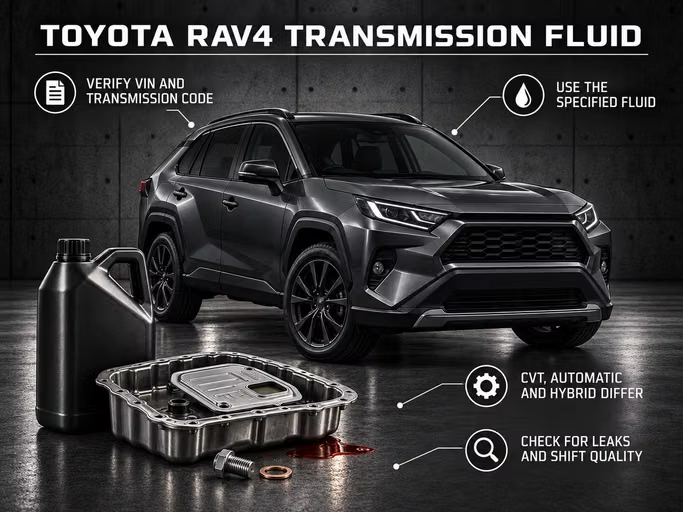
For a Toyota RAV4, the transmission-fluid service point depends on generation, original market, powertrain, drive layout, and unit code. The manual for the exact model year specifies the required fluid and checking procedure. A conventional automatic schedule must not be transferred to a Direct Shift‑CVT, while the hybrid e‑CVT differs from both.
Transmission fluid lubricates loaded surfaces, removes heat, and helps transfer torque. In a conventional automatic it also operates the hydraulic controls and clutch packs; in a CVT it protects the belt or chain, pulleys, and launch gear where fitted. Compatibility therefore matters more than color or marketing name.
5 Signs Your Toyota RAV4 Transmission Fluid Needs Inspection
A RAV4 may spend its life in dense traffic, on highways, or on rough roads. Heat, slow travel, repeated acceleration, and heavy loading increase thermal stress, so any change in behavior should be assessed alongside temperature, fault codes, and service history.
- D or R engages after a recurring delay. On a conventional automatic, check level and pressure; on a CVT, verify level, fluid condition, and control-valve operation. On a hybrid, also consider transaxle logic and the high-voltage system.
- Acceleration brings jolts, shudder, or rising engine speed without the expected vehicle response. Fluid is only one possible cause; mounts, drive shafts, engine control, or internal wear can create similar symptoms.
- Wet traces appear on the pan, casing, or undertray. Inspect plugs, seals, joints, and the cooling circuit where fitted. Repair leakage before setting the final level by the procedure for that transmission.
- A sharp odor appears after congestion, climbing, or a fully loaded trip. If traction changes, vibration develops, or a warning appears, reduce load and arrange diagnosis.
- A warning lamp illuminates and operating modes are restricted. Save fault codes and freeze-frame data first; simply clearing them can erase the conditions that triggered the fault.
Why a Single Jolt Does Not Prove the Fluid Is Worn Out
One harsh event after a cold start, battery disconnection, or abrupt throttle input may relate to control adaptation. Judge it by repeatability, diagnostic data, mounts and drive shafts, fluid level, and actual fluid condition.
What Happens When RAV4 Transmission Service Is Delayed?
The result depends on design. A hydraulic automatic relies on pressure and clutch control, a Direct Shift‑CVT on its contact surfaces and hydraulic control, and a hybrid transaxle on lubrication of gears and electromechanical components. No single failure pattern applies to every RAV4.
- Heat resistance declines. Oxidized fluid tolerates further thermal stress poorly and forms deposits more readily.
- Control accuracy deteriorates. Contaminated passages and valves can cause delays, jolts, or unstable torque delivery.
- Working surfaces wear faster. Weak lubrication and abrasive particles increase stress on bearings, gears, clutch elements, or CVT components.
- Heat removal becomes less effective. Low level, foaming, or restricted flow raises local temperature and the risk of damage.
- Repair costs increase. Metal particles, persistent slip, noise, or fail-safe operation call for internal assessment; fluid replacement cannot repair a mechanical fault.
How to Determine the Fluid Inspection and Replacement Interval
RAV4 generations do not share one interval that can be applied without verification. Identify the VIN, model year, engine, drive type, original market, and transmission code, then compare mileage- and time-based operations in the Service book. An instruction to “inspect” does not automatically mean “replace.”
| Parameter | Conventional automatic | Direct Shift‑CVT |
|---|---|---|
| Operating principle | Torque converter and clutch packs | Pulleys and belt/chain; launch gear may be fitted |
| Typical product | Toyota Genuine ATF WS—verify first | Toyota Genuine CVT Fluid FE—verify first |
| What to identify | VIN, year, market, and transmission code | VIN, year, market, and CVT code |
| Level check | Unit-specific method at the specified temperature | CVT procedure; do not copy the automatic method |
| Hybrid variant | Service separately | An e‑CVT is not a belt-type CVT |
Under normal use, follow the schedule for the exact variant. If history is unknown, begin with diagnostics, a leak check, and assessment of a drained sample. A machine exchange should not be the first step when the baseline is uncertain.
When to Inspect the Transmission Earlier
- Frequent short journeys. The unit repeatedly heats and cools without remaining at a stable operating temperature for long.
- Extended congestion. Low speed and repeated starts add thermal load that mileage alone does not represent well.
- Regular heavy loading or towing, where permitted for the variant. Extra mass and climbs increase transmitted torque and fluid temperature.
- Any sign of leakage or overheating. Odor, a warning, noise, shudder, or changed throttle response justifies an unscheduled inspection regardless of the odometer.
Which Fluid Should Be Used in a RAV4 Transmission?
Some RAV4 models with conventional automatic transmissions use Toyota Genuine ATF WS, while certain Direct Shift‑CVT applications require Toyota Genuine CVT Fluid FE. These products are not interchangeable. Confirm the VIN, transmission code, and exact specification before purchase.
A hybrid e‑CVT is not a belt-type CVT. It is an electromechanical transaxle with its own service procedure; many variants specify ATF WS, but the final choice must come from the manual for the correct year and market.
Why Total Capacity Is Not the Normal Drain-and-Fill Quantity
A drain removes only part of the fluid; some remains in passages, the heat exchanger, and internal cavities. Determine refill quantity from the measured drain and service procedure, then set the final level within the specified temperature range or through the designated check opening.
Why Can a RAV4 Develop Jolts on Aged Fluid?
Heat and contamination can alter pressure, friction behavior, and actuator response. Similar symptoms may come from solenoids, the valve body, mounts, drive shafts, sensors, software adaptations, or an engine fault. Treat fluid condition as one diagnostic input, not a universal cure.
| Problem | What changes | What the driver notices |
|---|---|---|
| Overheating | Fluid oxidizes faster and removes less heat. | Odor, changed response, warning indication. |
| Low level | Lubrication and hydraulic operation become unstable. | Delayed D/R, noise, shudder. |
| Excess fluid | Foaming and excessive internal pressure may develop. | Irregular operation, breather discharge, leaks. |
| Deposits | Particles obstruct valves and accelerate surface wear. | Jolts, delays, fault codes. |
| Incorrect product | Friction properties do not match the unit. | Vibration, harsh operation, accelerated wear. |
| Mechanical wear | Bearings, gears, clutches, or CVT elements are damaged. | Persistent slip, noise, debris, fail-safe mode. |
Practical Checklist Before Service
- Identify the exact variant. Record the VIN, model year, engine, original market, drive type, and transmission code; note separately whether the powertrain is petrol or hybrid.
- Reconstruct the history. Record dates, mileage, fluid products, and the method used during previous work when that information is available.
- Scan before clearing data. Save fault codes, freeze frames, and live parameters before resetting adaptations or disconnecting the battery.
- Inspect the unit. Check the case, pan, plugs, seals, and cooling circuit; repair leakage before the final level adjustment.
- Select materials by VIN. Choose fluid, gaskets, washers, and the filter or strainer for the exact transmission, not by model name alone.
- Verify the result. Follow the specified temperature window and level-check method, confirm there are no leaks or warnings, then assess operation with the vehicle cold and fully warmed.
When assessing a used vehicle, compare its documents and VIN with the installed transmission, then confirm condition by diagnosis and a road test.
Mistakes to Avoid
- Applying one interval to every RAV4. Generation, market, engine, and transmission design change the requirements.
- Choosing fluid by color or an “universal” label. Exact specification—not shade—establishes compatibility.
- Adding total reference capacity after a normal drain. This can cause overfill, foaming, and improper operation.
- Treating an e‑CVT as a belt-type CVT. Their construction, fluid requirements, and service procedures differ.
- Using a machine exchange with unknown history and no diagnosis. Assess fluid condition, the pan, and wear material first.
Conclusion
Correct Toyota RAV4 service begins with exact vehicle and transmission identification, not an averaged mileage figure. Conventional automatics, Direct Shift‑CVTs, and hybrid e‑CVTs require different materials and procedures. Inspect earlier under demanding use, and when shopping for a used vehicle compare current offers only after checking the VIN, history, and unit operation.


