


How Often Should You Change Toyota RAV4 Brake Fluid?
Toyota RAV4
Toyota RAV4•
•45 مشاهدة
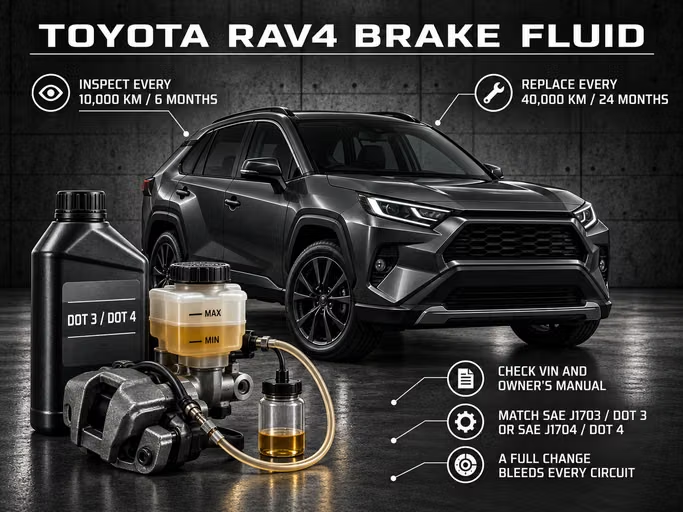
For an XA50-generation Toyota RAV4, the published schedule calls for brake-fluid inspection every 10,000 km or 6 months and replacement every 40,000 km or 24 months. Whichever limit arrives first applies. A newer generation, another destination market or a different powertrain may follow another schedule, so the starting point is the vehicle's VIN.
When Does RAV4 Brake Fluid Need an Early Check?
The scheduled interval assumes a healthy system. A new symptom, falling level or uncertain service history must be investigated separately instead of being postponed until the next routine visit.
- Two years have passed since the last documented complete change. Low annual mileage does not extend the calendar limit.
- With the usual foot pressure, the pedal now travels farther before firm braking begins, or resistance starts later in the stroke. Avoid high speed and abrupt manoeuvres until the cause is known.
- The red brake-system warning remains on after start-up. Low fluid or a hydraulic fault may be present, so stop the vehicle safely.
- The reservoir level falls again after a top-up. Pad wear can change the level gradually, but repeated volume loss calls for a leak inspection.
- Pedal travel increases after a descent or several hard stops. Recovery after cooling does not clear the system; check for moisture, trapped air and overheating.
- Flakes, cloudiness or traces of an unknown fluid are visible. Colour alone cannot reveal the boiling point, but obvious contamination should not be ignored.
Why Does Brake Fluid Age?
Glycol-based brake fluid gradually absorbs moisture through the reservoir vent, seals and flexible parts of the hydraulic circuit. The process may go unnoticed in normal driving, yet it reduces the margin before vapour forms when brake temperatures rise.
- Water content increases with time, including while the vehicle is used infrequently.
- Moist fluid boils sooner in the hottest sections close to the calipers.
- Vapour compresses under pressure, making the pedal move farther and the response less consistent.
- Water and debris promote corrosion in cylinders, pipes, ABS valves and the passages of the hydraulic unit.
- A top-up corrects the reservoir mark only; aged fluid remains in the lines and the cause of volume loss is still unresolved.
Toyota RAV4 Schedule and Fluid Specification
The XA50 Toyota RAV4 maintenance schedule specifies inspection every 10,000 km or 6 months and replacement every 40,000 km or 24 months. The interval restarts after a complete change, and the earlier time or distance threshold controls each service.
The 2025 Toyota RAV4 owner's manual lists SAE J1703 / FMVSS No. 116 DOT 3 or SAE J1704 / FMVSS No. 116 DOT 4. Confirm those markings against the reservoir cap on the individual vehicle before servicing it.
| Item | Reference | Practical meaning |
|---|---|---|
| Inspection, XA50 | 10,000 km or 6 months | Check level, sealing, hydraulic lines and brake operation. |
| Replacement, XA50 | 40,000 km or 24 months | Measure from a complete bleed, not a reservoir top-up. |
| Fluid class | SAE J1703 / DOT 3 or SAE J1704 / DOT 4 | Confirm the standard in the manual and on the cap. |
| Other RAV4 versions | By VIN and destination market | Do not assign the XA50 schedule to a new generation automatically. |
| Quantity | No universal service volume | Allow enough fresh fluid to displace the old contents from every circuit. |
How Do You Choose Brake Fluid for a RAV4?
The complete performance designation matters more than colour, price or a claimed high boiling point. Read the SAE and FMVSS wording together with the prominent DOT label on the container.
- Use fresh fluid from a factory-sealed container with a legible specification and intact closure.
- Do not add silicone-based DOT 5; its chemistry differs from the specified DOT 3 and DOT 4 fluids.
- Do not choose DOT 5.1 without explicit confirmation in the vehicle documentation.
- Open the bottle immediately before the job and do not save an opened container until the next scheduled change.
- Protect painted surfaces. Brake fluid attacks paint, so rinse any spill promptly with clean water.
Which Conditions Put More Heat into RAV4 Brakes?
Brake temperature in a crossover depends on mass, terrain and the frequency of electronic intervention as well as road speed. A hybrid RAV4 can recover energy while slowing, but regenerative braking does not remove the hydraulic brakes from the system.
Higher-Temperature Scenarios
- A long descent with passengers, luggage or roof cargo. Extra mass raises the energy that the discs and pads must dissipate.
- Travel on sand, gravel or an uneven surface. ABS and stability control may repeatedly adjust pressure at individual wheels.
- Stop-and-go traffic with short accelerations and frequent braking. The assemblies may not have enough time to release stored heat.
- A forceful stop from high speed. One event can heat the calipers more than a prolonged sequence of gentle slowdowns.
- A full or overheated traction battery in a hybrid. Regenerative capacity may be reduced, increasing the friction brakes' share of the work.
Heat Dust and Humidity
High ambient temperature does not create a separate official interval, but it reduces the cooling margin after demanding braking. Humidity reinforces the importance of the time limit, while dust makes careful reservoir handling essential.
Clean the cap and surrounding surface before opening the reservoir. Grit can damage precision valves, so the tools, funnel and bleeding bottle must be spotless and reserved for brake fluid.
What Does a Complete RAV4 Fluid Change Include?
A complete change progressively pushes old fluid out through the specified bleed points. Extracting liquid from the reservoir alone renews only a small share of the total and leaves the wheel circuits untouched.
- Identify the vehicle. Confirm the VIN, year, engine, hybrid type, destination market and reservoir-cap standard.
- Inspect the system. Examine the reservoir, master cylinder, pipes, hoses, joints, calipers, discs and pads.
- Repair faults first. Correct leaks, damaged lines or binding hardware before bleeding.
- Use the version-specific procedure. Bleed order and the steps involving the pump or hydraulic actuator must not be chosen from a generic diagram.
- Verify the result. The level should remain stable, joints should stay dry, and pedal travel should repeat consistently through consecutive applications.
Can You Replace It Yourself?
Petrol and hybrid RAV4 versions manage brake pressure differently. Air in the actuator, replaced hydraulic parts or an interrupted sequence may require a service mode and diagnostic scan tool. Without the exact instructions, do not switch vehicle modes during the job, let the reservoir run dry or open bleed screws arbitrarily.
What to Check on a Used Toyota RAV4
Brake condition follows the vehicle's real workload. One RAV4 may spend years on short urban trips, while another regularly carries cargo, descends mountain roads or travels on dusty surfaces. Odometer mileage alone cannot describe those differences.
- There is no record of a complete change within 40,000 km or 24 months for an XA50. After a leak check, include fresh fluid in the initial service plan.
- An invoice records only a top-up or a general brake inspection. Neither entry proves that every circuit was bled.
- The level is below MIN. Before adding fluid, measure pad wear and inspect joints, hoses and calipers for dampness.
- The pedal begins to travel farther after several stops. End the road test and diagnose the system before purchase.
- A hybrid has lightly worn pads but heavily corroded disc faces. Check slider movement, contact pattern and disc thickness.
- A caliper, master cylinder, hose or actuator was changed recently. Obtain evidence of the correct bleeding procedure and confirm that no air remains.
Common Service Mistakes
- Replacing only the contents of the reservoir and leaving aged fluid in the pipes and calipers.
- Judging condition by colour alone and ignoring the date of the previous complete change.
- Filling to MAX with heavily worn pads without considering the level after new pads are fitted.
- Combining leftovers from containers that have been open for a long time, even when the DOT class matches.
- Attributing increased pedal travel to hybrid behaviour and postponing leak and bleeding checks.
Conclusion
For an XA50 Toyota RAV4, use inspection every 10,000 km or 6 months and complete replacement every 40,000 km or 24 months as the working reference. Confirm the fluid class by VIN, manual and reservoir cap; a top-up is not a replacement. Longer pedal travel, a red warning or recurring level loss requires diagnosis regardless of mileage. Current listings for Toyota RAV4 can help compare model years and powertrains, but hydraulic condition must be judged from the individual vehicle, its service history and an inspection.


