When should brake pads and rotors be replaced on a Toyota Land Cruiser 300?
Toyota Land Cruiser السلسلة 300
Toyota Land Cruiser السلسلة 300•
•61 مشاهدة
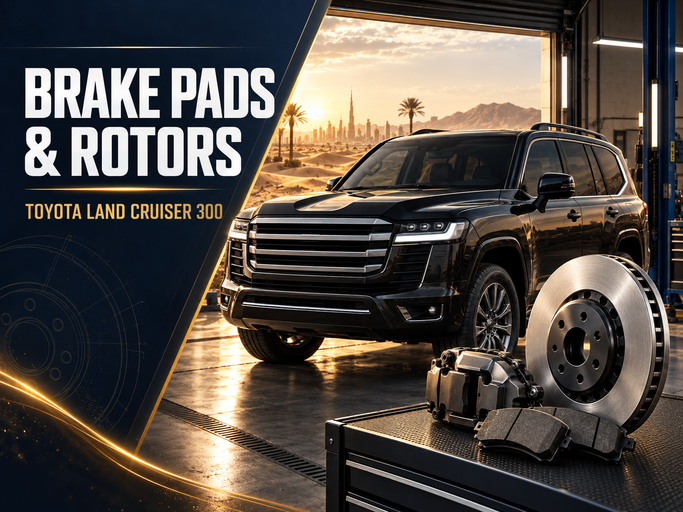
There is no single safe replacement interval for the Land Cruiser 300's brake pads and rotors. They should be inspected at every scheduled service and replaced according to their actual condition: friction-material and rotor thickness, wear uniformity, runout, cracks, overheating and the vehicle's behaviour under braking. Wear-indicator noise, vibration or weaker deceleration calls for an unscheduled inspection.
4 signs of worn brake pads and rotors on a Land Cruiser 300
One symptom does not always identify one faulty part. A squeal may come from a wear indicator, trapped sand or a glazed pad, while vibration can also be caused by the hub, wheel or suspension. Treat these signs as reasons to inspect the vehicle, not as a diagnosis by themselves.
- Metallic squeal or grinding. A persistent high-pitched squeal while driving or braking may occur when a mechanical wear indicator touches the rotor. Harsh grinding is more serious: the friction material may be gone and the pad backing plate may already be damaging the working surface. Stop using the vehicle until it is inspected.
- Brake-pedal or steering-wheel vibration. If pulsation repeatedly appears during normal braking and changes with speed, check rotor thickness variation, lateral runout, hub condition and the uniformity of pad-material transfer. Normal ABS operation can also pulse the pedal during emergency braking, but that is a different operating condition.
- The vehicle pulls to one side or brakes unevenly. Possible causes include a sticking caliper, different wear rates between the inner and outer pads, surface contamination, a tyre problem or a suspension fault. Replacing only the most worn pad will not correct the underlying cause.
- Pedal travel has increased or the stopping distance is longer. A soft pedal, delayed bite, a hot-brake smell or noticeably weaker deceleration requires urgent inspection of the whole system. In addition to the pads and rotors, check the fluid, hydraulic integrity, calipers, brake booster and electronic systems.
What happens if brake pads and rotors are not replaced in time?
Wear develops gradually, but the final stage can arrive quickly once the friction material becomes too thin. A heavy SUV needs an adequate braking reserve: the system must dissipate substantial energy, and high loads combined with repeated stops increase heat rapidly.
- Braking consistency deteriorates. A thin pad provides less thermal insulation for the caliper, heats up faster and may lose effectiveness during repeated braking. The driver presses the pedal harder, while the brakes become less predictable.
- The rotor surface is damaged. Once the friction material is worn away, the metal backing plate cuts deep grooves into the rotor. A rotor that could have remained serviceable may become unusable, often adding pad replacement and caliper service to the repair.
- The risk of overheating and runout increases. Uneven pad operation, contaminated slide pins or overloading can create areas with different friction levels. Pulsation, vibration and local hot spots then appear. Machining a rotor without measurements will not always solve the problem.
- Nearby components are affected. Heat transfers to the caliper, dust boots, slide-pin grease, hub and brake fluid. A dragging brake also places additional load on the tyre and increases fuel consumption.
- The vehicle becomes unsafe. The brakes may feel acceptable during calm city driving yet lose effectiveness in an emergency stop, on a descent or with a full load. Do not postpone repairs until grinding becomes constant.
Toyota's official approach to LC300 brake maintenance
Toyota does not specify one mandatory replacement mileage for brake pads and rotors. The owner's manual describes brake-pad wear-limit indicators that produce a warning noise when replacement is required. Periodic maintenance includes brake-system inspection, while the exact service limits must be taken from the repair data for the individual vehicle.
According to the service information at toyota.ae, the owner's manual and the vehicle's own data should be used to confirm the exact schedule and scope of work. For an LC300, verify the VIN, model year, supply market and brake specification: rotor dimensions or part numbers from another version must not be transferred automatically.
| Component | What to inspect | When replacement or repair is required |
|---|---|---|
| Brake pads | Friction-material thickness excluding the metal backing plate; inner and outer pads at every wheel. | The repair-manual limit has been reached, the wear indicator is audible, or there are cracks, separation, contamination or pronounced uneven wear. |
| Rotors | Thickness at several points, thickness variation, lateral runout, scoring, cracks, corrosion and heat marks. | Thickness is below the limit, cracks or serious damage are present, or runout and friction variation cannot be corrected by an approved service procedure. |
| Calipers | Free movement of the slide pins, piston and dust-boot condition, and even pad clamping. | Binding, leakage, a torn dust boot or corrosion must be repaired before new wear parts are installed. |
| After repair | Free wheel rotation, no leaks or abnormal noise, and correct pedal and electronic parking-brake operation. | Carry out a final check and safe bedding-in procedure according to the parts manufacturer's and workshop's instructions. |
Which brake pads and rotors fit the Land Cruiser 300?
The safest choice is Toyota Genuine Parts or high-quality equivalents that match the VIN and the exact brake system. Model and year alone are not enough: the front and rear axles use different parts, and the equipment may vary by market and trim level.
- Part number. Select parts by VIN in a current catalogue, not only by comparing them with a photograph of the old pad. Confirm the side, axle, rotor diameter and compatibility with the electronic parking brake.
- Friction characteristics. A pad must deliver the intended braking performance, heat resistance and rotor compatibility. An excessively hard compound may accelerate rotor wear and increase noise, while an unknown compound may become inconsistent after heating.
- Rotor dimensions. Diameter, thickness, overall height, ventilation, mounting dimensions and installation direction must all match the specification. A rotor that looks similar is not necessarily suitable.
- Repair as an axle set. Replace the pads as a complete set on one axle. Compare both rotors and normally service them as a pair to preserve equal braking force on the left and right sides.
- Installation hardware. Inspect shims, springs, sensors or mechanical indicators, dust boots and slide pins. Old or incorrectly installed hardware is a common source of noise and uneven wear.
Before ordering parts, it is useful to verify the generation, engine and main specifications in the Toyota Land Cruiser 300 catalogue. Final confirmation of pad and rotor part numbers must still be made by VIN: the model catalogue helps identify the vehicle but does not replace a parts lookup.
Why does the LC300 squeal, vibrate or brake poorly?
Noise and vibration can appear after parts have been replaced even when the remaining thickness is normal. Separate the symptom from its cause and the corrective action: replacing rotors 'just in case' may achieve nothing if the hub, caliper or installation is responsible.
| Symptom | Possible causes | What to do |
|---|---|---|
| Squeal under light braking | Wear indicator, sand, glazing or pad vibration | Measure the pads; inspect the surface, shims and installation |
| Harsh grinding | Friction material is gone or a hard object is trapped between the parts | Stop using the vehicle and inspect the rotor, pads and caliper |
| Pedal pulsation | Rotor thickness variation, runout or hub contamination; ABS operation during an emergency stop | Measure runout and thickness before deciding on repair |
| Steering-wheel vibration | Front rotors, hub, wheel or suspension | Inspect the brakes together with the wheels and suspension |
| Pulling to one side | Sticking caliper, different friction levels, a tyre issue or suspension fault | Compare left/right temperatures and wear; correct the cause |
| Burning smell or smoke | Severe overheating, a dragging mechanism or overload | Stop safely; do not cool hot rotors with water; arrange diagnosis |
How heat, sand and heavy use affect brake life
High ambient temperature does not create a separate brake-pad replacement interval by itself. What matters more is how much heat the brakes absorb within a short period and whether they have time to cool. Across the Gulf, several common operating conditions can increase this load.
- Congested traffic and hard acceleration. Frequent stops in a heavy vehicle accelerate front-pad wear. Smooth, anticipatory braking reduces unnecessary heat cycles.
- Dunes and off-road driving. Sand and small particles can enter the contact area, while the stability system may apply individual brakes. After a demanding route, check for noise, unusual heat, damaged boots and uneven wear.
- Towing and full loads. Additional mass increases the energy that the brakes must dissipate. Use engine braking on descents and avoid holding the pedal continuously.
- Washing after heavy braking. Cold water on very hot rotors creates a sudden temperature change. Allow the brakes to cool naturally and do not direct a powerful water jet at a hot assembly.
- Long-term parking and humidity. Light surface rust on the rotors often disappears after a few normal stops. Deep corrosion, pulsation or persistent noise requires inspection.
Practical inspection and replacement checklist
- Record the symptom. Note the speed, temperature, pedal effort and conditions in which noise or vibration appears. This makes diagnosis faster and more accurate.
- Inspect both sides. A pad cannot be assessed reliably through a wheel spoke. The inner pad may wear faster than the outer pad because of a sticking slide pin or piston.
- Ask to see the measurements. A useful repair order records the remaining pad material, each rotor's thickness and the service limit for the exact version. 'They still have some life left' is not a measurement.
- Correct the cause of uneven wear. New parts will quickly develop the same problem if the caliper, hub or installation hardware is not serviced.
- Follow the rear-brake procedure. The electronic parking brake requires the correct service mode. Forcing the piston back can damage the mechanism.
- Bed in the new parts correctly. After installation, avoid unnecessary emergency-level stops and prolonged clamping of hot pads while stationary. Follow the part manufacturer's procedure; road safety always takes priority over the bedding-in routine.
- Inspect a pre-owned vehicle. In the Land Cruiser listings, rotor condition can only be estimated from photographs. Before purchase, obtain measurements, a safe road test and a caliper inspection.
Mistakes to avoid
- Replacing parts solely by mileage. The same mileage may represent relaxed motorway use or constant stop-and-go driving with a full load. Actual condition matters more than an arbitrary number.
- Installing new pads on an unchecked rotor. Deep grooves, runout or thickness below the service limit will not disappear after pad replacement and may damage the new set.
- Replacing only one side. Different materials and wear levels on the same axle create unequal braking force. Pads must be installed as a complete axle set.
- Treating every squeal as a pad fault. The source may be contamination, installation hardware, the dust shield or a trapped object. Locate the source before replacing parts.
- Ignoring a soft pedal. This symptom cannot be explained by pad wear alone. Air, a leak, overheated fluid or another fault may be present, so the brake system needs urgent inspection.
Conclusion
Land Cruiser 300 brake pads and rotors should be replaced according to regular inspection and measurement, not one fixed mileage. Wear-indicator noise, grinding, vibration, pulling or reduced braking performance requires prompt diagnosis. Select parts by VIN and replace them as a complete axle set.