


When Should You Replace Toyota Corolla Brake Pads and Rotors?
Toyota Corolla
Toyota Corolla•
•37 مشاهدة
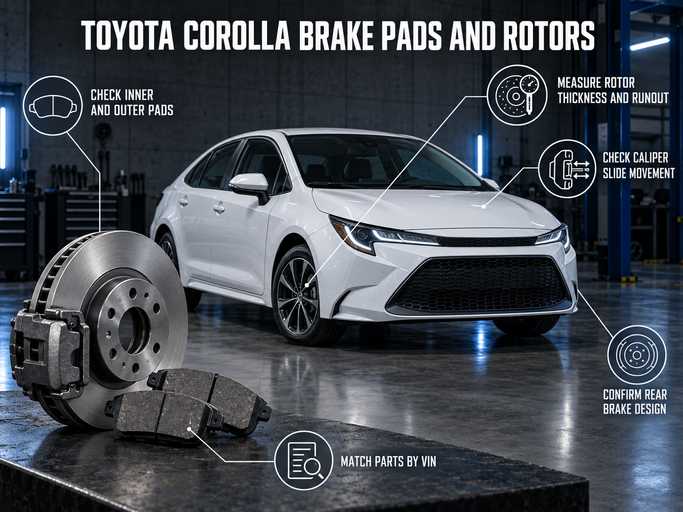
Toyota Corolla brake pads do not have one replacement mileage for every vehicle. Their remaining thickness, wear pattern, and lining condition determine the decision. Rotors require thickness and runout measurements plus inspection of both friction surfaces. Driving pattern, generation, rear brake layout, and a hybrid powertrain can all change service life.
4 Signs of Toyota Corolla Brake Wear
The first change may appear before a warning is shown on the dashboard. Persistent noise, vibration, or a different pedal feel must be assessed as a system because similar symptoms can originate from pads, rotors, calipers, hubs, tyres, or suspension components. Record whether the symptom occurs with cold or warm brakes, under light pressure, or only during stronger deceleration.
- Grinding or a persistent squeal during braking. A brief sound after washing or damp parking may disappear after several gentle stops. If it repeats, inspect both pads, the wear indicator, rotor surface, dust shield, and the area for trapped sand.
- Pedal pulsation or steering-wheel vibration. Repeatable vibration at the same speed can result from lateral runout, rotor thickness variation, contamination at the mounting face, or hub play. Tyre and suspension faults must also be ruled out.
- The vehicle pulls while slowing. Unequal braking force can be caused by a sticking caliper, contaminated friction material, a damaged hose, or different component condition on the left and right. Tyre pressure and wear are part of the same inspection.
- Longer pedal travel or one hot wheel. A soft pedal, overheating smell, or a clear temperature difference requires immediate diagnosis. Possible causes include a leak, air in the system, a sticking piston, or a parking brake that does not release fully.
Why Looking Through the Wheel Is Not Enough
The outer pad is easier to see, but the inner pad can wear faster when a slide or piston does not move freely. Wheel spokes also hide part of the rotor surface. A reliable assessment requires removing the wheel, comparing both linings, and inspecting the inner face of the rotor. A left-to-right difference can reveal binding before the vehicle begins to pull noticeably.
What Happens When Replacement Is Delayed
Brake components do not provide a safe reserve until the next noise appears. Once the friction material approaches its limit, the assembly can deteriorate quickly after stop-and-go driving, a mountain route, or continued use with a binding caliper.
Braking becomes less predictable. Overheated or nearly exhausted friction material handles repeated stops poorly, so familiar pedal pressure no longer produces the expected response.
The pad damages the rotor. When the working material is gone, the metal backing cuts grooves and rapidly raises temperature. Fitting pads without evaluating the rotors will not correct the problem.
The caliper operates outside its normal range. An overextended piston places extra load on the boot and seal. Contaminated slides increase misalignment and uneven wear.
The car begins to pull. Unequal performance across one axle reduces stability during emergency braking and may accelerate tyre wear.
Repair costs rise. A planned pad replacement can turn into rotor replacement, caliper work, or correction of damaged hub mounting surfaces.
What to Measure Before Corolla Brake Replacement
Use the inspection procedure and service limits for the exact year and version. Confirm the VIN and actual brake design before dismantling. Measure thickness with suitable tools rather than judging the rotor by the visible wear lip or the appearance of one side.
| Component | What to inspect | Reason for repair |
|---|---|---|
| Front pads | Inner and outer lining thickness, contact pattern, cracks, contamination, and signs of overheating. | The limit for the exact version, damaged material, a major side-to-side difference, or wear-indicator contact. |
| Front rotors | Thickness at several points, both friction faces, lateral runout, grooves, cracks, and heat marks. | Insufficient thickness, excessive runout, cracks, or damage that cannot be corrected safely. |
| Rear brakes | The installed mechanism, remaining lining, disc or drum condition, and parking brake operation. | Use the values and design for that Corolla; front axle limits do not apply to the rear. |
| Calipers and hydraulics | Slide and piston movement, boots, hoses, absence of leaks, fluid level, and pedal stability. | Binding, damaged rubber parts, leakage, or a soft pedal requires correction of the cause. |
| Hub and fasteners | Clean mounting surfaces, play, thread condition, and even wheel fastening. | Corrosion beneath the rotor can cause runout; damaged fasteners or hub play must not be ignored. |
Mileage can determine when to inspect, but it does not prove how much service life remains. Urban driving creates more brake cycles, while limited use can expose rotors to corrosion. The final decision should reflect measurements, the type of damage, and free movement of the mechanism. Fit pads as an axle set, and assess rotors as a pair after comparing their condition so braking force remains balanced.
How to Avoid Mixing Parts from Different Corollas
The Corolla name covers sedans, hatchbacks, and estates from several generations, while powertrain availability varies by market. Cars built in the same year may still have different rotors, calipers, and rear brakes. Record the VIN, model code, engine, drivetrain, wheel size, and installed hardware. A photograph of a similar component is not a substitute for confirming the part number.
What Causes Squeal, Vibration, and Pulling
One symptom does not identify one fault. A squeal may come from surface corrosion or contamination, vibration may originate at the rotor, hub, or wheel, and pulling may involve the brakes, tyres, or suspension. Diagnosis starts by reproducing the condition and continues with measurements.
| Symptom | Possible cause | Next step |
|---|---|---|
| Brief squeal after parking | Moisture or a thin layer of surface corrosion. | Make several gentle stops. If the sound remains, inspect the assembly. |
| Persistent squeal | Wear indicator, contamination, glazed lining, or an assembly error. | Inspect both pads, the rotor, shims, and installation. |
| Grinding | Exhausted friction material, trapped debris, or a damaged component. | Stop normal use and arrange diagnosis without delay. |
| Pulsation or vibration | Runout, thickness variation, corrosion under the rotor, hub play, or a wheel fault. | Measure the rotor and hub, clean mounting faces, and inspect the wheel and suspension. |
| Pulling or one hot wheel | A sticking caliper, hose, contaminated pad, tyre, or parking brake. | Compare both sides without touching hot parts, then inspect the mechanism and hydraulics. |
| Soft pedal or warning | Air, a leak, low fluid level, or another brake-system fault. | Do not continue normal driving until brake safety has been checked. |
When a Film on the Rotor Is Normal
A thin film can develop after washing or a damp night. It normally clears evenly after several gentle stops. If patchy contact, deep pitting, a pronounced wear lip, pulsation, or persistent noise remains, inspect and measure the surface. Repeated hard braking is not a repair method.
Operating Conditions That Accelerate Corolla Brake Wear
Service life depends on the number of stops, temperature, and time parked. Equal mileage therefore does not mean equal condition: an urban saloon, a highway car, and a hybrid that uses regenerative braking place different demands on the friction brakes. Driving style matters as well: early, progressive slowing limits heat, while frequent hard stops raise pad and rotor temperatures more quickly.
- Dense urban traffic. Frequent stops increase heating cycles. Hard acceleration toward the next signal also consumes brake material without a meaningful time benefit.
- High temperatures and dust. Sand contaminates exposed surfaces and may restrict mechanism movement. After difficult conditions, inspect boots and slides without cooling hot rotors with a water jet.
- Long descents. Holding speed continuously with the pedal overheats rotors and linings. Select a suitable range early and use powertrain braking within the guidance for the exact transmission.
- Hybrid versions. Regenerative deceleration can reduce use of the friction brakes. Mechanical wear may fall, but short trips and humidity can leave the working surfaces less frequently cleaned, so corrosion still requires attention.
- Parking in damp conditions. A long period of standing can affect rotors and the rear mechanism regardless of mileage. When driving resumes, check that the wheels release evenly and that the surface film clears.
What to Check on a Used Corolla
Recently fitted pads do not prove that the complete system is healthy. Measure the rotors, compare inner and outer linings, and inspect caliper movement, hoses, hubs, the rear mechanism, and the parking brake. During a safe road test, assess straight-line braking, pedal feel, and vibration without attempting dangerous emergency stops. Ask about overheating and previous caliper work because new consumables may have been installed before sale without correcting the cause of earlier uneven wear.
How to Plan Brake Diagnosis and Service
A consistent sequence helps identify the cause before new parts are installed and reduces the risk of repeated dismantling. Record measurements for each wheel separately so both sides of an axle can be compared and the values retained for the next inspection:
Describe when the symptom occurs. Record speed, temperature, weather, parking time, and the point at which noise or vibration begins.
Identify the vehicle. Confirm the VIN, model code, engine, original market, and rear brake layout before ordering components.
Inspect both sides of the assembly. Compare the inner and outer pads, both rotor faces, boots, and evidence of overheating.
Take measurements. Check thickness at several points and measure runout correctly, then compare the result with the limit for the exact version.
Correct the underlying cause. Clean mounting faces and inspect the hub, slides, piston, and hydraulic components.
Verify the result after assembly. Restore a firm pedal, rule out leaks, check that the wheels rotate freely, and bed in the parts safely according to their manufacturer instructions.
Common Service Mistakes
- Buying parts by production year alone, without confirming the VIN, original market, and actual brake equipment.
- Judging wear through the wheel spokes, leaving the inner pad and inner rotor face unexamined.
- Installing pads on unmeasured rotors, ignoring thickness, runout, cracks, and friction-surface condition.
- Servicing only one side of the axle, creating a difference in component condition and braking force.
- Treating the absence of loud noise as proof of safety, without checking pedal feel, wheel temperature, and system warnings.
Conclusion
Service Corolla brakes according to measurements rather than a universal mileage interval. Inspect both pads, the rotors, calipers, and the rear mechanism fitted to the exact version. Before buying, compare vehicle condition with current listings and make a brake inspection part of the selection process.


