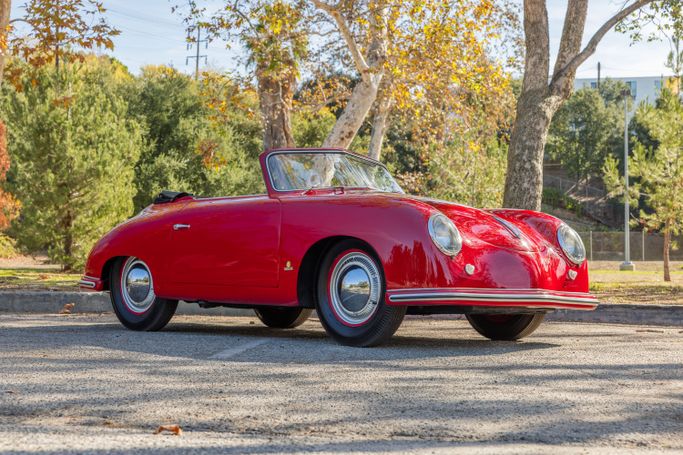
Porsche 356 Pre-A 1500S Cabriolet, 1952
Porsche 356 I
Porsche 356 I•
•49 مشاهدة
Chassis No.: 15051
Estimate: US$220,000 - US$250,000 USD
- 1,498cc OHV Flat 4-Cylinder Engine
- Dual Carburetors
- 70bhp at 5,000rpm
- 4-Speed Manual Transaxle
- 4-Wheel Independent Suspension
- 4-Wheel Hydraulic Drum Brakes
- Special piece of early Porsche production history
- Desirable 'bent windshield' Pre-A specification
Having commenced manufacture with a short run of aluminum-bodied cars built at the Gmünd, Austria-based old sawmill, Porsche began volume production of the steel-bodied 356 Coupe at its old base in Stuttgart, at first in premises shared with coachbuilders Reutter and then from 1955 in its original factory at Zuffenhausen. In 1951 a works car finished first in class at the Le Mans 24 Hours, thus beginning the marque's long and illustrious association
with Le Sarthe.
Constant development saw the 356's engine progressively enlarged, and in 1952 the original split windscreen was replaced by a one-piece bent screen and a Porsche synchromesh gearbox adopted. 1955 marked the arrival of the revised 356A, the newcomer being readily distinguished by its curved windscreen and 15" - down from 16" - wheels.


These early 'Pre-A' Porsche 356 models are today considered some of the most collectible and rare Porsche cars ever produced and are admired for their pure and clean design.
THE MOTORCAR OFFERED


One of only 130 cabriolets made in 1952, and 635 356's produced in total for the entire year, across all markets, this very special Pre-A 356 cabriolet's scarcity dips to as low as one-of-116 when counting range-topping 1500S examples.
Porsche production had just shifted from Gmünd, Austria to Stuttgart, Germany in 1950, and as such, 1952 cars such as the lovely little auction example are packed full of fascinating, charming quirks–take for example the 'bent' windshield, with its distinct central crease, ventilated wheel covers, smooth, horn grille-less nose, peaked bumper, and much more.


Coachwork was built by Karosserie Reutter, a local coachbuilder that would come under the wing of Porsche in the 1970s, right around the time they became known as Recaro and switched gears to the building of outstanding car seats.
The cabin is another wonderland of early, hand-built, Reutter coachbuilt production details, including elegant green typeface Veigel mechanical gauges and a particularly wonderful Telefunken shortwave radio. Note all the bakelite switchgear, as well as the intricate spring-spoke steering wheel.