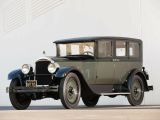
Packard 1-35 Twin Six Seven Passenger Touring, 1916
Packard Six
Packard Six•
•38 مشاهدة
Chassis No.: 87058
Engine No.: 87058
Estimate: US$80,000 - US$100,000 USD
- 424 ci T-Head V12
- 88bhp at 2,600rpm
- 3-Speed Manual Transmission
- Solid Front Axle – Semi-Floating Rear Axle
- 2-Wheel Mechanical Brakes
- Original family ownership from 1916-1992
- 2 owners from new
- A time-warp example of the model
At 6,950cc, or 424 cubic inches, Packard's new V-12 was only marginally larger in displacement than the smaller of the two Sixes it would replace. Aluminum pistons, a product of WWI technology, reduced reciprocating mass. The two blocks, each of six cylinders, were cast as a unit with the heads. The crankshaft, less massive than the Six's, was supported in three main bearings. At 900 pounds, the new engine weighed 400 pounds less than the previous Six.
Production of the new First Series Twin Six began in 1915 for the 1916 model year. It was offered in two wheelbase lengths, and priced at $2,600 to $4,600, undercutting its predecessors by hundreds of dollars.
The engine's smoothness and tractability left automotive journalists grasping at superlatives. A writer for The Automobile raved that the car would accelerate smoothly from 3 miles per hour in top gear. A journalist who caught a ride with American soldiers in their pursuit of Mexican revolutionary Pancho Villa related that, "it was like riding on velvet when those big Packards laid back their ears and breezed along as though their only ambition was to catch up with the horizon."


One of Packard's greatest features was its exceptional in-house coachwork. Packard's deep pool of in-house stylists had developed an extensive range of handsome bodywork to adorn their new flagship model. The generous 135-inch chassis, referred to as the 1-35 to denote its series and length, was offered with a choice of 13 commodious bodies.
Unlike coachbuilt cars of the period, Packard had the ability to unify the styling of the whole car. A Packard hallmark well into the classic period, the Twin Six was equipped with some of the most finely styled "jewelry" of the day. Every light, bezel, and gauge was carefully designed for this new model. The form of the Packard radiator shell was repeated in the headlights, speedometer, and taillight.


THE MOTORCAR OFFERED
It is a common thread in the preservation of automobiles, that some of the more luxurious cars that were supplied might well be retained by the original owners for many years, since for the most expensive price points they were the best of their day and took a while to be eclipsed, and there was unlikely to be a need to sell them to acquire the next model. This is perhaps one of the reasons that time warp automobiles such as the Twin Six presented here survive to this day, as they may have been stored in the back of an Estate's coachhouse for decades.


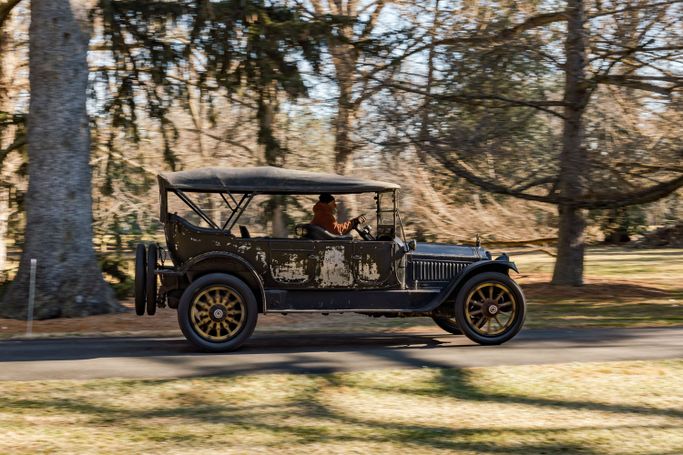
Such is the tale of this Packard. It is understood to have been bought new by Lillie S. Roshon the matriarch of the Roshon family of Philadelphia in 1916, and remarkably remained with her until 1980, some 64 years of custody. At that point it passed to Charles Roshon, her grandson.
Howard Schaevitz collecting of the marque was well under way by the early 1990s, when he met Charles Roshon and negotiated the acquisition of 87058 from him, papers handed over at that point and remaining on file today include Penna Automobile Certificates for 1918 and 1919.


The Roshon Packard remains much in the condition in which it was purchased 30 years ago, some 106 years old, its degree of preservation is quite remarkable, the majority of its interior leather is still in place, and features such as the jump seats show very little wear at all, as are its door panels. Owing to their condition the front fenders have been sympathetically repainted in a matt finish which matches the rest of the car well. Even details such as the passenger compartment floor lights are operational!
Having been resting again for a number of years, in preparation for its sale, the Packard was checked over professionally and started without major issue and was driven for its photography shoot. A car that will surely draw fascination wherever it is toured or displayed, this 'two owner' Packard is deserving of close inspection.