


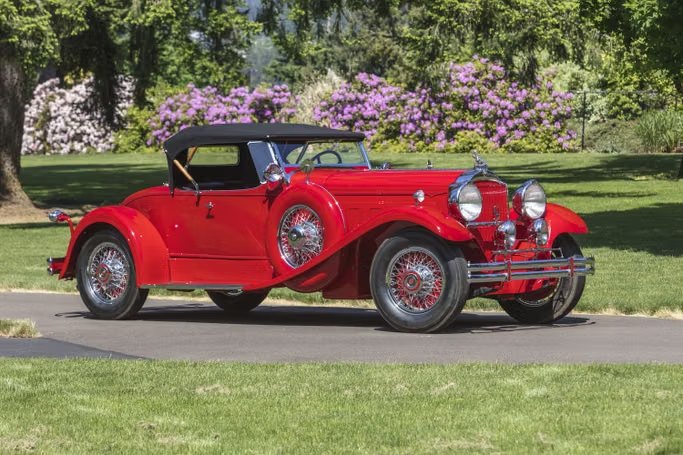
Packard "Model 734 Speedster" Runabout, 1930
Packard Custom Eight
Packard Custom Eight•
•47 مشاهدة
Chassis No.: 184098
Engine No.: 184098
US$417,500 USD | Sold
- 385ci L-Head Straight 8-Cylinder Engine
- Dual-Throat Updraft Carburetor
- 145bhp at 3,400rpm
- 4-Speed Manual Gearbox
- 4-Wheel Semi-Elliptical Leaf Springs with Live Axles
- 4-Wheel Mechanical Drum Brakes
- A stunning and accurate recreation of Packard's legendary model
- Assembled in Harrah's shop from genuine 734 Speedster parts
- Subject of a 54-month restoration in the '90s
It was at Col. Vincent's urging that Packard built its banked oval 2½ mile test track. It was the fastest closed course in the world – even faster than Indianapolis – and retained that distinction until after World War II. Col. Vincent constructed his own Speedster, a cutdown 2-seater on the 443 chassis, which he drove for years.
The Speedster concept was not new, or even new to Packard. Tired touring cars and sedans all over America (and the world) had for years been rebodied by second and third owners into Speed Cars with lightweight bodies offering minimal – if any – weather protection to extract maximum performance from their engines. Mercer and Stutz had made their reputations with the Raceabout and Bearcat, factory-built speedsters.
There was a horsepower race at the end of the 20th Century's third decade. In a sense Duesenberg had already won it, but with a chassis price a thousand dollars more than the most expensive fully bodied and trimmed Packard limousine it was a Pyrrhic victory. Cadillac set off a parallel race in cylinder count with its 1929 announcement of impending V-12 and V-16 engines. Packard kept extracting more power from its straight eight, leading its competitors in the power of its mainstream production cars.
The Packard 734 Speedster is an enigma in Packard history. Part of the Seventh Series, it wasn't introduced until January 1930, five months after the formal introduction of the Seventh Series on August 20, 1929 and three months after Black Tuesday. Perhaps understandably in the exigent circumstances following the Crash, it was never promoted. Only a single 8-page black & white brochure was produced. The 734 was rarely shown at salons and received little attention from Packard's press department.


The 734 Speedster, however, was recognized early on by owners who appreciated its combination of performance and style. Identified early as exceptional examples of an exceptional marque, the Packard 734 Speedsters have been preserved since the late Forties, when they were barely fifteen years old. A registry of known examples was created by Smith Hempstone Oliver in the mid-Fifties.
The innate appeal of the Packard 734 Speedster arises from its specifications. The chassis employed boxed 733 Standard Eight side rails in the 134½" wheelbase with 733 cross-members. The engines were massaged with two-barrel Detroit Lubricator carburetors, finned manifolds and, optional at no extra cost, a 6:1 compression ratio cylinder head said to deliver 145 horsepower. Quite out of character for the time, Packard also equipped the Speedster with special finned forged iron brake drums, cable-operated at the front and rod-operated at the rear. The braking surface was 2" wide, with 3-leading shoe linings.
They were virtually devoid of fade in the most demanding high-speed use. 19" wire wheels with 6.50 profile tires were fitted. The 734 Speedster's power, torque and lightweight coachwork gave Packard the opportunity to equip it with high-speed rear axles giving it 60mph performance in second gear. The 734 Speedsters achieved road speeds in excess of 100mph in top gear.
One of the great appeals of the Packard 734 Speedsters is that they will today lope along with modern freeway and interstate traffic and do it in relaxed, unstressed style – ready to downshift and accelerate to highly illegal speeds to the amazement of drivers of their latter-day successors. Well-tuned examples have been known to get 18-19 miles per gallon in the process.


The inherent performance of the Packard 734 Speedsters' chassis and engine was wrapped in unique coachwork, the crowning touch in Packard's brief flirtation with Jazz Age style. The Speedsters were offered in boattail Runabout, Phaeton, Victoria, Sedan and, late in the series, Roadster versions. Speedster bodies were built in Packard's own coachworks, sectioning and narrowing standard bodies to fit the Speedster designs created by LeBaron veterans Raymond Dietrich, Werner Gubitz and Ray Birge. Far from the minimalist speedsters which preceded them, they were fully trimmed and outfitted but far lighter than their production counterparts. The passenger compartment was set back on the chassis, creating a long hood-short deck layout that emphasized the Speedster's performance.
Only 118 Packard 734 Speedsters are believed to have been built.
THE CAR OFFERED


In the 1960's, Bill Harrah acquired an unknown number of Speedsters and restored three vehicles. He was an aficionado of modern classics like the Ferraris he sold from his show room in Reno, but also a student of early performance automobiles. His Packard 734s got the Harrah's treatment with meticulous detailed restoration. But when these three Speedsters were completed, the many parts of the unrestored vehicles were left over and later sold.
Carefully and meticulously assembled from authentic Packard 734 pieces and parts acquired primarily from Harrah's stash including an authentic chassis, motor and coachwork, this is a choice example of a classic car that has acceded to its place among its brethren. It is not recognized as one of the original 734 Speedster because of the inability to identify the original vehicle or vehicles from which the parts derived. Nonetheless, they were brought together and incorporated here, the elements of a singular Thirties experience.
Its chassis, engine and gearbox numbers are within the range known to contain all the known 734 Speedsters. The engine and gearbox numbers are the same.
Fitted with wind wings, dual C.M. Hall spotlights, a pair of Packard script junior Pilot Rays, chrome wire wheels, dual enclosed sidemount spares with mirrors, muffler cutout, tire supply air compressor, leather spring gaiters and the only known example of the dashboard mounted North East tachometer, this is the image of the Jazz Age. It was restored in the early '90s, a 54-month project to carefully define its details with input from 734 Speedster owners and surviving documents, then effected by experienced specialists with Packard experience.


It has the most desirable of all 734 Speedster bodies, the boattail Runabout, distinguished by its tapered tail with a hatch to access limited luggage storage, about enough space for the several changes of clothes appropriate for a weekend on Long Island's Gold Coast. It also has an offset passenger's seat placed several inches behind that of the driver to give more elbow room.
The engine and chassis are like new, just as Col. Jesse Vincent would have specified it in 1930. Despite its restoration now being almost three decades old the quality of the restoration's materials and workmanship, the meticulous attention to detail during restoration, and the care and attention since restoration to preserve its quality are apparent.
It will run rings around most of its contemporaries. It is beautifully built, with show-quality paint and upholstery, brilliant chrome and the best and most rare accessories, a rare opportunity to acquire a carefully and accurately built example of one of the most famed of all American cars of the classic era.
التكلفة
1,533,269 AED


