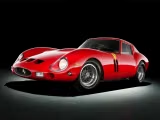
Ferrari 250 GTO, 1962
Ferrari 250 GTO I
Ferrari 250 GTO I•
•9 مشاهدة
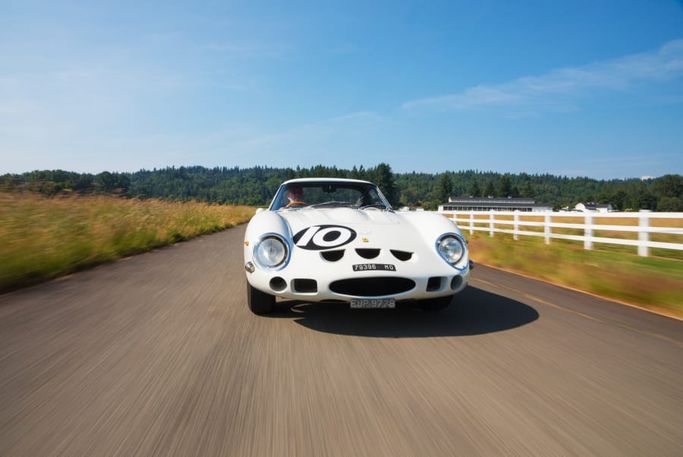
Chassis No.: 3729GT
$38,500,000 | Sold
- Engine: V-12
- Transmission: Manual
- Exterior: Bianco
- Interior: Nero
- The only Ferrari 250 GTO finished in Bianco paint by Ferrari
- Purchased new by British privateer racing team owner John Coombs
- Successful racing career with one victory and five 2nd-place finishes in GT class
- Driven in competition by Graham Hill, Jack Sears, Mike Parkes, Roy Salvadori, Mike MacDowel, Mike Salmon and Richie Ginther
- In all five of Bianco Speciale’s 2nd-place finishes, the winning car was another Ferrari 250 GTO
- Loaned to Jaguar Competition Department for aerodynamic and performance testing in 1962
- Driven by Jack Sears to 1st in GT class for the 1963 Guards Trophy Race at Brands Hatch
- Sears later owned this Ferrari 250 GTO from 1970 to 1999
- Part of the Jon Shirley Collection since 1999
- Retains period racing details like the hood louvers and cockpit air hose added by Coombs
- Ferrari Classiche Red Book
No other automobile has captured the imagination quite like the Ferrari 250 GTO. It arrived at a time when Ferrari was already the dominant force in motor racing, especially in its most grueling form: long-distance sports car racing. A masterful blend of power, finesse and beauty, the GTO reinforced that reputation with an unparalleled string of victories that produced three consecutive FIA World Manufacturers’ GT Championships and solidified Enzo Ferrari’s stature as motorsport’s Colossus. Sixty years later, Ferrari remains the most charismatic marque in the world, the 250 GTO its ultimate expression—revered by collectors and a guaranteed entry into the world’s most exclusive car club.
Driven by racing heroes Graham Hill, Mike Parkes and Jack Sears, this 1962 Ferrari 250 GTO boasts a singular pedigree, a celebrated racing career and excellent provenance. Yet beyond those impeccable credentials, Chassis 3729GT occupies a unique place in Ferrari history. Of the 36 examples produced between 1962 and 1964, it is the only one factory finished in white— Bianco—a bold deviation from Ferrari’s deeply rooted tradition of Italian Racing Red. This extraordinary distinction was not granted lightly. It required quiet internal approval, almost certainly facilitated by Alfredo Reali, Ferrari’s discreet liaison for bespoke builds.
Through his subtle influence, 3729GT received the unprecedented factory white livery, becoming what is now known as Bianco Speciale—a singular expression of individuality within the most exclusive fraternity in automotive history. The Road to Ferrari’s 250 GTO Ferrari began dominating international sports racing competition following the 1953 debut of the FIA World Sportscar Championship, taking the title eight times in the first 10 years after its inception.
When the FIA limited engine displacement to 3.0 liters in 1958, Ferrari tweaked Gioachinno Colombo’s renowned V-12 engine for its 250 GT platform, birthing a dynasty of legendary racing machines: the 250 MM, the 250 Europa GT, the Testa Rossa and finally the 250 GT SWB (Short-Wheelbase Berlinetta) that embarrassed the competition in 1960 and 1961. In 1962, the FIA introduced the International Championship for GT Manufacturers to encourage more participation from production-based sports cars. Ferrari’s response was typically ruthless.
Operating in total secrecy within Maranello, chief designer Giotto Bizzarrini—soon to depart during the infamous 1961 “Walk Out”—headed a hand-picked team of engineers to refine the SWB concept into something far more potent: the 250 GTO. Balancing aerodynamic and performance considerations dictated much of Bizzarrini’s approach to his new design. He began by relocating the engine completely behind the front axle for improved weight distribution and specified a dry sump oiling system to further lower it, dropping the center of gravity and enabling a lower hood line.


Higher-duration cams, larger valves and an upgrade to six dual-throat Weber 38 DCN carburetors combined to increase output from the 250 GT SWB’s 260-280 HP to 300. A new 5-speed gearbox replaced the SWB’s 4-speed, and a sturdier differential with revised Watts linkage was introduced. The front suspension geometry featured more negative camber and cross-braced Koni shocks. Bizzarrini’s attention to exterior airflow and reduced weight produced the GTO’s faired-in headlights, smaller radiator opening and additional cooling vents. The smallest details were addressed, right down to the recessed fuel filler cap and smaller, lighter, more aerodynamic door handles.
Drawing on his success with the SWB “Breadvan” and the mid-engine 246 Sports Prototype, Bizzarrini designed a Kamm-style tail. Southern California racer and talented Ferrari development driver Richie Ginther added a rear deck spoiler and a subtle secondary tunnel spoiler between the exhaust tailpipes to smooth underbody airflow. In direct comparison tests between the 250 SWB and the new GTO at Monza in September 1961, the GTO easily outpaced the SWB by several seconds per lap; Ferrari clearly had another winner.
Introduced in the factory courtyard alongside the new Grand Prix and Sports Prototype racers during the annual Maranello press conference on February 24, 1962, the Ferrari 250 GTO represented the ultimate road-legal sports racer, one that would soon speak for itself in competition. One month later, the Ferrari 250 GTO made its racing debut at the 12 Hours of Sebring as Phil Hill and Olivier Gendebien drove to second overall and first in GT class for Luigi Chinetti’s North American Racing Team. The success at Sebring was followed by a GT class victory at the Targa Florio in May and a one-two finish in the GT class at the 24 Hours of Le Mans in June.
Ferrari had nearly secured the International Championship for GT Manufacturers just halfway through the season; indeed, the GTO would go on to capture that title three consecutive times from 1962 through 1964. Bianco Speciale – 3729GT Ordered through Ronnie Hoare’s Maranello Concessionaires by British racing privateer and highly successful Jaguar dealer John Coombs, chassis 3729GT was completed on May 7, 1962 and sent to Scaglietti for its aluminum coachwork.
Early series features included twin fender vents, C-pillar sail panel vents, a wider radiator opening, circular brake ducts, rectangular fog lights, semi-recessed parking lights, chrome rings around the headlight covers and a riveted-on rear spoiler. Coombs’ bold request that his 250 GTO be finished in white was a deliberate nod to his racing identity and a subtle challenge to his rivals at Jaguar, whose competition cars often wore white. The Ferrari factory issued the car’s certificate of origin on July 13, 1962, assigning Modena registration MO 79396 to bypass British import duty. Delivered to Coombs on July 28, 1962, 3729GT arrived on British soil wearing its specially ordered paint.


Bianco Speciale had officially arrived. Brands Hatch, August 6, 1962 – A Grand Debut The Peco Trophy race at Brands Hatch held on August Bank Holiday Monday was the occasion for Bianco Speciale’s racing debut. Coombs placed British Formula 1 veteran and 1959 Le Mans co-winner Roy Salvadori in the cockpit of the brand-new Ferrari, one of an imposing six-car pack of privately entered new GTOs additionally piloted by Mike Parkes, John Surtees, Innes Ireland, Colin Davis and David Piper. Coombs also entered his Jaguar E-Type for Graham Hill, who qualified in fourth on the outside of the front row, with Surtees on pole, Salvadori in second and Parkes in third.
Surtees initially surged into the lead, but Parkes took over on lap 3 as Ireland moved up to challenge Salvadori and Surtees in a gripping contest that continued through a lashing downpour. Salvadori prevailed when Surtees spun out on lap 21, finishing second behind Parkes and ahead of Ireland in third. The Bianco GTO had shown its mettle. The literal heat of competition prompted a rush of development in the two weeks leading up to the RAC Tourist Trophy Race at Goodwood. Two rows of louvers were added to the car’s hood and a third vent was opened in both front fenders. The lower driving lights were also removed to improve airflow.
Goodwood, August 18, 1962 – Graham Hill and the Tourist Trophy The oldest event in British motor racing, the Royal Automobile Club’s (RAC) Tourist Trophy race at Goodwood carried special importance as an official round of the International Championship for GT Manufacturers in 1962. The incomparable Stirling Moss had recently dominated the event, winning four times since its move to Goodwood in 1958, his two most recent victories in Rob Walker’s Ferrari SWB becoming a key motivation in Coombs’ acquisition of the Bianco GTO.
With Moss retired after his horrific Easter Monday crash at the same circuit, the title of Britain’s top driver was being contested by the talented and popular Graham Hill. Debonair, witty and remarkably fast, Hill perfectly suited Coombs’ desire for
التكلفة
141,391,250 AED