


Bentley 4¼-Litre All-weather Tourer, 1937
Bentley T-Series
Bentley T-Series•
•54 مشاهدة
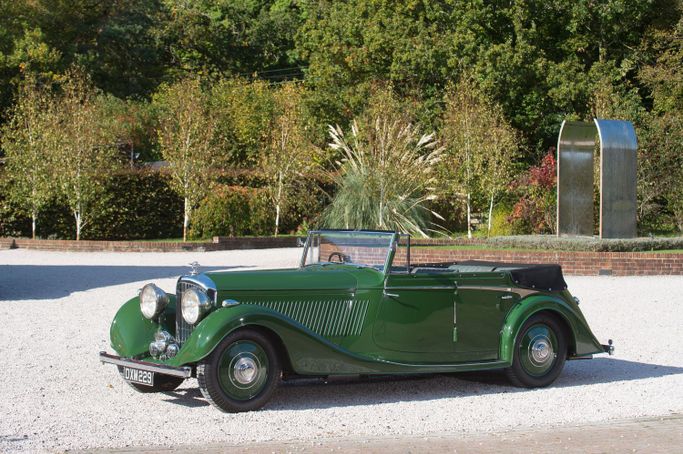
Chassis No.: B179JY
£138,000 GBP | Sold
- Unique 'wide body' coachwork
- Restored in the early/mid-1990s
- Present ownership since 1998
- Featured in Classic and Sportscar magazine
- Overdrive transmission
- Excellent condition
'Think of all the driving qualities that make a sports car – crisp handling responses, precision of control, strong acceleration, a general liveliness in demeanour – and this imposing Bentley possesses them all.' – Mark Hughes, Classic and Sportscar.
Although Rolls-Royce's acquisition of Bentley Motors in 1931 had robbed the latter of its independence, it did at least ensure the survival of the Bentley name. Launched in 1933, the first of what would become known as the 'Derby' Bentleys continued the marque's sporting associations, but in a manner even more refined than before. Even W O Bentley himself acknowledged that the 3½-Litre model was the finest ever to bear his name.
Based on the contemporary Rolls-Royce 20/25, the 3½-Litre Bentley was slightly shorter in the wheelbase at 10' 6" and employed a tuned (115bhp), twin-SU-carburettor version of the former's 3,669cc overhead-valve six-cylinder engine. Add to this already remarkable package a part-synchromesh four-speed gearbox and servo assisted brakes, and the result was a vehicle offering the driver effortless high performance in almost absolute silence. 'The Silent Sports Car', as it was quickly dubbed, had few peers as a tireless long-distance tourer, combining as it did traditional Rolls-Royce refinement with Bentley performance and handling.
By the end of the 1930s the 'Derby' Bentley had undergone a number of significant developments, not the least of which was an increase in bore size in 1936 that upped the capacity to 4,257cc, a move that coincided with the adoption of superior Hall's Metal bearings. This new engine was shared with the equivalent Rolls-Royce - the 25/30hp - and as had been the case with the preceding 3½-Litre model, enjoyed a superior specification in Bentley form, boasting twin SU carburettors, raised compression ratio and a more 'sporting' camshaft. Thus the new 4¼-Litre model offered more power than before while retaining the well-proven chassis with its faultless gearchange and servo-assisted brakes.
Surviving factory records show that the car offered here, chassis number 'B179JY', was delivered new on 14th May 1937 to Miss D Skinner of Haywards Heath, Sussex having been sold to Sir Sydney Skinner (then Chairman of Barkers department store), presumably her father. The car was delivered with a unique all-weather touring body by London-based coachbuilder Vanden Plas, a firm that had forged its not inconsiderable reputation by a most fortuitous alliance with Bentley, bodying some 700-or-so of the latter's chassis during the 1920s, including the Le Mans team cars.


The firm survived Bentley's demise and resurrection under Rolls-Royce ownership, diversifying into other makes and resuming the relationship with its old partner to produce some of the most sublime designs on the Derby Bentley chassis.
What makes this car's body unusual is the fact that it was specified to be 4" wider than standard, the bonnet being altered to suit - changes that contributed £45 to the final price of £1,705. In 1939, ownership passed to a Brighton pig farmer, who had an estate conversion grafted onto the rear of the original body, the boot section being removed in the process. It seems likely that this was done to take advantage of the additional wartime petrol allowance granted to 'utility' vehicles. In this form the Bentley was used and driven until it was placed in barn storage in 1970, remaining there until 1992.
Rescued by Robin Moore, Specials Registrar for the Bentley Drivers' Club, it then passed into the ownership of Benetton Formula 1 Team technician Robin Grant, an experienced devotee of the marque who had already restored two other Derby Bentleys. Fortunately, most of the Vanden Plas body had survived and was repairable, though a new boot section had to be fabricated to restore the car to original specification. Ravaged by woodworm, the original timber frame was replaced in its entirety, with all bodywork repairs and reconstruction being entrusted to Steve Penny of Vintage Carriage Bodies.
The body was repainted by Julian Stokes of RS Restorations, while the owner attended to the restoration of the chassis and mechanicals himself. An electrically operated overdrive was fitted and a new hood frame fabricated - all 104 pieces - a process that involved much trial and error before the hood could be made to fold down flush with the body as its maker intended. With the frames of the winding windows swivelled out of sight, the result is an elegantly smooth waistline running from front to rear.


Shortly after the restoration's completion, 'B179JY' featured in an article by Mark Hughes in
Classic and Sportscar
magazine, a copy of which may be found in the comprehensive history file. The current vendor purchased the Bentley from Robin Grant in June 1998, since when it has been maintained in full working order, and is only selling it because a forthcoming house move will see him lose his six-car garage.
Possessing unique coachwork by one of the most exceptional coachbuilders, and a fascinating history, 'B179JY' remains a rare and significant representative of one of most exclusive and desirable of all British Post-Vintage Thoroughbreds: The Derby Bentley.
التكلفة
691,588 AED


