When to Replace Coolant in a Mercedes-Benz G-Class AMG
Mercedes-Benz G-Class AMG
Mercedes-Benz G-Class AMG•
•16 مشاهدة
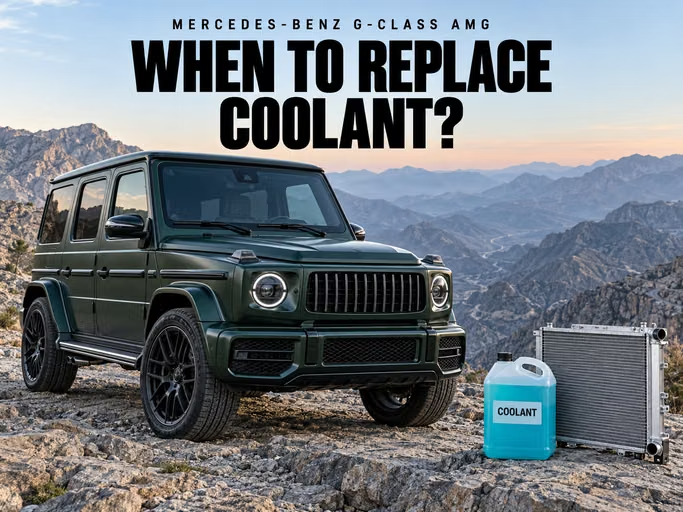
Coolant replacement in a Mercedes-Benz G-Class AMG depends on the service requirements for the specific version and the condition of its cooling system. Establish the build year, engine and maintenance history first. Heat, sand driving and sustained loads warrant careful monitoring, but do not define a replacement interval by themselves. Here is what to check and agree with the workshop.
Establishing the Coolant Replacement Interval
The G-Class AMG name covers vehicles from different years and specifications. Advice for one G 63 should not automatically be applied to another; a similar body shape does not establish identical maintenance requirements. Give the workshop the VIN, or vehicle identification number, and ask for the schedule that applies to your car. Compare it with the date and mileage of the previous replacement.
What the G-Class Manual Says
The May 2020 G-Class manual, on printed pages 412–413, refers to specification 310.1 and a 50–55% concentrate proportion. It requires regular replacement by a specialist workshop but gives no numerical interval in that section. AMG owners must also consult the applicable supplement. Check applicability before using these details for another model year.
It would therefore be inaccurate to promise a single interval for every G-Class AMG. Ask the technician to identify the document behind the recommendation and record the next due point on the job order. An unscheduled replacement should have a specific reason, such as repairs, unsuitable fluid, contamination or another established problem.
Information Needed to Check the Schedule
Invoices and job records are useful evidence. An entry stating that a service was completed does not reveal whether coolant was changed. Distinguish the full agreed replacement procedure from a small top-up after a hose was removed. Both operations may involve adding coolant, but they leave a different maintenance history for the system as a whole.
| Detail to check | Where to find it | Effect on the decision |
|---|---|---|
| Version and build date | VIN and vehicle documents | Establishes the applicable schedule |
| Previous replacement | Dated job order with mileage | Provides a starting point for the interval |
| Installed product | Invoice and exact fluid name | Helps establish compatibility |
| Cooling-system repairs | Parts and operations listed | Shows what was drained and refilled |
Missing records do not prove that the coolant is either fresh or deteriorated. Begin with an inspection, check available service records and agree on a plan. If the product and history cannot be established, discuss a controlled replacement with a suitable fluid. Adding a fresh portion cannot reconstruct an unknown maintenance history.
When Inspection Cannot Wait for Scheduled Service
Routine replacement and fault diagnosis serve different purposes. Fluid age matters for maintenance planning, while repeated losses need investigation regardless of the fill date. Before visiting the workshop, note when the symptom appeared, the driving conditions and anything that changed after the most recent repair.
- A low-coolant message keeps returning. Record top-up dates and quantities, if any were added; this helps establish how the problem is developing.
- Fluid traces appear around connections, on the underbody protection or beneath the parked vehicle. The point where a drop lands may not be the source, so inspection is needed.
- An overheating warning or steam appears. Stop putting the vehicle under load, pull over safely and follow its instructions.
- Sediment, foreign particles or an oily film are visible in the expansion tank. Identify the contamination source before arranging a fresh fill.
- Temperature behaviour or cabin heating changes after cooling-system work. Report the change to the workshop that carried out the repair.
These signs guide investigation; they do not identify a failed component. An overheating message alone, for example, does not establish that old coolant is the cause. Ask the workshop to distinguish its findings from its assumptions: what was observed, which checks were performed and why the proposed work is appropriate.
Monitoring the Level
Compare readings on level ground with the vehicle fully cooled, following its own manual. Photographs taken under consistent conditions are more useful than comparing hot and cold fluid levels. Do not fill above the prescribed mark or judge coolant condition solely by how bright its colour appears.
Choosing Coolant for a G-Class AMG
Selection starts with vehicle requirements rather than bottle colour. GLYSANTIN explains that colour does not identify a coolant's chemical and technical properties. Two similarly coloured products can have different applications. A broad claim such as “for European vehicles” is also insufficient to establish suitability for a particular AMG version.
Ask for the exact product name and applicable approval before work begins. The manual's reference to 310.1 directs the reader to coolant requirements; it does not replace selection of a suitable material. If the existing fill is unknown, the technician needs to account for that when choosing the procedure instead of simply adding whatever fluid is available.
Premixed Coolant and Concentrate
Use ready-to-use coolant according to its instructions. Concentrate needs water of the required quality and the correct mixing ratio. Do not dilute a premixed fluid out of habit. If the system is flushed, the workshop must also consider retained water, which can alter the final concentration.
Avoid increasing the concentrate proportion in pursuit of extra protection in hot weather. Follow the vehicle and product requirements. Similarly, plain water does not become a suitable permanent fill just because freezing temperatures are unlikely. The system needs material protection as well as a liquid capable of carrying heat.
How Much Coolant Is Needed
Quantity depends on the version and the procedure. Total system capacity can differ from the amount actually drained because some fluid remains inside. Where several circuits are present, agree explicitly which ones will be serviced. The G-Class AMG name alone is not enough to calculate how many containers to buy.
Also ask how material is counted in the quotation: only the final fill, or additional fluid used during cleaning. This makes it easier to compare offers covering the same work. The completed job order should record the product name, actual quantity and operations performed, so the next technician does not have to reconstruct them from the owner's memory.
Hot Weather and Off-Road Use
A G-Class AMG needs attention to the exterior surfaces of its heat exchangers as well as the fluid inside. Sand or mud driving can make an earlier inspection necessary. The cited manual includes the radiator among components to be checked and cleaned after driving through sand, mud, water or gravel.
External radiator cleaning and coolant replacement address different conditions. Renewing the fluid will not remove dirt obstructing airflow through the outside surfaces. Have cleaning performed by specialists: access and cleaning methods must account for the vehicle's construction and avoid damaging delicate heat-exchanger elements.
What to Tell the Workshop After a Demanding Trip
Explain whether you drove through sand, climbed slowly, towed a trailer or noticed a warning after sustained load. Mention whether the symptom disappeared after stopping and whether it returned. If someone inspected the vehicle or added fluid during the trip, provide the product name and quantity as accurately as possible.
This information helps select relevant checks; it does not establish an automatic replacement interval. Annual replacement based solely on the climate needs a substantiated reason. Before a long journey, check the cold level, visible signs of leakage and maintenance history in advance. Resolve a recurring warning before planning further travel.
Risks of an Old or Unsuitable Fill
Protective performance can deteriorate even when the liquid looks clear. GLYSANTIN explains that additives gradually lose effectiveness. However, a coolant supplier's general advice does not replace the Mercedes-Benz schedule. The decision must account for the vehicle, the installed product and the documented maintenance history.
| Condition | Possible consequence | Workshop inspection focus |
|---|---|---|
| Reduced protective performance | Internal corrosion | Maintenance history and system condition |
| An unknown mixture | Uncertain compatibility | Products used and how to restore the correct fill |
| Insufficient coolant | Impaired cooling and overheating | Source of loss and leak-tightness |
| Trapped air after repairs | Unstable cooling performance | Correct filling and air removal |
The table describes possible risks, not a diagnosis based on the reservoir's appearance. Replacing fluid cannot restore a component that is already damaged. If a leak or contamination is found, agree on resolving the cause before cleaning and refilling. Otherwise, the fresh coolant may be lost or contaminated again.
The cost depends on access, the procedure and any necessary repairs. Request separate entries for diagnosis, materials, replacement labour and additional work. If substantial repairs are recommended after overheating, ask for test findings and a list of confirmed damage. Comparing total prices without knowing the included operations provides little useful information.
Checklist After Replacement
☐ Check that the job order identifies your vehicle version.
☐ Obtain the coolant name and confirmation of suitability.
☐ Confirm which circuits and components were serviced.
☐ Check the record of leak testing and air removal.
☐ Ask for the result of the level check after cooling.
☐ Retain the date, mileage and material quantity.
☐ Record the next due point and whom to contact if a warning returns.
Observe the vehicle during ordinary use after collection. If a message returns or fresh fluid traces appear, contact the workshop. Repeated top-ups with different products are no substitute for inspection. When shopping for a G-Class AMG, compare current listings alongside service histories: cooling-system records help clarify the work a vehicle may need.
Conclusion
Determine the G-Class AMG coolant replacement interval from your version's schedule and service history. Select a compatible product, consider radiator condition after off-road driving and retain the records. Investigate leakage or overheating before agreeing on repairs and a fresh fill.