















Кузов
Цены
Выгодно купить в

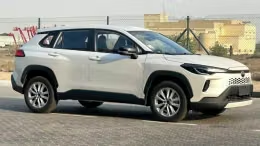
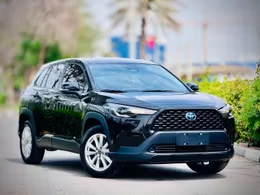
Toyota Corolla Cross Внедорожник 5 дв.
52 000 - 103 810 AED
Выгодно купить в
В кредит
На гарантии
Обмен
С видео
Со скидками
Для экспорта
127 объявлений
Узнавайте о новых объявлениях первыми
Сохраняйте параметры поиска объявлений и находите нужные объявления быстрее
Цена Toyota Corolla Cross начинается от 52 000 AED и достигает 103 810 AED. Итоговая стоимость на дороге может незначительно отличаться в зависимости от страховки, регистрации и дополнительных аксессуаров.
Toyota Corolla Cross Внедорожник 5 дв.
Выгодно купить в
Toyota Corolla Cross Вариатор
Выгодно купить в
Toyota Corolla Cross Бензин
Выгодно купить в
Toyota Corolla Cross Гибрид
Выгодно купить в
Toyota Corolla Cross 2026
Выгодно купить в
Toyota Corolla Cross 2025
Выгодно купить в
Toyota Corolla Cross 2024
Выгодно купить в
Toyota Corolla Cross 2023
Выгодно купить в
Toyota Corolla Cross 2022
Выгодно купить в
Toyota Corolla Cross Дубай
Выгодно купить в
Toyota Corolla Cross Шарджа
Выгодно купить в
Toyota Corolla Cross Медина
Выгодно купить в
Toyota Corolla Cross Абу-Даби
Выгодно купить в
Toyota Corolla Cross Маскат
Выгодно купить в
Toyota Corolla Cross Аджман
Выгодно купить в
Toyota Corolla Cross Эр-Рияд
Выгодно купить в
На графике — динамика средней цены модели на вторичном рынке за последний год. Эти данные помогут вам оценить выгодность покупки и спрогнозировать будущую стоимость авто.
Цены на AUTO.AE могут отличаться от фактической стоимости продажи. Данные основаны на нашей базе проданных автомобилей и актуальных объявлениях. Для точной оценки воспользуйтесь нашим инструментом.

A Toyota Corolla Cross Hybrid has two separate liquid-cooling circuits: one for the petrol engine and another for the power electronics. Their initial replacement points and capacities are not the same. This guide sets out verified figures for the 2026 GCC model, early warning signs and practical checks between scheduled services. In brief. On a 2026 Corolla Cross Hybrid, engine coolant is first replaced at 160,000 km and power-control-unit coolant at 240,000 km. Each circuit then follows an 80,000 km interval. A leak, contamination or repair calls for earlier inspection. When a Corolla Cross Needs Attention Before the Scheduled Point The long rated life of SLLC does not make the reservoirs irrelevant until the replacement mileage arrives. This compact crossover spends much of its time in slow traffic with the air conditioning running, so dependable heat rejection matters. Judge the system from repeatable evidence rather than one isolated observation. Previous maintenance paperwork is missing. An entry that says “coolant top-up” neither proves a complete renewal nor identifies the circuit involved. Establish the model year, original market and powertrain, then compare invoices and workshop orders. On the hybrid, engine-circuit work does not renew the liquid in the power control unit loop. The cold level falls again after replenishment. Evidence may never reach the parking floor because a small seep can dry on a hot housing or collect on the undertray. Look for pink crystalline residue, damp joints and a characteristic odour around caps, hoses, pumps, heat exchangers and both expansion reservoirs. The liquid is no longer uniform. Flakes, persistent foam, cloudiness, brown sediment or an oily film call for identification of the source. Fresh fluid cannot correct internal leakage, corrosion or mixed chemistries. Inspect heat exchangers, seals and the product history before deciding how either circuit should be cleaned. Cabin-heater temperature changes without a new command. In the engine loop this can point to a low level, trapped air or uneven circulation, especially after recent work. Normal heater performance, however, says nothing conclusive about the separate loop that removes heat from the hybrid power electronics. Temperature rises in congestion, on a long grade or with a full load. Test fan operation, airflow through the condenser-radiator stack, the pressure cap, thermostat and pump performance. Treat a hybrid-system message as a separate clue: the PCU circuit can develop a fault without an obvious rise on the engine temperature display. Checking Both Reservoirs Safely Park the Corolla Cross on level ground and let it cool fully. The engine reservoir and power-control-unit reservoir should each read between FULL and LOW; neither reading substitutes for the other. If a level is low, use only compatible coolant and investigate the loss. Never remove a hot cap because the circuit is pressurised. What Changes as Coolant Ages Coolant does more than carry heat. Its additive package limits electrochemical attack between dissimilar metals, supports pump-seal life and discourages deposits. Once that protection weakens, external parts can still appear healthy while deterioration has already begun in narrow internal passages. Corrosion debris moves with the circulating liquid. It can lodge in fine radiator, heater and hybrid heat-exchanger passages, increasing resistance to flow. The first clue may be more frequent fan operation or a small dry stain at a joint; later, leakage and reduced thermal performance become more apparent. An incorrectly prepared mixture can leave mineral scale. Tap water, an accidental dose of concentrate or an incompatible coolant may create an insulating internal layer. The pump must then move liquid through a less effective heat exchanger, even though the colour in the reservoir can still look familiar. Air and contamination shorten pump life. Bubbles encourage cavitation, hard particles abrade working surfaces and unsuitable chemistry compromises seal conditions. Weak flow in the engine loop is often exposed by sustained load; in the PCU loop it can produce a system message or a temporary power limitation. Incomplete bleeding may reveal itself only after several journeys. The bottle looks correct immediately after filling, but trapped air later escapes and the level drops towards LOW. Each circuit therefore needs its own circulation and air-removal routine, followed by another check after the vehicle is completely cold. A red warning, visible steam or a strong sweet odour is a reason to stop, not to accelerate towards a workshop. Continued driving can distort engine components, damage the head gasket or trigger hybrid-system protection. Let the vehicle cool naturally; do not open a hot cap or pour cold water over heat-soaked parts. Important. Check both reservoirs only after complete cool-down. Hot coolant is pressurised, and a correct engine-circuit level does not confirm that the power-electronics cooling loop is healthy. Coolant Specified for a Toyota Corolla Cross The manual permits Toyota Super Long Life Coolant or a similar high-quality ethylene-glycol product that is non-silicate, non-amine, non-nitrite and non-borate, with long-life hybrid organic acid technology. Toyota SLLC is supplied as a 50% coolant and 50% deionised-water premix rated to −35°C. Do not dilute it further or determine compatibility from colour alone. Choose the document for the exact year, equipment and destination market from Toyota’s manuals. Its vehicle-specific requirement takes priority over a broad statement on a container: imported petrol Corolla Cross versions and hybrids can differ in circuit count, capacity and bleeding sequence. Official 2026 Corolla Cross Hybrid Intervals and Capacities According to the information presented on toyota.ae, the current 2026 Corolla Cross Hybrid uses a 1.8-litre hybrid powertrain. Its GCC regional manual gives two capacities: 5.7 litres for the petrol-engine circuit and 1.5 litres for the power control unit. Engine coolant is first replaced at 160,000 km and PCU coolant at 240,000 km; each then follows an 80,000 km interval. These figures apply to the 2026 GCC Corolla Cross Hybrid, including the UAE specification. Capacity describes a dry system; a routine drain can release less because liquid remains in passages and heat exchangers. Verify another variant by VIN, model code and original market before ordering supplies. Why the Figures Must Not Be Combined The engine and power electronics have their own reservoirs, pumps, pipework and thermal duties. The 5.7-litre engine figure does not include the 1.5-litre PCU loop, and a correct reading in one bottle reveals nothing about the other. Even when both use SLLC, they are filled as independent systems. Nominal capacity helps estimate the required stock but is not an instruction to force the whole quantity into a partially drained circuit. Record what was removed, follow the correct filling and bleeding routine, and set the final level after circulation, warm-up and complete cool-down. Overfilling cannot correct trapped air. Why Heat Rejection Is Harder in a Hot Climate High ambient temperature narrows the difference between outside air and the heat exchangers, while continuous air-conditioning adds heat ahead of the main radiator. In slow urban traffic, ram airflow is limited, making fan operation and stack cleanliness more influential. Fine sand can accumulate between layers while remaining hidden from a view through the grille. A full passenger load, a sustained climb and extended stationary running reduce the margin further. Diagnosis should therefore cover airflow, caps, pumps, thermostat and data from both cooling loops instead of blaming coolant age alone. Establishing the Next Service Point A detailed workshop order is available. Confirm that it records the circuit, product, date and odometer. The engine and PCU require separate entries because their initial schedules differ. After a verified complete replacement, calculate the next point for each serviced circuit using the subsequent 80,000 km interval. Only a generic “coolant” note remains. Identify the amount and location of the work because one line does not prove that both systems were renewed. Compare cold levels, clarity and signs of disassembly, then request detail from the workshop. A concentration tester cannot measure every remaining corrosion inhibitor. A radiator, hose or pump was recently replaced. Local repairs often end with a partial refill, so the repair date may not start a new full interval. Establish how much liquid left the system, which product restored the level, whether bleeding was completed and whether circulation was verified after cool-down. Unknown coolant or oil is visible in a reservoir. Identify the source and assess seals, heat exchangers and passages before cleaning. An aggressive flush without diagnosis can mobilise sediment and send it into a restricted channel. Inspect the circuits separately and never turn them into one shared drain path. Pre-Replacement Checklist ☐ Record the VIN, model year, original market, complete model code and powertrain type. ☐ Locate the engine reservoir and the separate PCU reservoir; label them before starting work. ☐ Photograph both cold levels and inspect caps, hoses, clamps, pumps and the undertray for evidence. ☐ Verify the full chemical specification rather than relying on colour or a generic “for Toyota” claim. ☐ Prepare separate containers to collect and measure liquid from each cooling circuit. ☐ After filling, confirm circulation, complete bleeding, leak-free operation and a stable cold level. Monitoring Between Replacements Compare both levels in the morning on the same level surface. A photograph taken after service creates a useful baseline; later images reveal a slow trend more reliably than a hot reading made on an incline. Record the amount, date and circuit every time any coolant is added. Inspect the heat-exchanger stack, fan operation, hoses and dry residue around joints. Remove dust after severe use without bending the fins. Stop driving after suddenly cold heater output, steam, a strong coolant smell, a red temperature warning or a hybrid-system alert, and investigate after the vehicle has cooled. Conclusion For a 2026 Corolla Cross Hybrid, first replace engine coolant at 160,000 km and PCU coolant at 240,000 km, then service both every 80,000 km. Before buying, compare the VIN and history with current listings for Toyota Corolla Cross vehicles.

For the Toyota Corolla Cross Hybrid covered by the published Toyota manual, brake fluid is inspected every 10,000 km or 6 months and replaced every 40,000 km or 24 months. In both cases, the earlier limit applies. Occasional driving and regenerative braking do not remove the time limit. Before servicing. Check the VIN, model year, engine, petrol or hybrid powertrain, transmission, drivetrain and original market. The figures below apply to the Corolla Cross Hybrid covered by the cited document; always confirm that they match the individual vehicle. When the Brakes Need an Early Inspection An unusual braking response takes priority over the next service date. When booking an inspection, describe exactly what the pedal does, when the symptom occurs and whether a warning appears on the dashboard. You have to press the pedal farther than before to obtain firm deceleration. The first application feels soft, but several repeated presses make the pedal firmer. Treat this as a reason for hydraulic diagnosis, not a technique for continuing the journey. With steady pressure while stationary, the pedal gradually sinks. The system needs checks for leakage and correct master-cylinder operation. Fluid falls below the permitted level again after a top-up, or fresh wet traces appear on hoses and connections. A red brake-system warning remains after the parking brake is released; a hybrid may also display a brake-control malfunction message. Important. If braking effectiveness drops noticeably, the pedal sinks towards the floor, fluid escapes rapidly or a red brake-system warning appears, stop safely and arrange recovery. Fresh fluid alone cannot repair a damaged hose, a leak or a faulty brake actuator. Why Low Mileage Does Not Keep Fluid Fresh Glycol-based brake fluid absorbs moisture. As the water content increases, its boiling point falls, leaving less margin before vapour can form during repeated heavy braking. Vapour compresses, so the pedal may move farther without producing the expected deceleration. Gentle urban driving may not expose the problem. Clear-looking fluid does not prove that it remains suitable either. Assessment should account for age and service history; an instrument check adds information but does not cancel a scheduled replacement. Topping up has a different purpose: it raises the reservoir level. It does not renew fluid in the wheel circuits or explain why the level dropped. A small decrease can accompany pad wear, but frequent refilling requires investigation. Corolla Cross Hybrid Schedule and Fluid Specification The Corolla Cross Hybrid manual gives the inspection and replacement schedule on page 286 and the fluid requirements on page 383. It permits SAE J1703 or FMVSS No. 116 DOT 3, and SAE J1704 or FMVSS No. 116 DOT 4. Use these details only after confirming that the document covers the vehicle being serviced. Choosing the Fluid Choose a product that clearly states compliance with the required specification. A higher DOT number is not, by itself, a reason to change grades. Silicone DOT 5 is not a substitute for the listed glycol-based fluids, and colour does not establish compatibility. Use a sealed container and clean equipment reserved for brake fluid. Remove dust from the reservoir cap and neck before opening; keep water, oil and cleaning chemicals out of the system. Never return drained fluid to the circuit or use leftovers with an unknown storage history. Protect your eyes and skin, and immediately rinse any fluid spilled on paintwork with water. How Driving Conditions Affect Maintenance Distance alone does not describe the work done by the brakes. A level motorway trip and a route with frequent descents can produce very different heat loads over the same mileage. Hot weather by itself does not establish a new factory interval. Brake Loads on the Road Repeated stops and passengers with luggage increase the work done by the friction brakes. On a long descent, use the engine-braking mode specified in the manual, remain within the permitted load and avoid controlling speed by continuously pressing the brake pedal. If braking weakens or an overheating smell develops, stop somewhere safe; do not continue without assessing the cause. Dust matters particularly during servicing because dirt around an open reservoir can enter the system. Extra inspections after demanding use help monitor condition. An early replacement decision should be distinguished from Toyota’s mandatory schedule. What Is Different on the Hybrid The Corolla Cross Hybrid returns some braking energy to the traction battery, but it still has hydraulic brakes. Slower pad wear does not mean that fluid can remain in service for the same extended period. Regenerative braking varies with driving conditions and system state, so the wheel brakes must remain fully functional. Bleeding a hybrid requires checking the instructions for its electronically controlled braking system. Front-wheel drive or all-wheel drive alone does not determine the procedure. Do not borrow pump activation, pressure-release or service-mode instructions from another Toyota. What a Complete Fluid Change Involves The job is not finished when the reservoir contents have been extracted. Fresh fluid must pass through all circuits required by the service procedure. If the hydraulic system has been opened, air must also be removed correctly from the affected sections and brake actuator. The technician identifies the braking system and selects the procedure for the VIN and configuration. Before replacement, the technician checks for leaks, examines pads, pipes, hoses and calipers, and checks dashboard warnings. Identified faults are repaired. The correct fluid and equipment are prepared, including any specified electronic service operations. Fluid is exchanged in the prescribed sequence while the reservoir stays at an acceptable level and air is kept out. The final level is checked in the required system state, together with sealing and pedal response. A road check follows only after stationary checks pass. The invoice records the date, mileage, fluid product and procedure completed. Can You Do the Work Yourself Follow the owner’s manual for routine checks, but do not treat it as a workshop bleeding procedure. Do not open bleed screws without understanding pump operation and stored pressure in a hybrid braking system. If the correct instructions or equipment are unavailable, use a workshop familiar with the exact Corolla Cross version. Checking a Used Toyota Corolla Cross A record saying “brakes serviced” may mean only that pads were replaced. Before buying, establish when the fluid was changed, which product was used and whether repairs involved opening the hydraulic circuit. Missing records mean an unknown service history, even when the reservoir looks clean. ☐ Compare the last replacement date and mileage with the schedule for the exact version. ☐ Confirm that the record describes a full fluid exchange rather than a top-up. ☐ Inspect accessible connections and the inner sides of the wheels for fresh leak traces. ☐ Ask about replacement of the master cylinder, actuator, calipers and hoses. ☐ For a hybrid, request checks of brake-system fault codes and hybrid-system operation. ☐ If braking is questionable, postpone the road test until the car has been diagnosed. Service Mistakes to Avoid Following mileage alone and missing the time limit. Treating regeneration as a replacement for hydraulic brakes. Renewing only the reservoir contents and recording a complete fluid change. Overfilling without accounting for system state and pad wear. Choosing fluid by colour or copying a specification from another configuration. Repeatedly topping up without finding the reason for fluid loss. Conclusion Follow the schedule that applies to your Corolla Cross, giving fluid age the same attention as mileage. A complete change must cover the required circuits and account for electronic brake controls. Leakage or increased pedal travel calls for diagnosis regardless of the next service date. When choosing a used Corolla Cross, current listings can help compare versions. Ask for evidence of brake servicing when inspecting each individual car.

Replace Toyota Corolla Cross spark plugs according to the schedule for the fitted engine, and investigate misfires before that service falls due. The hybrid also has spark plugs because its petrol engine relies on spark ignition. Electric driving does not remove the engine’s maintenance requirements. The four-cylinder 1.8-litre and 2.0-litre versions covered here each use four plugs. That shared quantity does not establish a common part number or service interval. Identify the model year, original market and engine code before buying a set. Important. The Corolla Cross Hybrid petrol engine uses spark plugs, not glow plugs. Neither the electric motor nor the traction battery needs either type. Spark plug quantities across Corolla Cross versions According to the information on toyota.ae, the UAE Corolla Cross Hybrid 2026 has a 1.8-litre four-cylinder hybrid powertrain. Toyota’s model description separately describes 2.0-litre petrol and hybrid models for the US market. Their service specifications must not be applied automatically to a 1.8-litre vehicle. When an early spark plug inspection is warranted Symptoms while the petrol engine is running • The engine develops pronounced vibration, runs unevenly or hesitates as speed rises. • Acceleration repeatedly falters, particularly when the engine is under load. • The malfunction indicator illuminates and diagnosis records combustion misfires. • Starting deteriorates or fuel consumption increases on comparable journeys. None of these signs proves that the plugs are worn. An ignition coil, injector, intake leak, fuel problem or mechanical engine fault can produce similar symptoms. What changes on a Corolla Cross Hybrid The petrol engine starts and stops automatically. A brief change in sound as it joins in is not itself a fault. Repeated heavy shaking, rough running after the start and recorded misfires deserve investigation. Failure to display READY requires a separate assessment; it is not a spark-plug diagnosis. How Corolla Cross ignition works The hybrid petrol engine The ignition coil supplies high voltage and a spark across the plug electrodes ignites the cylinder’s mixture. Hybrid control determines when the engine operates, but combustion still requires a spark. Do not subtract electric-only mileage from the prescribed service interval. Non-hybrid versions Spark ignition works on the same principle. The plug design, heat characteristics and installation requirements may differ. Similar-looking parts are not necessarily interchangeable. What can shorten spark plug life Electrodes wear gradually, but an early failure often reflects conditions inside the cylinder or damage to the plug. When a fresh set fouls quickly, investigate the cause instead of repeating the replacement. Heat and sustained load make sound engine cooling particularly important. Dust calls for attention to intake sealing. Neither factor, by itself, establishes a new universal spark-plug replacement interval. Why continuing misfires matter Misfires can send unburned fuel into the exhaust and overheat the catalytic converter. Power delivery and smoothness also suffer. A worn plug’s enlarged gap requires more firing voltage and can expose weaknesses in coil insulation. Important. If the malfunction indicator flashes, the engine shakes heavily or power drops sharply, do not keep driving under load. Stop safely and arrange diagnosis; use vehicle recovery when symptoms are severe. Toyota Corolla Cross service intervals and plug specifications Using the service information A matching model name is not enough to identify the correct manual. Check the model year, destination market and powertrain. A routine service interval is not automatically a spark-plug interval. If the matching document is unavailable, request VIN-specific information and distinguish workshop preventive advice from the factory schedule. Selecting a set for the fitted engine Match the full part number, thread, reach, seat and heat characteristics. “Iridium” describes an electrode material, not compatibility. Scheduled replacement normally uses a complete set of specified plugs. An isolated failure calls for a decision based on the condition of the others and the underlying cause. Installation calls for a cool engine, clean plug wells and controlled tightening. Do not add anti-seize compound out of habit because it changes thread friction. Follow the specified plug’s instructions on lubrication and tightening. Checking a used vehicle When comparing Toyota Corolla Cross current listings, establish each vehicle’s engine and service history. A “plugs replaced” entry is useful when it includes the date, mileage and part number. With an unknown history, verify the fitted parts and assess engine operation first. What a removed plug can tell you Keep removed plugs identified by cylinder. One plug that differs from the others can be more informative than the overall deposit colour. Appearance guides testing rather than replacing it. Note. A brown ring on the external ceramic near the metal shell can be corona staining. On its own, it does not prove combustion-gas leakage or justify replacing a sound plug. Diagnosis before replacing spark plugs A practical diagnostic sequence Record the operating conditions: cold start, warm running, acceleration or hybrid engine engagement. Save fault codes and freeze-frame data before clearing memory. Identify affected cylinders. Codes P0300 and P0301–P0304 indicate misfires but do not identify a failed component. Inspect connectors, coils, boots and plug wells for water, oil and insulation damage. Check the plugs and compare cylinders. A technician may move a compatible coil as a controlled test; a misfire that follows it supports a coil fault. If the cause remains unclear, test injection, intake sealing and compression. Confirm that symptoms and misfires stay absent after repair. Checklist before service ☐ Record the VIN, year, original market and engine code. ☐ Check the service schedule and previous replacement records. ☐ Confirm plug part number, quantity and installation requirements. ☐ Switch the hybrid system off, confirm READY is out and prevent an accidental restart. ☐ Leave orange high-voltage cables and connectors untouched. ☐ Check that plug wells are dry and coil boots are sound. ☐ Verify engine operation after repair and retain a service record. Selection and replacement mistakes • Selecting plugs solely by engine capacity or a packaging photograph. • Borrowing a replacement interval from a Corolla, Highlander or another-market Corolla Cross. • Treating electric driving as a reason to omit petrol ignition maintenance. • Abrading fine electrodes or adjusting their gap without manufacturer approval. • Replacing every ignition coil solely because a misfire code is stored. • Erasing codes before preserving diagnostic evidence and correcting the cause. Frequently asked questions about Corolla Cross spark plugs Does the hybrid need spark plugs Yes. They ignite the mixture in its petrol engine. No spark is needed while the car travels electrically with the engine stopped, but ignition resumes when that engine runs. Could it use glow plugs instead No. The petrol and hybrid Corolla Cross versions covered here do not use glow plugs. Glow plugs provide heat in diesel engines and cannot replace a spark source. How many plugs are required These four-cylinder engines require four plugs for a full set. Verify the part number by VIN; a 2.0-litre hybrid set is not automatically suitable for the 1.8-litre engine. Is there one interval for every Corolla Cross No. Use the documents for the vehicle’s engine, year and market. Reduced engine running time in a hybrid does not authorise extending Toyota’s specified schedule. Should coils be replaced with the plugs Sound coils are not mandatory replacement items during a plug change. Test them during diagnosis and replace them when a fault or damage is established. Can cleaning replace a new set Cleaning cannot restore worn electrodes or a damaged insulator. Aggressive treatment is particularly unsuitable for fine-wire plugs. Establish why fouling occurred before deciding what to do. What if misfires appear after replacement Check the set’s suitability, connector and coil seating, insulators and installation. A new part can still be damaged. If installation is correct, continue with mixture and mechanical testing. Why will plugs not fix every starting problem Starting also depends on electrical power, fuel delivery and control systems. On a hybrid, no READY indication and rough running of an already-started engine are different problems. Plug service should follow identification of the cause. Conclusion For a Corolla Cross, timely replacement of four plugs matters only when the parts match the exact engine. Hybrid operation still relies on spark ignition. Follow the applicable schedule and investigate the plug, coil, fuel delivery and cylinder condition when combustion becomes uneven.
В объявлениях могут быть представлены комплектации Toyota Corolla Cross Elite Edition (China), GLI, Deluxe Edition (China), XL и другие. Актуальный список зависит от выбранной страны, года выпуска и наличия автомобилей. Используйте фильтр «Комплектация», чтобы сравнить доступные варианты.
Пробег следует оценивать вместе с возрастом, состоянием и сервисной историей автомобиля. Сравните показатель с похожими машинами того же года и перед покупкой проверьте историю обслуживания и фактическое состояние автомобиля.
Сейчас на AUTO.AE представлены Toyota Corolla Cross по цене от 52 000 до 103 810 AED. Цена зависит от года выпуска, пробега, комплектации, состояния и региональной спецификации. Данные рассчитаны по активным объявлениям и могут меняться.
У частного продавца цена может быть ниже, а шоурум может предлагать дополнительные услуги — например, финансирование, гарантию или помощь со страхованием. Условия различаются, поэтому проверяйте информацию в объявлении, документы автомобиля и данные продавца.
Проверьте регистрационную карту автомобиля Mulkiya, VIN на автомобиле и в документах, данные владельца, сервисную историю и сведения об авариях. Также уточните наличие действующего кредита, штрафов или других ограничений. Перед сделкой желательно провести независимую проверку.
Да. Можно договориться с продавцом о независимой технической проверке в выбранном сервисном центре. Диагностика поможет оценить состояние двигателя, трансмиссии, кузова, электроники и других узлов.
GCC Specs означает, что автомобиль изготовлен в спецификации для рынков стран Персидского залива. Такие версии обычно рассчитаны на местные климатические условия. Однако GCC Specs сама по себе не подтверждает состояние автомобиля и не означает наличие действующей гарантии — это нужно проверять отдельно.
Некоторые шоурумы предлагают финансирование. Если оно доступно, условия или ориентировочный ежемесячный платёж могут быть указаны в объявлении. Итоговая ставка и одобрение зависят от банка, первоначального взноса и данных покупателя.


