


How Often to Change the Engine Oil in a Toyota RAV4 XA50: Intervals, Specifications and Capacities
Toyota RAV4
Toyota RAV4•
•47 просмотров
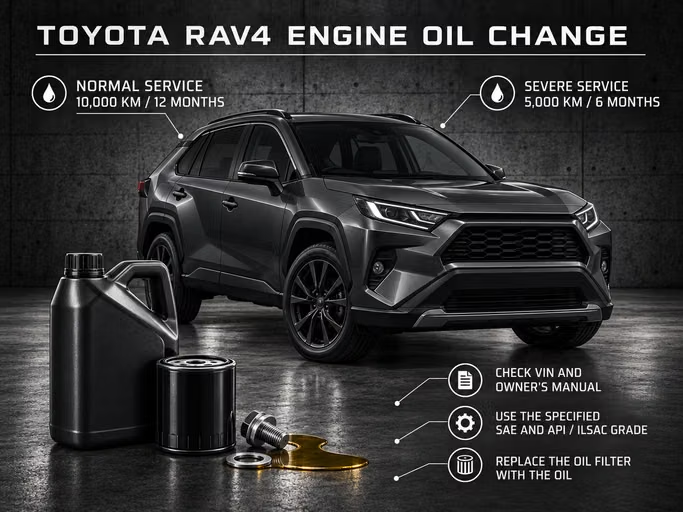
For a Toyota RAV4 XA50, 10,000 km is a sensible upper distance limit between oil changes. The time limit comes from the documentation for the vehicle’s original market and is usually 6 or 12 months. If the crossover routinely faces congestion, short journeys, high ambient temperature, or dust away from paved roads, plan service at roughly 5,000 km or 6 months. Use the VIN, engine code, and service booklet to establish the final schedule.
5 Situations When a RAV4 Should Not Wait for Its Scheduled Date
Mileage alone does not describe the lubricant’s workload. Consider elapsed time, engine hours, temperature, dust, and changes in level. Dipstick colour cannot replace this information: oil that still looks clean may have lost part of its additive reserve, while normal darkening does not always reveal a fault.
- The distance or time threshold has arrived. Change the oil at whichever condition occurs first. Even an infrequently driven engine experiences heat cycles, cooling, and condensation.
- The vehicle regularly travels on dusty roads. Contamination reaches the engine bay and intake system more quickly. Frequent driving away from pavement calls for closer filter checks and the shorter service schedule.
- The level falls noticeably between checks. Leakage, cylinder-related consumption, or a crankcase-ventilation problem may be responsible. A top-up restores quantity but does not correct the cause.
- The level rises or the dipstick smells of fuel. Repeated journeys without full warm-up can dilute the lubricant with petrol. A clear change requires injection and engine diagnosis before continued use.
- The red pressure warning remains on after start-up. This is an emergency alert, not a routine service reminder. Switch the engine off, check the level, and follow the owner documentation.
Why RAV4 Oil Load Is Not Always Visible on the Odometer
A crossover may creep through traffic, idle with the air conditioning running, or cover a short stretch of sand and dust. In each case, engine hours and heat rise faster than mileage. The shorter interval accounts for that difference. Do not move to a thicker grade simply because the climate is hot: the permitted SAE range belongs to the exact powertrain and market.
What Happens to Oil After the Interval Is Exceeded
In a healthy engine, lubricant separates loaded surfaces, carries away some heat, and transports particles towards the filter. With use, additives are consumed while oxidation products, moisture, and fuel accumulate.
- Viscosity becomes less stable. Fuel dilution can thin the film, while oxidation may make the fluid thicker. Either direction reduces predictable lubrication.
- Contamination remains in the system longer. Once detergent and dispersant reserves decline, varnish and sludge can attach more readily to passages, piston rings, and valve-timing components.
- The filter approaches its holding limit. A loaded element creates additional restriction. If the bypass valve opens, part of the flow moves around the filtering medium.
- Heat removal becomes less effective. Ageing and an incorrect level reduce protection during sustained speed, climbs, wheelspin, and high ambient temperature.
- The risk of oil starvation increases. Loss of pressure threatens bearings, crankshaft journals, camshafts, and valve-timing actuators. Stop driving when a red pressure warning appears.
Reference Data for Common RAV4 XA50 Engines
The fifth-generation RAV4 was offered with petrol and hybrid powertrains from different engine families. The figures below cover common M20A‑FKS, A25A‑FKS, and A25A‑FXS versions. They are useful for planning supplies but do not replace vehicle-specific data. After a control start and leak inspection, switch the engine off, observe the specified waiting period, and establish the final level with the dipstick.
| Item | M20A‑FKS 2.0 | A25A‑FKS 2.5 / A25A‑FXS 2.5 Hybrid |
|---|---|---|
| Normal operation | Up to 10,000 km; 6–12 months by market | Up to 10,000 km; 6–12 months by market |
| Severe operation | About 5,000 km / 6 months | About 5,000 km / 6 months |
| With a new filter | Approximately 4.2–4.3 L | Approximately 4.5 L |
| Without filter change | Approximately 3.9–4.0 L | Approximately 4.2 L |
| Typical viscosity | Usually 0W‑16 or 0W‑20 by year and market | Usually 0W‑16 or 0W‑20 by year and market |
| Oil quality | The vehicle-specific API/ILSAC standard | The vehicle-specific API/ILSAC standard |
The body series, model year, and powertrain can first be compared with current listings. Before buying oil, open the manual for the exact VIN and original market; its requirements take priority over the reference table.
How to Use the Table Without Mixing Specifications
A 2.0- or 2.5-litre label is not enough to choose lubricant. Differences exist within one generation by model year, market, and powertrain. The earlier RAV4 XA40 also used the 2AR‑FE, 3ZR‑FAE, and other engines, so XA50 quantities must not be transferred to it.
In a hybrid RAV4, the petrol engine may remain off for part of a journey, but the oil still ages by calendar time and undergoes repeated start and warm-up cycles. An electrified drivetrain is not a reason to extend the interval without a matching instruction.
Matching the Interval to Real RAV4 Use
- Steady motorway journeys. When the engine reaches full operating temperature, idling is limited, and maintenance records are complete, stay within 10,000 km and the calendar limit for the original market.
- Daily congestion and short routes. Repeated starts and stationary air-conditioning use add operating hours without comparable odometer growth. About 5,000 km or 6 months is a more suitable planning point for this pattern.
- Regular travel on sand or unpaved roads. Dust increases filtration demands, while low road speed under load adds heat. Inspect the air filter and oil level more often instead of waiting for the maximum interval.
- Infrequent vehicle use. Low mileage does not eliminate condensation, incomplete warm-ups, or calendar oxidation. Record the last change date as carefully as the distance.
Problems Made More Likely by Overdue Oil
Old lubricant rarely damages an engine in isolation. Risk usually combines an exceeded interval with a low or excessive level, a loaded filter, overheating, leakage, or injection faults. Noise, smoke, or a warning calls for diagnosis rather than another container of oil alone.
| Condition | What happens | Possible signs |
|---|---|---|
| Fuel dilution | The film becomes thinner and loaded surfaces lose protection. | Fuel odour, a rising level, or unstable running. |
| Oxidation | Viscosity and the tendency to form deposits increase. | Start-up noise, rougher operation, or additional heat. |
| Loaded filter | Restriction rises and flow may use the bypass valve. | There may be no clear sign before a warning or noise. |
| Varnish and sludge | Passages, rings, and valve-timing controls become contaminated. | Uneven idle, faults, or weaker response. |
| Level below MIN | The pump may draw air, reducing pressure and cooling. | A red warning, knocking, or overheating requires shutdown. |
| Level above MAX | Foaming, higher crankcase pressure, and oil entering the intake may occur. | Smoke, leaks, rough running, or fresh oil traces. |
Checks Before the Oil Change
- Identify the engine code. Match the VIN, identification plate, and documents. A quantity for the M20A‑FKS cannot automatically be applied to an A25A‑FKS, A25A‑FXS, or an earlier-generation engine.
- Confirm the required SAE and quality level. Viscosity, API, and ILSAC information must come from the same model year and original market. Do not assemble a specification from different manual versions.
- Match the filter and washer by VIN. Parts that appear similar may differ in threads, valves, and seal dimensions. Confirm the number before work begins.
- Inspect the underbody shield and drain plug. Sump access can vary with the fitted lower protection. Correct damaged threads or a distorted seal before refilling.
- Start below the reference capacity. After the new filter has filled, approach the final level in small steps. Never exceed the MAX mark.
- Verify the result after start-up. Confirm that the pressure warning goes out and that the filter and plug remain dry. Recheck the level, then record the date, mileage, and oil specification in the service history.
Four RAV4 Service Mistakes
- Transferring figures from another model because the engine code matches. Packaging, sump design, and vehicle documentation may differ. Use the specification for the correct RAV4 model year.
- Choosing viscosity from air temperature alone. Hot weather does not cancel the approved SAE range. Oil-system design and the required performance standard also matter.
- Leaving the used filter in place during a full change. A contaminated element reduces the reserve of the new fill and can increase flow restriction. Replace the filter with the oil unless the vehicle documentation clearly states otherwise.
- Filling above the MAX mark. Excess oil can foam, raise crankcase pressure, and enter the intake. Remove the surplus instead of waiting for the engine to consume it.
Conclusion
For a Toyota RAV4 XA50, base the plan on a 10,000 km ceiling and the 6- or 12-month time limit assigned to the original market. Congestion, short routes, dust, and persistent heat reduce the practical planning point to about 5,000 km or 6 months. Identify the engine from the VIN before buying supplies, then confirm viscosity, quality, and refill capacity in the vehicle documentation.


