


When to replace spark plugs in a Toyota Highlander
Toyota Highlander
Toyota Highlander•
•8 просмотров
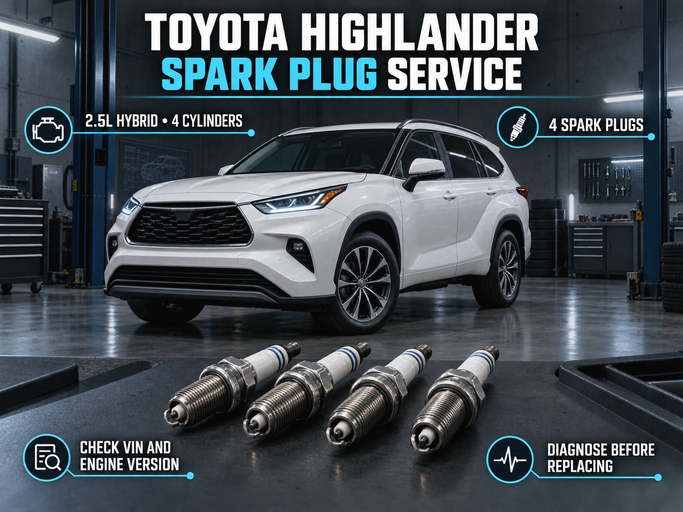
There is no single spark-plug replacement point for every Toyota Highlander generation. The current 2026 Highlander Hybrid for the UAE has a 2.5-litre four-cylinder petrol engine and therefore uses four spark plugs. Earlier V6 versions use six, while imported Highlanders with a four-cylinder turbo engine use four.
Identify the model year, destination market, powertrain and engine code first. Then confirm the interval and specification from the VIN and the documents for that exact vehicle. Inspect the ignition system earlier if there are misfires, an uneven start, loss of power or a flashing Check Engine light.
How many spark plugs different Highlander versions use
Cylinder count determines quantity, but it does not identify the correct part. Plugs with the same quantity can still differ in thread size, seat design, heat range, resistance and electrode construction.
| Highlander version | Engine | Quantity | What to confirm |
|---|---|---|---|
| 2026 Highlander Hybrid for the UAE | 2.5-litre petrol, 4 cylinders | 4 | VIN, engine code, plug specification, gap and torque |
| Imported turbo versions | 2.4-litre petrol, 4 cylinders | 4 | Year, original market and exact turbo-engine specification |
| Earlier petrol versions | 3.5-litre V6 | 6 | Generation, V6 variant and access to the rear cylinder bank |
| Highlander with unknown history | Identify from the vehicle | By cylinder count | Engine code and the numbers on the installed parts |
When to inspect the plugs before scheduled replacement
A worn plug requires more voltage to create a spark. A weakness can therefore appear under load before it is obvious at idle: the engine may start confidently yet hesitate during acceleration or on an incline.
Symptoms on a petrol engine
- extended cranking or uneven running during the first seconds after starting;
- idle vibration, especially when the air conditioner is switched on;
- loss of response during acceleration, overtaking or climbing;
- P0300 or P0301-P0306 faults and a flashing Check Engine light;
- higher fuel consumption on the same route and under the same load.
What to consider on a Highlander Hybrid
The hybrid’s petrol engine starts automatically and may run in short cycles. Electric drive can partly mask a mild misfire, so the driver may not notice it immediately. Stored codes, freeze-frame data, cold-start behaviour and the transition into combined powertrain operation are more useful evidence.
None of these symptoms proves that a spark plug is faulty. Similar behaviour can come from an ignition coil, injector, intake leak, intake deposits, low 12-volt battery voltage or a mechanical cylinder problem.
How the Highlander ignition system works
Current four-cylinder hybrid
Each cylinder has one plug and one individual ignition coil. The control system coordinates the spark with fuel injection and hybrid operation. An enlarged gap or damaged insulator may be most noticeable during an automatic petrol-engine start or when engine load rises.
Turbo versions and earlier V6 engines
The four-cylinder turbo engine also uses one plug per cylinder, but its specification must not be transferred to the naturally aspirated hybrid engine. A V6 has two cylinder banks and six plugs; access to the rear bank may require additional removal work. Confirm quantity, part type and procedure for the exact variant.
What shortens spark-plug service life
| Factor | What happens | What to check |
|---|---|---|
| Short trips and extended idling | The insulator self-cleans less effectively and deposits form | Route, warm-up and intake condition |
| Rich mixture or faulty injector | Fuel and deposits cover the electrodes | Fuel trims, injectors and sensors |
| Oil consumption or coolant entry | Deposits overheat the plug and weaken the spark | Compression, seals and crankcase ventilation |
| Faulty ignition coil or boot | Voltage leaks across contaminated or damaged insulation | Coil, rubber boot and plug well |
| Incorrect plug or installation | The thermal regime changes and thread damage becomes more likely | Catalogue specification and tightening torque |
Remove sand and dust from the top of the engine and the plug wells before lifting the coils. Remove the plugs only after the aluminium cylinder head has cooled. Apply thread compounds only when the component manufacturer gives a direct instruction.
What can happen if replacement is delayed
- An enlarged gap increases the electrical load on the ignition coil.
- Misfires under load can develop into continuous rough running.
- Unburned fuel can overheat the catalytic converter.
- Repeated starting attempts add load to the starter and 12-volt battery.
- Heavy deposits can make safe plug removal more difficult.
- On a hybrid, a mild misfire may remain unnoticed between short engine-running cycles.
- A new set can foul quickly if a mixture, oil or compression fault remains.
Toyota Highlander maintenance guidance and specifications
According to the information presented on toyota.ae, the 2026 Highlander Hybrid for the UAE uses a 2.5-litre four-cylinder petrol engine. An official Toyota overview separately describes the 2.4-litre four-cylinder turbo version and its change from the previous 3.5-litre V6. These powertrains must not share one plug specification or service schedule.
No universal interval applies to every Highlander. Confirm the replacement point, part number, gap and tightening torque from the VIN, engine code and documents for the exact vehicle. If a direct manual for the required year and market is unavailable, the word “manual” is not a substitute for checking the parts catalogue and vehicle data.
| Engine and version | Component | What is confirmed | How to apply it |
|---|---|---|---|
| 2.5-litre Hybrid 2026 for the UAE | 4 spark plugs | Four-cylinder petrol engine | Verify the part number and interval by VIN |
| 2.4-litre Turbo from other markets | 4 spark plugs | Four-cylinder turbo version | Do not transfer data from the 2.5-litre hybrid |
| Earlier 3.5-litre V6 | 6 spark plugs | Two cylinder banks | Confirm generation and exact V6 variant |
| Unknown history | Set selected by engine code | Condition is established through diagnosis | Do not order from displacement alone |
How to use the table
- Record the VIN, model year, destination market and engine code first.
- Use cylinder count only to establish quantity, not the part specification.
- Do not transfer specifications among the 2.5-litre hybrid, 2.4-litre turbo and 3.5-litre V6.
- For a hybrid, check the petrol-engine data rather than relying only on the Hybrid badge.
- When history is unknown, begin with diagnosis and inspection of the installed set.
How to choose the correct set
Thread diameter and reach, seat type, heat range, resistance, electrode material and terminal design must all match. A photograph, socket size or matching displacement does not confirm compatibility.
Checking a used Highlander
A replacement record should show the date, mileage, part numbers and workshop invoice. When comparing current listings, check the engine variant, cold-start behaviour, stored faults and operation under load separately. Recently installed plugs without records do not confirm the condition of the coils, injectors or cylinders.
What a removed spark plug can reveal
Inspection helps compare cylinders but does not replace measurements and diagnosis. The same deposit colour can accompany different faults, so plug traces must be compared with fault codes, fuel trims and compression.
| Observation | Possible cause | Next check |
|---|---|---|
| Dry black deposits | Rich mixture, weak spark or frequent short trips | Coil, injector, intake and fuel trims |
| Plug wet with fuel | The mixture enters but does not ignite | Spark, coil, injector and compression |
| Oily deposits | Oil enters the cylinder or plug well | Seals, crankcase ventilation and compression |
| Pale deposits or melted electrode | Overheating, lean mixture or wrong plug | Specification, cooling, injector and intake leaks |
| Cracked insulator | Impact, misaligned tool or excessive torque | Plug well, coil and installation method |
| One plug differs from the others | A local cylinder problem | Coil, injector, sealing and compression in that cylinder |
Diagnosing a fault
Save the DTCs and freeze-frame data before clearing the memory. Then confirm the engine variant, compare cylinders and inspect the coils, power supply and plugs. Replace the set after excluding faults that could quickly damage the new components.
| Symptom | Possible plug-related cause | Other causes | First action |
|---|---|---|---|
| P0300: random misfire | Wear in several plugs or deposits | Mixture, fuel or intake leak | Save freeze-frame data and identify the conditions |
| P0301-P0306: one cylinder | Damage to one spark plug | Ignition coil, injector or compression | Confirm cylinder numbering and compare components |
| Hesitation during acceleration | The spark fails as cylinder pressure rises | Fuel delivery, transmission or sensors | Reproduce the symptom safely and record data |
| Uneven cold start | Deposits or enlarged gap | 12-volt battery, injector, intake leak or compression | Check voltage and the first running cycles |
| Flashing Check Engine light | Active misfires may be plug-related | Any cause of a severe misfire | Reduce load and arrange urgent diagnosis |
Diagnostic sequence
- Read the DTCs and save freeze-frame data before clearing the memory.
- Record temperature, engine speed, load and when the symptom appears.
- Confirm the engine and correct cylinder numbering.
- Inspect the connectors, ignition coils, boots and plug wells.
- Compare the plugs without mixing up their original locations.
- If a plug does not explain the fault, check the injector, mixture and compression.
- After repairs, perform a verification start or road test and scan again.
Checklist before service
☐ Record the VIN, production year, market and engine code.
☐ Confirm the quantity and catalogue specification of the plugs.
☐ Save DTCs and freeze-frame data before disconnecting power.
☐ Allow the engine to cool and remove sand from the work area.
☐ Prepare the correct spark-plug socket and extension.
☐ Confirm the gap and tightening torque for the exact engine.
☐ Do not apply thread compounds without a direct manufacturer instruction.
☐ Inspect the ignition coils, boots and connectors.
☐ After assembly, confirm smooth operation and no new codes.
Mistakes to avoid
- Ordering plugs using only the descriptions “Highlander 2.5” or “Highlander 3.5”.
- Transferring a part specification among hybrid, turbo and V6 engines.
- Treating one interval as mandatory for every generation and market.
- Adjusting a fine electrode without approval for the exact plug type.
- Cleaning worn plugs and treating this as complete replacement.
- Replacing parts after an active fault without checking coils and injectors.
- Clearing codes before saving the original conditions.
- Removing plugs from a hot aluminium cylinder head.
- Tightening plugs without torque control.
Frequently asked questions about Toyota Highlander spark plugs
How many spark plugs are fitted to a 2.5-litre Highlander Hybrid
The current four-cylinder version uses four spark plugs, one per cylinder. Confirm the exact specification from the VIN and vehicle data.
How many spark plugs does a V6 Highlander use
A six-cylinder engine uses six plugs. The specification still depends on the generation and exact V6 variant.
Does a Highlander Hybrid have spark plugs
Yes. The electric motor does not replace the petrol engine’s ignition system. Selection requires the year, market, VIN and engine code.
Can the replacement point be determined from mileage alone
No. Time, operating pattern, engine type and the confirmed date of the previous service all matter. Diagnose earlier if symptoms appear.
Should all spark plugs be replaced as a set
During scheduled service, a matching set for that engine is normally fitted. If one new plug quickly becomes contaminated, investigate that cylinder first.
Does a P030X code always mean a faulty spark plug
No. An ignition coil, injector, wiring fault, intake leak or compression loss can create the same code. The code helps localise the issue but is not a complete diagnosis.
Can the vehicle be driven with a flashing Check Engine light
Normal driving under load should not continue. Active misfires can overheat the catalytic converter, so stop safely and arrange diagnosis.
Should the plugs be replaced immediately after buying a used Highlander
Not automatically. Review the records, cold start, stored faults and installed parts first. If the history is unknown, base the decision on diagnosis.
Conclusion
The current 2.5-litre Toyota Highlander Hybrid uses four spark plugs, while earlier V6 versions use six. Quantity alone does not provide a part specification or universal replacement point. Determine the interval, gap and tightening torque from the VIN, engine and documents for the exact vehicle. When misfires occur, assess the plug together with the ignition coil, injector, mixture and compression; on a hybrid, also account for automatic petrol-engine starts.


