


Toyota Hiace Coolant Replacement: Intervals, Capacities and System Checks
Toyota HiAce
Toyota HiAce•
•53 просмотра
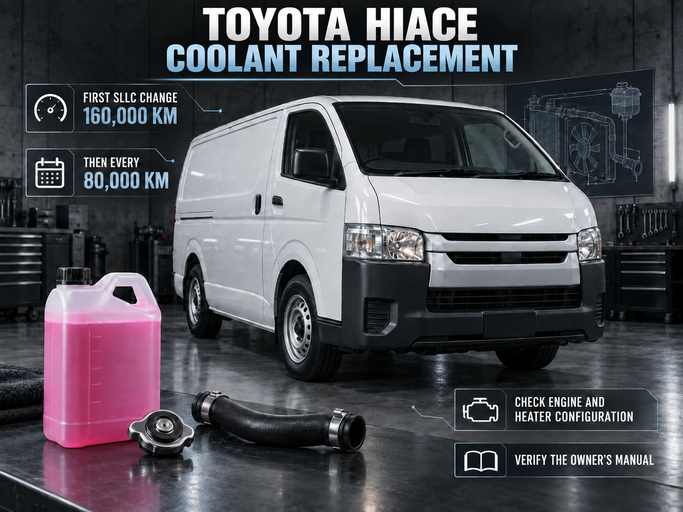
For a Toyota Hiace filled at the factory with Toyota Super Long Life Coolant, the baseline is a first replacement at 160,000 km, followed by 80,000 km intervals. Leaks, contamination or cooling-system repairs require earlier attention. Capacity varies with generation, engine, body and rear-heater equipment, so confirm the specification by VIN.
When a Hiace Needs Attention Before the Scheduled Replacement
A long coolant interval does not remove the need for routine inspection. In a working van, coolant temperature is affected by payload, extended idling, route conditions and the number of heater circuits. Check the cold level, fluid clarity, cabin heat and gauge behaviour under comparable operating conditions.
- The service history is not supported by records. Topping up does not renew the entire charge: old fluid remains in the engine water jacket, radiator and long heater pipes. Before mixing products, identify the engine code and supply market, determine what coolant is already present and check the system for leaks. Matching colours do not prove chemical compatibility.
- The level falls again after a top-up. On a Hiace, leaked coolant may not reach the ground because underbody panels, crossmembers and hot components can retain or evaporate it. Look for dried pink residue around hose clips, the water pump, cap, radiator and heater connections. Repeated loss calls for a pressure test rather than another top-up.
- The coolant has turned cloudy or contains sediment, foam or an oily film. These signs can point to contamination, an incompatible mixture or an internal fault. Colour alone cannot show remaining service life, but flakes, separated layers or persistent foam are reasons to stop adding chemicals and diagnose the system.
- The front and rear of the cabin warm up differently. Air trapped in the long heater circuit, a low level, a restricted hose or weak circulation may be responsible. If the difference appeared immediately after repair work, first confirm that the pipes were fully filled and that the specified bleeding procedure was completed.
- Temperature rises with a full load, on a long climb or in slow traffic. Inspection should cover the fan, pressure cap, thermostat, pump and heat-exchanger surfaces. Petrol and diesel versions require different reference values, so compare scan data with the specification for the exact engine.
How to Check the Level Safely
Park on level ground and allow the engine to cool completely. Coolant in the expansion tank should sit between FULL and LOW, or between the marks shown on the tank fitted to that version. If the level is low, add only a compatible product and find the cause of the loss. Never open a hot cap because the system is pressurised.
What Old or Incompatible Coolant Can Damage
Serviceable coolant transfers heat, protects metal surfaces and supports lubrication of the pump seal. As the additive package depletes, corrosion protection falls even though the vehicle may still show a normal temperature in light use. Mixing different chemistries makes the result less predictable because appearance does not reveal how the blend will react with aluminium, steel and elastomers.
- Corrosion often starts out of sight. Narrow radiator passages, joints and heater pipes can deteriorate without leaving a clear puddle under the van. A smell or dried deposit may appear first, followed by faster level loss. Oxide particles then circulate through the remaining components.
- Deposits reduce the effective heat-transfer area. Hard water, sealing compounds and incompatible additives can coat the radiator and engine passages. The fault may remain hidden in an empty van, then reduce cooling reserve at maximum mass or during prolonged air-conditioning use.
- The water pump and thermostat are forced to work under poor conditions. Weak lubrication, cavitation and abrasive particles accelerate seal wear. A thermostat that does not open fully, or a damaged pump impeller, may allow normal readings around town while temperature climbs on a sustained ascent.
- Air left after filling interrupts circulation. A Hiace with a rear heater has a longer coolant path, so a full expansion tank does not prove that every pipe is free of air. The level can fall after the first heat cycle and complete cool-down. Recheck it and test both heaters across their fan-speed range.
- Continuing to drive after an overheating warning can sharply increase the repair bill. Published UAE workshop price lists show that a minor leak repair may start near AED 300, radiator work near AED 500–800 and cylinder-head-gasket work from about AED 2,000. The final cost for a commercial Hiace depends on the engine, parts availability and damage found during diagnosis.
Choosing Coolant for a Toyota Hiace
The default product is premixed Toyota Super Long Life Coolant, containing 50% coolant and 50% deionised water. An alternative must fully meet Toyota requirements: an ethylene-glycol base, no silicates, amines, nitrites or borates, and long-life hybrid organic acid technology. Do not select a product by pink colour alone. Do not dilute premix with water or add third-party additives.
Select the relevant document from Toyota’s manuals catalogue by model year, engine and supply market. The instruction for the exact vehicle takes priority over a universal claim on the container because the Hiace name covers several generations and different cooling systems.
Toyota Coolant Schedule and Reference Capacities for the Hiace
The current Hiace range includes 2.7- and 3.5-litre petrol engines as well as a 2.8-litre diesel. The table gives planning references found across H200 and H300 documentation. They do not replace a model-code check: body type, rear-heater equipment, production update and installed equipment can change the actual capacity.
| Item | Hiace H200 reference example | Hiace H300 reference examples |
|---|---|---|
| First SLLC replacement | 160,000 km* | 160,000 km* |
| Later replacements | Every 80,000 km* | Every 80,000 km* |
| Engine circuit | 2TR-FE 2.7 L: about 11.2–11.6 L* | 7GR-FKS 3.5 L: about 13.2–13.9 L; 1GD-FTV 2.8 L: about 10.5–13.1 L |
| What changes capacity | Body, year, transmission and heater circuit | Engine, body and rear-heater equipment |
| Factory coolant | Toyota SLLC, premixed 50/50 | Toyota SLLC, premixed 50/50 |
| Acceptable alternative | A full chemical equivalent to Toyota requirements | A full chemical equivalent to Toyota requirements |
* The 160,000 km and 80,000 km intervals apply to systems originally filled with Toyota SLLC in the service schedules considered here. Capacities are reference ranges for common Hiace configurations. Before buying coolant, verify the VIN, engine code, model code, market, body and rear-heater equipment.
Why Body and Heater Equipment Change Capacity
A standard van, High Roof, Commuter and converted vehicle may use different pipe lengths and heat exchangers. A rear heater adds its own pipes and core, so the same engine can have more than one cooling-system capacity. Air conditioning alone should not be treated as proof that an additional liquid heater is installed.
Total system capacity also differs from the amount that drains through one plug. Coolant remains in the block, heaters and hoses. During routine replacement, follow the procedure for the vehicle. After a repair or flush, confirm concentration and cold level from the actual fill instead of forcing the full nominal quantity into the system.
Old Coolant and Hiace Overheating Risk in the UAE
A Hiace in the UAE often works with a full passenger or cargo load, the air conditioner running and long periods at low road speed. At speed, the radiator receives direct airflow; in queues and during idling, cooling depends more heavily on the fan and clean heat exchangers. Sand, dust and small debris can collect between the condenser and radiator while remaining difficult to see from the front. Old coolant is not the only cause of overheating, but depleted additives, deposits and incorrect concentration reduce the available thermal margin. On refrigerated or converted vehicles, also check whether added equipment restricts airflow.
| Problem | Change inside the system | Possible consequence |
|---|---|---|
| Depleted additives | Less protection for metals and seals | Corrosion in passages and joints |
| Mineral deposits | Heat transfer through surfaces declines | Temperature rises under load |
| Incorrect concentration | Boiling and corrosion margins shrink | Unstable operation in high heat |
| Mixed coolant technologies | Sediment, flakes or thickening may form | Restricted flow through the radiator |
| Air in the heater circuit | Coolant reaches only part of the pipework | Weak heating and local hot spots |
| Cavitation and abrasive debris | Pump impeller and seal wear accelerate | Leakage or insufficient circulation |
How to Set the Next Service Point
- A repair order confirms a full coolant replacement. Count the next interval from the recorded odometer reading and retain the date, product name and work performed. The record should state whether only the main circuit was serviced or the rear-heater lines were flushed as well.
- There is no reliable replacement record. First note the engine code, body model and odometer reading, then assess leakage, concentration and fluid condition. A handheld tester measures only selected properties and cannot show the remaining level of every additive, so the decision should combine history with system diagnosis.
- The radiator, pump, thermostat or a hose was replaced recently. Confirm how much coolant was removed, which product restored the level and whether the prescribed bleeding routine was completed. A partial refill after repair does not automatically reset the date of a full coolant service.
- Oil, heavy sediment or an unknown mixture is present in the tank. Identify the source of contamination before choosing a flushing method. Replacing the coolant without correcting the fault may improve its appearance briefly, but it does not restore the system to proper condition.
Checks Before Replacement
- Identify the generation, model year, engine code and model code. Labels such as “Hiace 2.7” or “Hiace 3.5” are not precise enough because vehicles can belong to different body families, use different heater equipment and require different bleeding procedures.
- Check every liquid heater circuit. Warm air from the front does not prove that a rear circuit is full and free of air. In a passenger body, compare output from the front and rear vents after the engine reaches operating temperature.
- Inspect the system before draining it. Photograph the cold level, examine connections in the engine bay and under the body, and look for dried coolant around the pump, radiator, cap and heater junctions.
- Verify the complete product specification. Do not select coolant only by colour, dilute ready-mixed SLLC or combine it with a universal product unless chemical compatibility is confirmed.
- Work only on a completely cold engine. Use the drain points, filling sequence and air-removal method specified for the exact model code.
- After warm-up, confirm stable temperature, operation of every heater and the absence of leaks. Set the final level only after complete cool-down because hot coolant expands and produces a different reading.
Checks Between Services
- Compare the level in the morning on the same level surface. For a working vehicle, take a reference photo after service and repeat it after several routes. This makes a slow loss easier to identify without confusing it with thermal expansion or body angle.
- Keep the heat-exchanger fins clean and monitor hoses and fan operation. After dusty-site use, inspect the space between heat exchangers and clean it without bending the fins. If the van regularly works at maximum mass, tows or idles for long periods with the air conditioner on, shorten the interval between visual checks without presenting it as a new factory coolant-replacement interval.
Conclusion
For a Hiace using SLLC, use 160,000 km as the first replacement reference and 80,000 km thereafter. Before purchase, compare the engine, heater equipment and service history with current listings. Diagnose unknown coolant before relying on it.


