


Which Fortuner engine should you choose: 2.7, 4.0 V6 or diesel?
Toyota Fortuner
Toyota Fortuner•
•25 просмотров
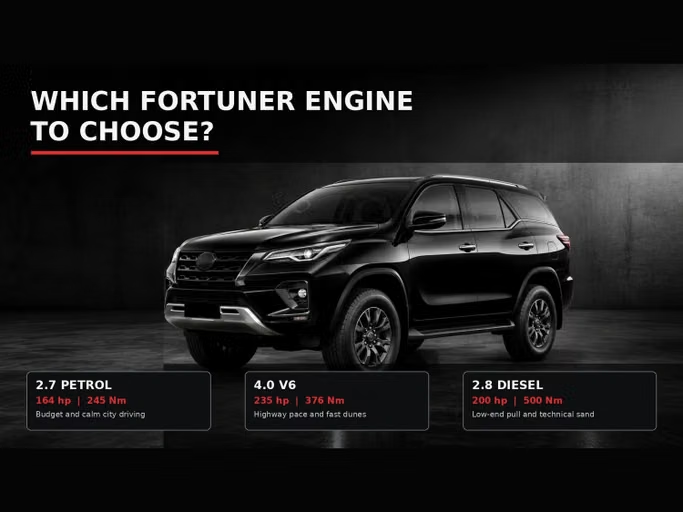
Three personalities in one SUV: the economical 2.7, the versatile V6 and the torque-rich diesel.
Choosing an engine for the Toyota Fortuner is not about deciding which powertrain is good or bad. The right answer depends on how the vehicle will be used. The 2.7-litre petrol engine keeps the purchase price down and suits relaxed city driving. The 4.0-litre V6 feels more confident on motorways and with a full load. The 2.8-litre diesel produces the most torque and is convenient where low-speed traction matters.
In the UAE, heat, constant air-conditioning use, high-speed motorways and sand also influence the choice. The practical comparison below avoids a one-size-fits-all answer: it explains who can live with the 2.7, when the V6 is worth the extra cost and where the diesel performs best.
All prices are approximate and based on market data available at the time of writing. Actual prices depend on model year, trim, mileage and vehicle condition.
Fortuner engines at a glance
- 2.7 petrol — for a limited budget, relaxed city driving and low annual mileage. Its strengths are simplicity and more affordable maintenance; its weakness is modest reserve power for overtaking and driving with a full load.
- 4.0 V6 — for motorway driving, frequent trips with passengers, confident overtaking and fast dune driving. It is the most versatile option, although stronger performance comes with higher fuel consumption.
- 2.8 diesel — for low-rpm torque, long journeys, towing and technical off-road driving. It uses fewer litres of fuel but demands more attention to the fuel system, cooling system and operating conditions.
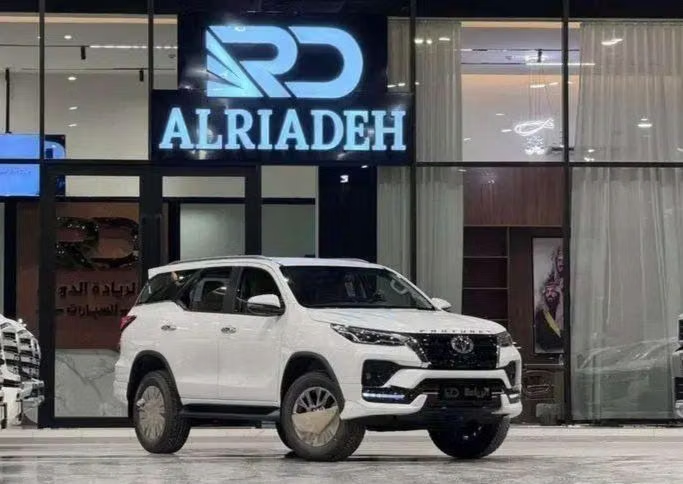
Toyota Fortuner 2.8 Diesel: 200 hp, 500 Nm and four-wheel drive.
Is the Fortuner V6 worth the extra cost?
Yes, if you regularly use the capabilities of a large body-on-frame SUV. On Sheikh Zayed Road, the E11 and intercity motorways, the V6 accelerates more comfortably beyond 100 km/h, overtakes with greater confidence and feels less strained with a full load. The 2.7 also gains speed, but it needs more time and more frequent downshifts.
According to toyota.ae, the Fortuner 2.7 produces 164 hp and 245 Nm, while the 4.0 V6 delivers 235 hp and 376 Nm. The difference is noticeable beyond acceleration alone. The V6 needs high revs less often, so it works more effortlessly under the same load.
When does the V6 justify the premium?
- Frequent motorway driving. There is enough power for quick lane changes and overtaking without a long run-up.
- A full load. With passengers, luggage and the air conditioner running, the difference from the 2.7 becomes especially clear.
- Regular desert trips. The V6 maintains speed more easily on soft sand and regains momentum more quickly after a climb.
- Long-term ownership. The naturally aspirated 1GR-FE is known for longevity; vehicles with a transparent service history often exceed 400,000 km without an engine overhaul.
When is the 2.7 the more sensible option?
If the vehicle spends most of its time in the city, normally travels without a full load and will not be used for serious desert driving, the V6's potential may go unused. In relaxed driving, the 2.7 handles everyday tasks while costing less to buy and service.
A realistic combined-consumption reference is about 11–13 L/100 km for the 2.7 and 13–15 L/100 km for the V6; in dense urban traffic, the V6 may use 14–16 L/100 km. Actual consumption depends on tyres, load, speed, traffic and driving style.
For new vehicles, the price gap between the 2.7 and 4.0 versions is around AED 26,000, while on the used market it often falls within AED 15,000–25,000. Before deciding, compare vehicles of the same year and a similar specification: differences in trim and condition can outweigh the engine premium.
Which Fortuner engine is more reliable — the 2.7 or 4.0 V6?
Both petrol engines are successful naturally aspirated Toyota units. Both use timing chains and avoid a turbocharger and complex diesel injection equipment. Under demanding conditions, however, they operate under different loads.
- Power and torque. The 2.7 produces 164 hp and 245 Nm, while the 4.0 V6 delivers 235 hp and 376 Nm. The V6 has substantially more reserve for overtaking, climbs and a full load.
- Performance under load. The four-cylinder 2.7 needs to be held at higher revs more often. The V6 completes the same work more comfortably and operates near its limit less frequently.
- Scheduled maintenance. The 2.7 costs less because it requires less oil and fewer spark plugs. Consumables for the V6 are more expensive, although service intervals are comparable.
- Age-related weak points. On high-mileage 2.7 engines, check oil consumption and compression. On the V6, inspect the water pump, ignition coils, gaskets and cooling-system condition.
- Service life. Both engines can cover high mileages with regular maintenance, but the V6 copes better with the sustained load of a heavy SUV.
4.0 V6: long service life with proper maintenance
The 1GR-FE engine is also used in the Land Cruiser Prado. It is valued for its robust design and ability to operate reliably in a hot climate when the cooling system is maintained. Typical age-related expenses include the water pump, coils and rubber seals.
The V6 has six spark plugs, a larger oil capacity and higher fuel consumption, so routine maintenance costs more. Its reserve power, however, reduces the need to keep the engine under constant strain on motorways and with passengers aboard.
2.7: simpler and cheaper, but more often pushed to its limit
The four-cylinder 2TR-FE can also cover high mileages. Maintenance is cheaper: fewer spark plugs, less oil and easier access to components. The Fortuner is heavy, however, so the engine often has to run at high revs during overtaking, climbs or sand driving.
If choosing between two vehicles in the same condition for long-term ownership, the V6 is preferable. If the budget is limited and the vehicle is intended for relaxed city use, a well-maintained 2.7 is a more rational choice than a neglected V6.
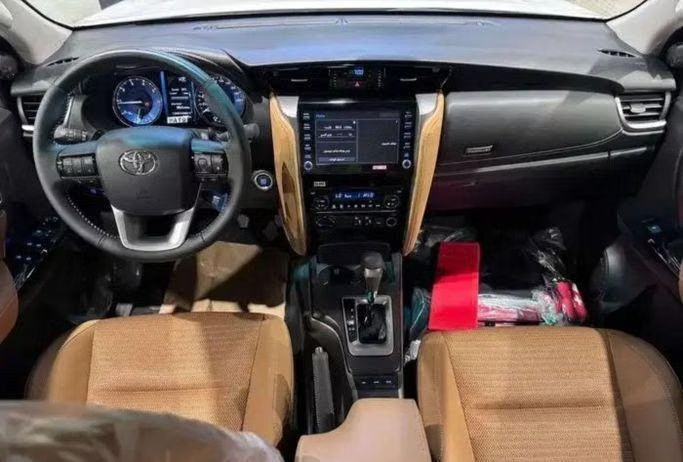
Before buying, look beyond the odometer: check for fault codes, monitor engine temperature and assess transmission operation on the road.
Which Fortuner engine is best for off-road driving?
Desert driving involves two distinct modes. The first is slow, technical progress, where the vehicle carefully negotiates soft sections and climbs. The second is fast dune driving, where maintaining momentum is critical. Different engines suit these tasks.
2.8 diesel: torque from low revs
In its current version, the 1GD-FTV turbodiesel produces about 200 hp and 500 Nm. Torque is the turning force the engine sends to the wheels. The earlier its strong torque becomes available, the easier it is for the vehicle to move off under load and crawl through a difficult section without excessive revs.
This makes the diesel convenient on slow sandy sections, rocky tracks and when towing. It does not tolerate neglected maintenance, however. In hot weather, clean radiators, a properly functioning intercooler, suitable oil and timely fuel-filter replacement are especially important.
For a more specific reference, consult the Toyota Fortuner II Facelift generation catalogue. In this version, the 2.8-litre diesel produces up to 200 hp and 500 Nm and is paired with four-wheel drive. This combination is designed for pulling power and sustained load rather than sports-car acceleration.
4.0 V6: the best choice for fast dunes
On soft sand, speed can matter more than idle-speed torque. The V6 revs freely, recovers engine speed faster after a gear change and helps preserve momentum on a climb. It is the most predictable option for dune bashing and dynamic desert trips.
Reserve power does not remove the need for preparation: reduce tyre pressure, monitor temperature, disable intrusive electronic aids only when necessary and never enter the desert alone.
Why is the 2.7 unsuitable for serious sand driving?
The 2.7 can handle light dirt roads and access tracks to a campsite. On deep dunes, however, it lacks reserve power and torque: the driver holds high revs for longer, the transmission shifts more often and temperatures rise. If desert trips are more than an occasional outing, the 2.7 is the weakest option of the three.
The practical choice is simple: choose the diesel for slow, controlled off-road driving and the V6 for speed and excitement on the dunes.
The seven-seat cabin increases the load on the engine: with passengers aboard, the difference between the 2.7 and the more torque-rich versions becomes clearer.
2.8 diesel or 4.0 V6 — which uses less fuel?
Measured in litres, the diesel wins convincingly. In real-world use, a Fortuner 2.8 typically consumes about 10–11 L/100 km in the city and 8–9 L/100 km on the motorway. The 4.0 V6 uses approximately 14–16 L/100 km in the city and 11–12 L/100 km on the motorway.
The cost per kilometre depends on more than consumption. In the UAE, diesel can cost more than Special 95 petrol. For example, in August 2026, according to emarat.ae, diesel was AED 3.80 per litre and Special 95 was AED 3.49 per litre. At these prices, 100 urban kilometres cost roughly AED 40–42 in the diesel and AED 49–56 in the V6. The diesel retains an advantage, but it is smaller than a comparison of litres alone suggests.
What changes the total cost of ownership?
- The diesel saves fuel, particularly on motorways and at high annual mileages.
- Diesel maintenance costs more because high-quality oil, fuel filters, injectors, the turbocharger and, on some versions, the diesel particulate filter all require attention.
- The V6 consumes more petrol, but its naturally aspirated design is simpler and more predictable over long-term ownership.
- Low annual mileage reduces the diesel's benefit. If the vehicle covers 10,000–15,000 km a year, one major fuel-system repair can erase the fuel savings.
The diesel suits a driver who covers long motorway distances, tows or regularly needs strong torque. For mainly short urban trips and moderate annual mileage, the V6 is often the more straightforward ownership proposition.
Which Fortuner should you choose?
- For the lowest purchase price, choose the 2.7 if you accept relaxed performance and do not plan serious off-road driving.
- For a versatile long-term Fortuner, look for a 4.0 V6 with a documented history. It is better suited to motorways, full loads and fast dunes.
- For strong pulling power and high annual mileage, consider the 2.8 Diesel, but carefully inspect the fuel system, turbocharger, cooling system and emissions equipment.
For most UAE owners, the V6 remains the sweet spot: it is substantially quicker than the 2.7 and more straightforward to maintain than a modern diesel. The best vehicle is not necessarily the most powerful, however. Compare prices, mileage and service history first, then select the engine that matches your actual routes and needs.


