


Toyota Corolla Coolant Replacement: Intervals, Capacities and Diagnosis
Toyota Corolla
Toyota Corolla•
•35 просмотров
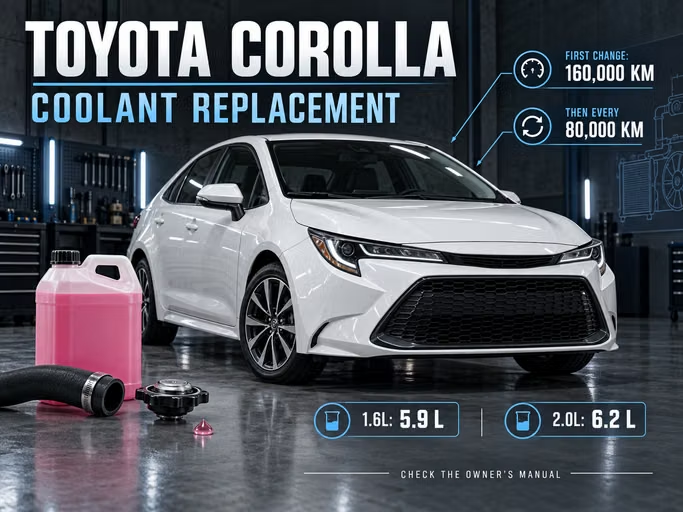
For a Toyota Corolla factory-filled with Toyota Super Long Life Coolant, the first scheduled replacement is at 160,000 km, followed by 80,000 km intervals. A leak, contamination or cooling-system repair calls for earlier inspection. Capacity depends on the engine, so current 1.6- and 2.0-litre versions require different quantities.
When a Corolla Needs Attention Before the Scheduled Change
The long service life of SLLC does not eliminate routine checks. An urban saloon sees repeated warm-ups, extended time in slow traffic and heavy air-conditioning use at low road speed. Assess more than mileage: compare the cold level, fluid clarity, heater consistency, fan operation and temperature behaviour under repeatable conditions.
- There is no documented service history. A note about a top-up does not prove that the complete charge was replaced because old fluid remains in the block, radiator and heater core. Before adding a product, identify the model year, engine code and supply market, then establish what is already in the system. A similar pink colour does not demonstrate chemical compatibility.
- The level drops again after replenishment. A small Corolla leak can dry on a hot engine surface or collect on the lower shield without marking the parking space. Look for crystalline residue around the pump, clips, hoses, radiator, cap and reservoir. Repeated loss requires pressure testing rather than a series of top-ups.
- The fluid has become cloudy or contains flakes, persistent foam or an oily film. This appearance may indicate mixed chemistries, corrosion or an internal fault. Colour alone does not measure remaining service life, but separation and visible contamination are reasons to stop adding chemicals and diagnose the circuit.
- Cabin heat has become inconsistent. Air that suddenly cools without a change in settings can point to a low level, trapped air or weak circulation. Pay particular attention after replacement of a radiator, pump, thermostat or hose: a full reservoir does not prove that every passage has been bled.
- Temperature rises in congestion but remains steady on the highway. Check the fan, the gap between the air-conditioning condenser and radiator, the pressure cap, thermostat and water pump. Scan data can relate actual coolant temperature to the fan command and help rule out a misleading sensor signal.
How to Check the Level Safely
Park the Corolla on level ground and let the engine cool completely. Coolant in the reservoir should sit between FULL and LOW. If it is below the normal range, add only a compatible product and investigate the loss. Never remove a hot cap because system pressure can release steam and boiling coolant.
What Aged or Incorrect Coolant Does Inside the System
Coolant does more than carry heat. It protects aluminium and steel components, discourages deposits and supports water-pump seal operation. When its additive package is depleted, or incompatible products share the same circuit, deterioration begins in narrow internal passages. Temperature can still look normal on an easy journey even though the safety margin has already diminished.
- Corrosion usually begins out of sight. Damage at a joint, heater pipe or radiator edge may first produce an odour or dry stain rather than a visible puddle. Oxide particles remain in circulation, contaminate the thermostat and radiator passages, and then accelerate wear elsewhere.
- Mineral scale reduces heat transfer. It can follow the use of hard water, an unsuitable concentrate or an unapproved sealing compound. Even a thin internal layer makes the fan work more often. High ambient temperature and continuous air-conditioning expose the restriction sooner than cool weather does.
- The water pump is sensitive to both coolant condition and trapped air. Cavitation bubbles, abrasive material and reduced lubrication damage its working surfaces and seal. A weak pump may hold normal temperature at a steady cruise yet allow it to climb on a long grade or during slow traffic.
- An air pocket disrupts circulation after repair work. Some passages receive an unstable flow, the heater output fluctuates and the level falls after the first complete heat cycle. Judge the result only after the specified bleeding process and a second cold check, not immediately after pouring coolant into the reservoir.
- Driving on after a red warning can turn a minor defect into major engine work. Excess heat can distort the cylinder head, damage the gasket and reduce oil protection. Stop safely, switch the engine off and allow it to cool. Do not open a hot cap or pour cold water into a heat-soaked engine.
Toyota-Recommended Coolant for a Corolla
The standard choice is premixed Toyota Super Long Life Coolant containing 50% coolant and 50% deionised water. An alternative must be a high-quality ethylene-glycol product that is non-silicate, non-amine, non-nitrite and non-borate, using long-life hybrid organic acid technology. Do not choose by colour alone. Do not dilute a premix or supplement it with aftermarket additives.
Select the document for the exact model year, engine and supply market from Toyota’s catalogue of manuals. The vehicle specification takes precedence over a universal statement on a container because a single Corolla generation can include different engines, transmissions and filling procedures.
Official Toyota Corolla Coolant Intervals and Capacities
The 2026 Corolla range in the UAE includes 1.6- and 2.0-litre petrol versions. The official document gives a 5.9-litre reference capacity for the GCC-market 1ZR-FE and 6.2 litres for the M20A-FKS. These figures describe the complete system and help plan the supply, but the amount accepted during service depends on how much old coolant was actually removed.
| Parameter | Corolla 1.6 | Corolla 2.0 |
|---|---|---|
| Engine in the manual | 1ZR-FE, GCC specification | M20A-FKS |
| First SLLC replacement | 160,000 km* | 160,000 km* |
| Later replacements | Every 80,000 km* | Every 80,000 km* |
| System capacity, reference | 5.9 L* | 6.2 L* |
| Factory coolant | Toyota SLLC, 50/50 premix | Toyota SLLC, 50/50 premix |
| Permitted alternative | A full chemical equivalent to Toyota requirements | A full chemical equivalent to Toyota requirements |
* The schedule places the first factory SLLC replacement at 160,000 km and later replacements every 80,000 km. The 5.9- and 6.2-litre values apply to the stated engines in the regional Corolla manual. Check a different model year, market, generation or hybrid powertrain separately by VIN and model code.
Why the Engine Version Matters
The 1.6-litre 1ZR-FE and 2.0-litre M20A-FKS differ in engine architecture, water-jacket volume and hose layout. A few hundred millilitres may sound insignificant, yet it can make a one-container purchase an incorrect estimate. Allow enough material for controlled filling, the follow-up check and the small loss that can occur during bleeding.
Complete system capacity is not the same as the amount released from one drain point. Fluid remains in the block, heater core and hoses. During routine replacement, do not force the nominal litre figure into the vehicle. Follow the procedure, account for the amount drained and set the final level after a full warm-up and cool-down cycle.
Why a Corolla May Overheat in UAE Conditions
High ambient temperature, dense urban traffic and continuous air-conditioning reduce the cooling system’s available reserve. At speed, ram air assists the radiator; at low speed, fan performance and clean heat exchangers matter more. Sand and fine dust can accumulate between the condenser and radiator while remaining invisible through the grille. Aged coolant is seldom the only cause of overheating, but deposits, incorrect concentration and weakened metal protection amplify the effects of restricted fins, a weak fan or a thermostat that does not open fully.
| Problem | Change inside the system | Possible consequence |
|---|---|---|
| Depleted additives | Protection of metals and seals weakens | Corrosion in passages and joints |
| Mineral deposits | Heat transfer through surfaces declines | Temperature rise under load |
| Incorrect concentration | Boiling and corrosion margins shrink | Unstable operation in high heat |
| Mixed coolant technologies | Flakes, sediment or thickening may develop | Restricted flow through the radiator |
| Air after filling | Some passages receive an unstable flow | Weak cabin heat and local hot spots |
| Cavitation and abrasive debris | Pump impeller and seal wear accelerate | Leakage or insufficient circulation |
How to Set the Next Service Point
- A repair order confirms a full replacement. Count the next interval from its odometer reading and retain the date, product name, engine identification and job scope. It is useful to record whether the system was flushed, whether the cap was renewed and whether the specified air-removal sequence was completed.
- There is no reliable replacement record. First note the engine code and cold level, inspect the circuit, assess clarity and test concentration. A handheld tester can indicate density or freeze protection, but it cannot report the condition of every additive. Base the decision on history, physical evidence and the risk of an unknown mixture.
- The radiator, pump, thermostat or a hose was changed recently. Confirm how much fluid was removed, which product restored the level and whether the work constituted a complete service. A partial refill after a local repair does not automatically reset the replacement interval for the entire charge.
- Oil, heavy sediment or an unidentified blend is visible in the tank. Find the contamination source and assess seals, heat exchangers and passages before choosing a cleaning method. Flushing without correcting the cause may improve appearance briefly, but it does not restore sealing or normal heat transfer.
Checks Before Coolant Replacement
- Identify the model year, market, generation, model code and engine. “Corolla 1.6” or “Corolla 2.0” is not precise enough when a vehicle was imported from another region or belongs to a different generation. Match the VIN to the correct document before purchasing coolant.
- Confirm the powertrain type. A hybrid Corolla may use a separate liquid circuit for its power electronics in addition to engine cooling. Do not combine capacities or apply a petrol-only filling method to a hybrid without checking the corresponding documentation.
- Inspect before draining. Photograph the cold level and examine the reservoir, cap, connections, pump and lower shield. Pink residue, a damp seam or a distinct odour can provide useful diagnostic evidence that disappears after the engine bay is washed.
- Verify the complete product specification. Do not select antifreeze by shade alone, dilute ready-mixed SLLC or combine it with a universal product unless chemical compatibility has been established.
- Work only on a completely cold engine. Use the specified drain points and filling order. Collect the old fluid in a sealable container: it is toxic, and its sweet smell makes careless storage particularly hazardous to animals.
- After filling, warm the vehicle according to the prescribed routine and confirm stable temperature, consistent heater output and leak-free operation. Establish the final level only after complete cool-down. If it falls again, do not treat the loss as normal consumption.
Monitoring Between Replacements
- Compare the level in the morning on the same level surface. A photograph taken after service provides a useful baseline. A slight change with temperature or body angle can occur, but a persistent downward trend requires inspection of the connections and a pressure test.
- Keep the heat-exchanger stack clean and monitor the hoses, pressure cap and fan. Remove dust after severe conditions without bending the delicate fins. If the warning appears, steam is visible, a strong smell develops or the heater suddenly turns cold, stop driving and allow the system to cool before diagnosis.
Conclusion
For a Corolla using SLLC, use 160,000 km for the first replacement and 80,000 km thereafter. Before buying, match the engine, system capacity and service history against current listings for Toyota Corolla models.


