


How Often Should You Change Toyota Corolla Brake Fluid?
Toyota Corolla
Toyota Corolla•
•29 просмотров
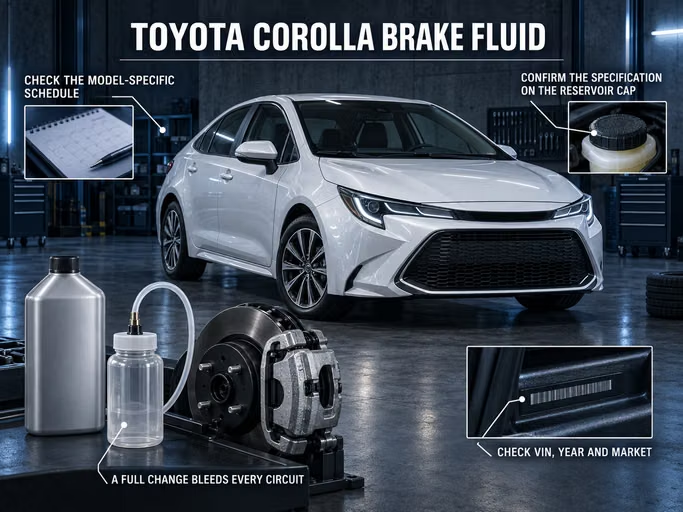
There is no single interval for every Toyota Corolla. Some regional schedules specify a full change at 40,000 km or 24 months, but that figure should be used only after checking the VIN, model year and original market. The fluid level, system integrity and brake operation should be inspected at every scheduled service.
When Does a Corolla Need an Unscheduled Check?
A maintenance interval assumes that the hydraulic system is healthy. A new pedal symptom or a falling fluid level calls for diagnosis rather than waiting for the next service.
- The pedal travels noticeably farther before firm braking begins, or resistance develops later than it used to.
- The pedal feels soft on the first application but firms up after several quick presses. Air or another hydraulic fault may be present.
- The red brake-system warning remains on after the parking brake is released, or a brake malfunction message appears.
- The reservoir level drops again after a top-up. Pad wear can lower it gradually, but repeated loss requires a leak inspection.
- Pedal travel increases after a long descent or repeated stops and returns to normal only after cooling.
- The reservoir contains haze, particles or traces of an unknown fluid. Colour alone does not measure service life, but visible contamination must be investigated.
What Happens to Brake Fluid Over Time?
The glycol-based fluids used in most Corollas gradually absorb moisture through reservoir ventilation, seals and flexible hoses. Braking may still feel normal in town while the safety margin under high heat is shrinking.
- Moisture builds with time, so infrequent use does not stop the fluid from ageing.
- The boiling margin falls where the fluid is hottest, close to wheel cylinders and calipers.
- Vapour can compress under pressure, increasing pedal travel and making the response less consistent.
- Water and contamination encourage corrosion inside cylinders, passages and precise ABS valves.
- A top-up restores the reservoir level but does not renew the fluid in the lines or explain why the level fell.
Toyota Corolla Interval and Fluid Specification
Where a version’s service schedule specifies 40,000 km or 24 months, whichever comes first applies. This is not a universal Corolla interval: requirements can differ by country, generation and model year.
Confirm the fluid grade in the owner’s manual for the exact car and on the reservoir cap. Even if a similar Corolla uses DOT 3 or DOT 4, do not transfer that choice without verification because brake-system specifications vary.
| Item | Working reference | What to confirm |
|---|---|---|
| Inspection | At every scheduled service | Level, leaks, warning messages and pedal response. |
| Replacement | 40,000 km or 24 months only when specified for that version | The interval by VIN, model year, market and vehicle documents. |
| Specification | Reservoir cap and owner’s manual | Do not choose a DOT grade from a similar variant or by fluid colour. |
| Hybrid | Version-specific procedure | Whether ABS/electronically controlled braking requires a service mode. |
| Quantity | No universal figure | Enough new fluid to displace the old fluid from every specified circuit. |
How Do You Choose the Correct Fluid?
An exact specification match matters more than price, brand or a headline boiling-point claim. Use only fresh fluid from a sealed container with legible markings.
- Confirming the standard by VIN, owner’s manual and reservoir cap.
- Avoiding selection by colour, which does not define chemistry or compatibility.
- Keeping silicone DOT 5 out of a system designed for glycol-based fluid.
- Avoiding a higher-numbered grade unless the vehicle documentation permits it.
- Opening the container immediately before use and discarding long-stored leftovers.
- Rinsing spilled fluid off paint with clean water promptly instead of wiping it across the surface.
How Does Corolla Use Affect the Brakes?
A compact sedan may spend far more time in stop-and-go traffic than its odometer suggests. Braking frequency, long descents and ambient temperature shape the heat load as much as distance does.
Petrol and Hybrid Versions
A Corolla Hybrid uses regenerative braking for part of its deceleration, so the friction brakes may operate less often. That does not remove hydraulic maintenance: the fluid continues to age, while the friction hardware and electronically controlled braking system still need inspection. Some versions require a service mode for bleeding, so a petrol Corolla procedure must not be assumed to suit a hybrid.
Heat, Humidity and Urban Driving
- Repeated stops in dense traffic allowing less time for discs and calipers to cool.
- Holding the pedal continuously on a long descent heating the system faster; use an appropriate gear and brake in controlled intervals.
- High ambient temperature reducing cooling reserve without creating a separate official interval by itself.
- Humidity making calendar time important even when annual mileage is low.
- Cleaning dust from around the reservoir before opening it so particles cannot enter the hydraulic system.
What Does a Full Fluid Change Include?
A complete service displaces the old fluid through the specified bleed points in every circuit. Extracting fluid only from the reservoir renews a small portion and is not a full bleed.
- Identify the car by VIN, generation, model year, market and powertrain.
- Inspect the reservoir, master cylinder, pipes, hoses, unions, calipers, wheel cylinders, discs, drums and pads.
- Repair leaks and mechanical faults before introducing new fluid.
- Follow the bleed order and service mode specified for that ABS or electronically controlled braking system.
- Bleed every required circuit while maintaining the reservoir level and preventing air entry.
- Check for a stable level, dry unions, no warnings and consistent pedal travel after the work.
Can You Do It Yourself?
On a modern Corolla, bleeding may depend on the ABS design, electronic parking brake and hybrid system. A wrong sequence can trap air in the actuator. Without the exact VIN-specific procedure, do not open bleed screws, start service modes or allow the reservoir to run dry; a workshop with suitable diagnostic equipment is the safer option.
What Should You Check on a Used Corolla?
Low mileage does not prove that the fluid is fresh, and a receipt saying “brake service” may not confirm a complete bleed. Match the records to the car’s actual condition.
- Requesting an invoice with the date, mileage and a clear description of a full change rather than a top-up.
- Checking whether the level falls over several drives and looking for damp marks at unions and calipers.
- Comparing pedal travel through repeated applications while stationary and during a short, safe road check.
- Comparing pad and disc wear with the recorded mileage; an unusual mismatch deserves further diagnosis.
- Checking hybrid warning messages and evidence that the correct service mode was used.
- Confirming a complete bleed after replacement of an actuator, master cylinder, hose or caliper.
Common Service Mistakes
- Replacing only the reservoir contents while leaving old fluid in the lines.
- Judging condition by colour alone and ignoring calendar age.
- Filling above MAX without considering pad wear and piston retraction during pad replacement.
- Copying a DOT grade or bleed sequence from a Corolla of another year, market or powertrain.
- Mixing leftovers from containers that have been open for a long time.
- Blaming increased pedal travel on heat or traffic and postponing a leak check.
Conclusion
Start with the schedule for the exact Toyota Corolla. Use 40,000 km or 24 months only where that interval is explicitly specified, and inspect the brake system at every service. Confirm the fluid by VIN, owner’s manual and reservoir cap, and complete a full change by bleeding every required circuit.
Current listings for Toyota Corolla make it easier to compare model years, source markets and powertrains; brake condition still has to be judged from the individual car, its records and a proper inspection.


