


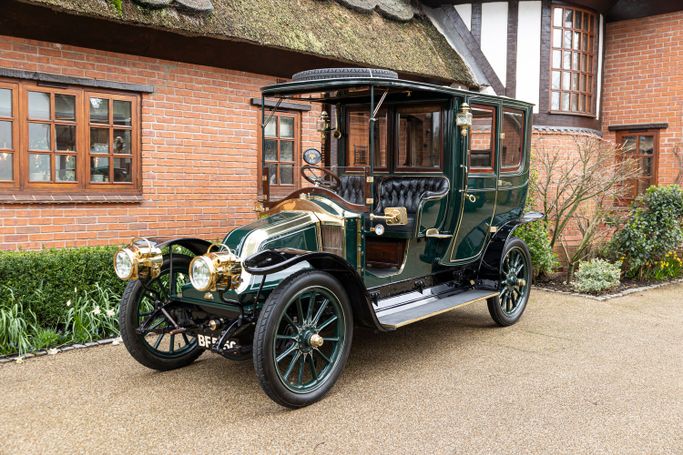
Renault Type BX 14/20hp Limousine, 1909
Renault 14
Renault 14•
•26 просмотров
Chassis No.: 359
Engine No.: 3384
£64,400 GBP | Sold
- Rare surviving mid-Edwardian Renault
- Delivered new in Paris and exported to Argentina
- Restored in the 1990s
From the outset Renault engineering was of the highest quality and the arrival of multi-cylinder models really put the company on the map. By 1904 Renault was building its own engines: large-capacity fours at first, followed by the AX twin that later developed into the AG, famous for its WWI role as the 'Taxi de la Marne'. Messrs Renault Frères exhibited five different models at Olympia in 1905, ranging from the twin-cylinder 8/12hp AX to the four-cylinder 35/45hp model.
The 14/20hp was powered by a conventional, four-cylinder sidevalve engine of a little over 3 litres capacity, and featured the traditional Renault 'coal-scuttle' bonnet, rear-mounted radiator, semi-elliptic suspension, rear-wheel brakes, cone clutch and a three-speed gearbox. This model was still in the range in 1909 as the 'BX', although the days of its 'paired cylinders' engine were numbered, and by this time was being built with a four-speed gearbox.
With a wheelbase of over 3 metres, the BX was capable of supporting a wide range of bodies, and this particular example carries exceptionally handsome open drive limousine coachwork by the well respected Parisian


carrossier
Henry Binder, where the chauffeur sits in the open front compartment protected by a canopy. Noted for his stylish landaulets and coupés de ville, Henry Binder was one of the masters of classical French coachbuilding from the automobile's earliest days right up until the start of WW2. Binder concentrated almost exclusively on bodying luxury cars, including some 200-or-so Hispano-Suizas during the 1920s and 1930s and one of the six Bugatti Royales.
Chassis number '359' is believed to have been purchased by its Argentinean industrialist first owner through Renault's Paris showroom as one of a pair to be used at the gentleman's town house in Buenos Aires and his summer retreat in Mar del Plata, where it was discovered in 2004 by a former owner. It is understood the Renault was restored in the late 1990s. The current vendor purchased the car in 2009 and describes it as 'all good' throughout. Accompanying paperwork consists of a V5C document and a Society of Automotive Historians dating certificate.


Finished in traditional green livery above black wings, this sympathetically renovated car remains outstandingly original; the rear compartment retains its original upholstery with twin folding occasional seats, horn handles and bevelled glass carriage windows, while the matching BRC Alpha acetylene headlamps are particularly worthy of note.
Renault's engineering integrity was second to none at this period. Its cars were made to the highest of standards but relatively few of these larger models survive and even fewer from the mid-Edwardian period.
Стоимость
322 741 AED


