


Packard 1101 Eight Touring Car, 1934
Packard One-Ten
Packard One-Ten•
•45 просмотров
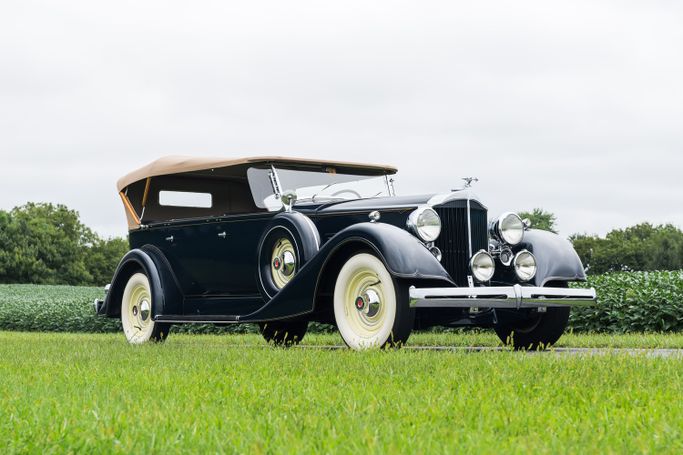
Chassis No.: 377723
Engine No.: 328569
Estimate: US$120,000 - US$160,000 USD
- 320ci L-Head Inline 8-Cylinder Engine
- Single Dual-Throat Carburetor
- 120bhp at 3,200rpm
- 3-Speed Manual Transmission
- Front and Rear Leaf Spring Suspension
- 4-Wheel Drum Brakes
- Over half a century of single family ownership
- Extensively documented maintenance records
- Presents in wonderful condition
In the 1934 luxury market Packard's accomplishment was truly remarkable, but it amounted to only 8,000 cars and they were spread out over three different engines and five different chassis.
In addition to the inherent quality, luxury, performance, and silence for which Packard was justly famous, the marque's design and styling combined conservative elegance with a hint of sporting flair. Raymond Dietrich had laid down the basic lines of Packard's cataloged and custom bodies while working for Murray Corporation subsidiary Dietrich, Inc. in the late twenties. Ray Dietrich's concepts were embraced by Ed Macauley, who was appointed as Packard's styling director in 1932 by his father Alvan Macauley, Packard's President.


Alexis de Sakhnoffsky joined Packard as a part-time consultant through the early thirties, contributing his own sense of form, flow and streamlining to the development of Packard coachwork. Sakhnoffsky's work was then implemented with great talent and skill by Werner Gubitz.
While a few remaining independent coachbuilders continued to body Packard chassis, the economy and Packard's extensive catalog of finely-styled designs kept most Packard coachwork production in Packard's own facilities. That was, as it turns out, a serendipitous consequence as the Packard coachwork of the early thirties, and particularly 1934, is among the best of the period.


Packard relied on their traditional buttressed grille shell, which since 1932 was vee-shaped with vertical blinds. The nose was complemented with veed headlight lenses and the "down-tick" dart-shaped shoulder molding created by Hibbard & Darrin. Packard cataloged no less than thirteen standard bodies on the prestigious 1104 Super Eight alone. Deliveries of closed sedans predominated but it is the few, very special, open 1934 Packards that are most appreciated today. These particular cars embody the essence of classic design and quality - their appeal is timeless.
THE MOTORCAR OFFERED


The known history of this Packard begins in 1950 when the vehicle was purchased by Curtiss L. Blake, the founder of Friendly Ice Cream Company. Soon after his acquisition, the car was brought to Packard Springfield Inc. for a restoration which included rebuilding the motor, applying a dark blue lacquer finish, fitting a new top, floor mats, tires and a plethora of new small items. After two years of enjoying his refurbished automobile, Mr. Blake parted ways with the car and handed it over to patriarch of the family which currently owns the vehicle. At this point, 52,000 original miles appeared on the odometer.
Under this gentleman's care, the Packard would split its time between a home in Pennsylvania and Cape Cod during the summer months. On two occasions the Wendling Brothers touched up the paint, and in 1971 the car was taken to Hibernia Auto Restorations for the first of many instances. In 1982, the car was purchased by a son of the family and would find its new home in New Hampshire. The practice of routine maintenance and continual restorative work would continue under this newest owner with trips to Partridge Restoration occurring in 1980, 1982, 1983, and 1985. Further brake and electrical work were carried out in 1984 and after moving the car to Pennsylvania, the Packard received new tires and engine work in 1994.


Just a year later the car was sent to Vermont for a full body off repaint, replating, engine rebuild and a new top. More Recently, the carburetor was rebuilt by Daytona Parts Company.
As described, this Packard benefits from a one family ownership that extends over 50 years and is subsequently accompanied by a plethora of paperwork documenting the extensive efforts carried out on the vehicle. This marks a rare opportunity to obtain a very well cared for example.


