


Lamborghini 400 GT 2+2 Coupé, 1968
Lamborghini 350/400 GT
Lamborghini 350/400 GT•
•29 просмотров
Chassis No.: 01273
€223,925 EUR | Sold
- One of only 224 built
- The first four-seater Lamborghini model
- A late production example
- Used sparingly since acquisition circa 2015
Lamborghini's first production car, the Carrozzeria Touring-styled 350 GT, debuted at the 1964 Geneva Motor Show. The work of two of Italy's most illustrious automobile designers, the 350 GT featured a glorious 3.5-litre, four-cam V12 designed by Giotto Bizzarrini, housed in a chassis penned by Gianpaolo Dallara. The 350 GT's four camshafts and all-independent suspension meant that it upstaged the best that Ferrari offered at the time, but to compete with his Maranello rival's larger models Lamborghini needed a four-seater, and the 400 GT 2+2 duly appeared in 1966. A development of the 350 GT, the newcomer used an enlarged - to 3,929cc - V12.
This 4.0-litre unit had first appeared in 1965, finding its way into a handful of late 350 GTs, this interim model being known as the 400 GT. Lamborghini's own five-speed all-synchromesh manual transmission first made its appearance on these cars. The 400 GT's claimed maximum power was 320bhp - up from the 350 GT's 270 - an output sufficient to make the former a 240km/h-plus car. The 400 GT 2+2 retained the overall, and highly acclaimed, looks of the 350 GT while contriving to be slightly taller in the interests of increased rear-passenger headroom.
Bodies were now steel (the 350 GT's had been aluminium) and the 400 GT 2+2 had the twin headlights that had already been adopted in place of the oval originals, largely to meet the USA's requirements. Despite its novice status as an automobile manufacturer, Lamborghini soon dispelled any lingering doubts about its ability to compete with the world's best Grand Tourers. Reviewing the 400 GT in its 2+2 form in 1967, Autocar magazine voted it "better than all the equivalent exotic and home-bred machinery in this glamorous corner of the fast-car market".
The relaxed manner of its long-legged performance was reckoned the finest quality of the Lamborghini, its V12 engine being judged to have the broadest range of smooth torque the testers had experienced. Autocar concluded: "To achieve this level of performance without noise, fuss, temperament or drama is an achievement; in the time taken for development, it is nothing short of sensational." A total of 23 examples of the interim 400 GT and 224 of the 400 GT 2+2 were completed between 1966 and 1968, which makes it one of the rarest Lamborghini models ever built.


Chassis number '1273' was built in January 1968 at the Lamborghini factory in Sant'Agata Bolognese, destined for the USA, and was originally supplied to Bob Estes, the West Coast Lamborghini distributor based in Southern California. The original colour combination was Verde (Green) with Senape (Mustard) interior. Not much is known about the car's early history; it is believed to have been owned by just one collector between 1990 and 2014, and during his ownership was fitted with a rebuilt type-correct engine. However, the matching-numbers engine ('1469') and cylinder heads remained with the car and will be included in the sale.
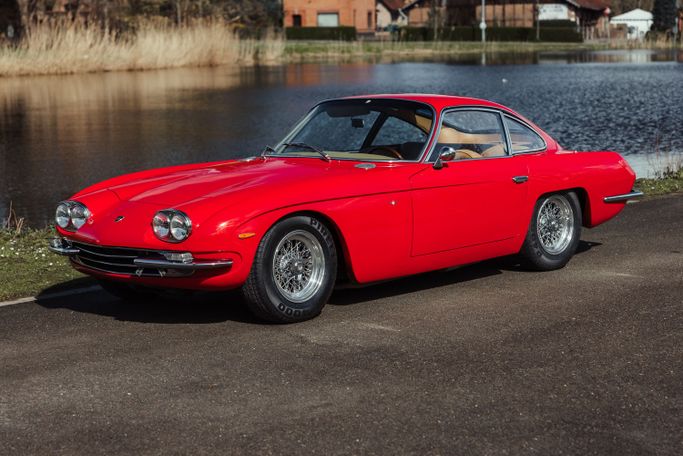
A work of art in its own right, the 4.0-litre V12 engine is never short of power and delivers a glorious soundtrack. The interior is trimmed in high quality supple leather with woollen carpets, while the seats, door panels, and carpeting are in very good condition and have aged well, possessing a subtle but nice patina. The car is now equipped with a wood-rim steering wheel with matching gear knob. We are advised that the bodywork is in very good condition, with straight panels and good panel gaps. Applied at some time in the past, the red paintwork shows bright and is still in very good condition overall.
The car rolls on a set of Borrani wire wheels, with the correct Borrani spinners, shod with older Pirelli tyres. The chromework is still beautifully finished and has a nice shine throughout. Around 2014 the Lamborghini returned to Europe and was bought by the current owner, who has used it sparingly. In general, this is a very nice car that has benefited from an older restoration, with a nice patina and a very strong driveline and mechanicals.


Accompanying documentation includes the Lamborghini Certificate confirming build details; invoices for work carried out in 2017; a valuation report from 2016, an Original sales brochure; a copy of the old US Title and current Belgian registration documents. With only 224 built, this beautiful 400 GT 2+2 represents a wonderful opportunity to acquire a fine example of this rare and desirable early Lamborghini.
It is the stuff of legend that Ferrari-owning industrialist Ferruccio Lamborghini only turned to automobile manufacture as a result of receiving off-hand treatment at Maranello, vowing to build a better car. A successful manufacturer of tractors and related machinery, Lamborghini possessed the resources to realise his dream without having to compromise. Lamborghini's first production car, the Carrozzeria Touring-styled 350 GT, debuted at the 1964 Geneva Motor Show. The work of two of Italy's most illustrious automobile designers, the 350 GT featured a glorious 3.5-litre, four-cam V12 designed by Giotto Bizzarrini, housed in a chassis penned by Gianpaolo Dallara.
The 350 GT's four camshafts and all-independent suspension meant that it upstaged the best that Ferrari offered at the time, but to compete with his Maranello rival's larger models Lamborghini needed a four-seater, and the 400 GT 2+2 duly appeared in 1966. A development of the 350 GT, the newcomer used an enlarged - to 3,929cc - V12. This 4.0-litre unit had first appeared in 1965, finding its way into a handful of late 350 GTs, this interim model being known as the 400 GT. Lamborghini's own five-speed all-synchromesh manual transmission first made its appearance on these cars.


The 400 GT's claimed maximum power was 320bhp - up from the 350 GT's 270 - an output sufficient to make the former a 240km/h-plus car. The 400 GT 2+2 retained the overall, and highly acclaimed, looks of the 350 GT while contriving to be slightly taller in the interests of increased rear-passenger headroom. Bodies were now steel (the 350 GT's had been aluminium) and the 400 GT 2+2 had the twin headlights that had already been adopted in place of the oval originals, largely to meet the USA's requirements. Despite its novice status as an automobile manufacturer, Lamborghini soon dispelled any lingering doubts about its ability to compete with the world's best Grand Tourers.
Reviewing the 400 GT in its 2+2 form in 1967, Autocar magazine voted it "better than all the equivalent exotic and home-bred machinery in this glamorous corner of the fast-car market". The relaxed manner of its long-legged performance was reckoned the finest quality of the Lamborghini, its V12 engine being judged to have the broadest range of smooth torque the testers had experienced.
Autocar concluded: "To achieve this level of performance without noise, fuss, temperament or drama is an achievement; in the time taken for development, it is nothing short of sensational." A total of 23 examples of the interim 400 GT and 224 of the 400 GT 2+2 were completed between 1966 and 1968, which makes it one of the rarest Lamborghini models ever built. Chassis number '1273' was built in January 1968 at the Lamborghini factory in Sant'Agata Bolognese, destined for the USA, and was originally supplied to Bob Estes, the West Coast Lamborghini distributor based in Southern California. The original colour combination was Verde (Green) with Senape (Mustard) interior.


Not much is known about the car's early history; it is believed to have been owned by just one collector between 1990 and 2014, and during his ownership was fitted with a rebuilt type-correct engine. However, the matching-numbers engine ('1469') and cylinder heads remained with the car and will be included in the sale. A work of art in its own right, the 4.0-litre V12 engine is never short of power and delivers a glorious soundtrack. The interior is trimmed in high quality supple leather with woollen carpets, while the seats, door panels, and carpeting are in very good condition and have aged well, possessing a subtle but nice patina.
The car is now equipped with a wood-rim steering wheel with matching gear knob. We are advised that the bodywork is in very good condition, with straight panels and good panel gaps. Applied at some time in the past, the red paintwork shows bright and is still in very good condition overall. The car rolls on a set of Borrani wire wheels, with the correct Borrani spinners, shod with older Pirelli tyres. The chromework is still beautifully finished and has a nice shine throughout. Around 2014 the Lamborghini returned to Europe and was bought by the current owner, who has used it sparingly.
In general, this is a very nice car that has benefited from an older restoration, with a nice patina and a very strong driveline and mechanicals. Accompanying documentation includes the Lamborghini Certificate confirming build details; invoices for work carried out in 2017; a valuation report from 2016, an Original sales brochure; a copy of the old US Title and current Belgian registration documents. With only 224 built, this beautiful 400 GT 2+2 represents a wonderful opportunity to acquire a fine example of this rare and desirable early Lamborghini.
https://cars.bonhams.com/auction/28935/lot/142/1968-lamborghini-400-gt-22-coupe-chassis-no-01273/
Стоимость
947 639 AED


