


Ferrari 250 GT Series II Coupé, 1959
Ferrari 250 GT Berlinetta
Ferrari 250 GT Berlinetta•
•43 просмотра
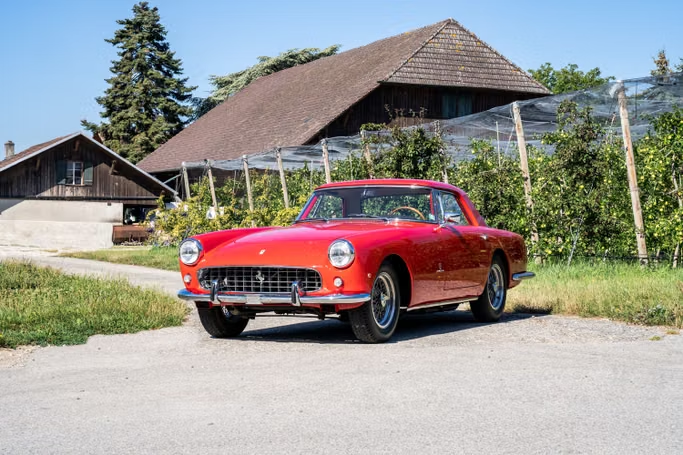
Chassis No.: 1583GT
Engine No.: 1583GT
Estimate: CHF400,000 - CHF600,000 CHF
- Matching numbers
- Delivered new in Italy in Grigio Fumo with a turquoise interior
- Present ownership since 1992
- Only some 8,000km since acquisition
- Comprehensively restored during the 1990s
- Registered in Switzerland
- Marcel Massini report on file
By the early 1960s, road car production had ceased to be a sideline for Ferrari and was seen as vitally important to the company's future stability. Thus the 250, Ferrari's first volume-produced model, can be seen as critically important, though production of the first of the line - the 250 Europa, built from 1953 to '54 - amounted to fewer than 20. Before the advent of the Europa, Ferrari had built road-going coupés and convertibles in small numbers, usually to special customer order using a sports-racing chassis as the basis. Ghia and Vignale of Turin and Touring of Milan were responsible for bodying many of these but there was no attempt at standardisation for series production and no two cars were alike.
The introduction of the 250 Europa heralded a significant change in Ferrari's preferred coachbuilder; whereas previously Vignale had been the most popular carrozzeria among Maranello's customers, from now on Pinin Farina (later 'Pininfarina') would be Ferrari's number one choice, bodying no fewer than 48 out of the 53 Europa/Europa GTs built. Pinin Farina's experiments eventually crystallised in a new Ferrari 250 GT road car that was first displayed publicly at the Geneva Salon in March 1956. However, the Torinese carrozzeria was not yet in a position to cope with the increased workload, resulting in production being entrusted to Carrozzeria Boano after Pinin Farina had completed a handful of prototypes.
True series production began with the arrival of Pininfarina's 'notchback' Coupé on the 250 GT chassis, some 353 of which were built between 1958 and 1960 within the sequence '0841' to '2081'. However, the relatively small scale of production meant that cars could still be ordered with subtle variations according to customer choice, as well as enabling a handful of show cars and 'specials' to be constructed on the 250 GT chassis.
A number of important developments occurred during 250 GT production: the original 128C 3.0-litre engine being superseded by the twin-distributor 128D, which in turn was supplanted in 1960 by the outside-plug 128F engine which did away with its predecessor's Siamesed inlets in favour of six separate ports. On the chassis side, four-wheel disc brakes arrived late in 1959 and a four-speeds-plus-overdrive gearbox the following year, the former at last providing the 250 GT with stopping power to match its speed.
More refined and practical than any previous road-going Ferrari, yet retaining the sporting heritage of its predecessors, the 250 GT is a landmark model of immense historical significance. Despite this, original survivors are relatively few, as many have been modified and converted into replicas of more exotic Ferraris such as the 250 GTO, Testarossa, etc.
According to the accompanying Massini Report, chassis number '1583' is the 228th of the 353 units built and as a 'Series II' car has the added advantage of disc brakes all round. The chassis entered Carrozzeria Pinin Farina's plant in Turin on 25th November 1959 was finally completed back at the Ferrari factory in March 1960. That same month the car was sold to its first owner, Filature A Brambilla di Verres SA, a textile manufacturer founded in 1940 and located in Milan, Italy. The original colour combination was the rather fetching combination of Grigio Fumo with a turquoise interior.
When purchased by the current owner in 1992 from Ferrari importers IFS in Nyon, Switzerland, the Ferrari had already been refinished in its present colour combination of red with a tan leather interior. The odometer reading at that time was recorded as circa 51,000 kilometres. The custodian embarked upon a comprehensive restoration, which commenced in 1993 when the interior was re-upholstered with tan Connolly leather and the headlining renewed. This was done by Ferrari restorers Sportgarage Leirer of Stein, Switzerland at a cost of CHF 17,470 (invoice on file).
The next step in the car's restoration was the replacement of the windscreen and rear window rubber seals, which was done at IFS in October 1993 for CHF 2,360 (invoice on file). A comprehensive engine overhaul followed in December 1996, this time undertaken by Ferrari and Rolls-Royce main agents Garage Beau Rivage of Lausanne, which cost no less than CHF 78,650 (detailed invoice on file). To finish the restoration, the car was treated to a bare-metal re-spray in Rosso Corsa at Ferrari bodywork specialists Carrosserie S. Di Dio in Crissier, Switzerland costing CHF 29,000.
The odometer at the time of cataloguing was 59,138 kilometres, showing that the car has only covered some 8,000 kilometres since its acquisition in 1992 and subsequent restoration. Not surprisingly, the vendor describes the car as in very good cosmetic condition. Fitted with a new clutch, this beautiful matching-numbers Ferrari 250 GT comes with Swiss registration documents and a FIVA Identity Card issued in July 2019.


Ferrari 250 GT Série 2 coupé 1959
Carrosserie Pininfarina
Châssis n° 1583 GT
- Numéros concordants
- Livrée neuve en Italie gris fumé avec un intérieur turquoise
- Aux mains de son actuel propriétaire depuis 1992
- Seulement 8 000 km depuis son acquisition
- Entièrement restaurée dans les années 1990
- Immatriculée en Suisse


- RapportMarcel Massini Au début des années 1960, la production des voitures de routes avait cessé d'être marginale pour Ferrari et était devenue vitale pour le futur de la marque. La 250, première Ferrari à être construite en série, peut donc être considérée comme importante, même si la production de la première de la lignée, la 250 Europa, construite de 1953 à 1954 – compte moins de 20 unités. Avant l'arrivée de l'Europa, Ferrari avait construit des coupés et des cabriolets de route en petites quantités, généralement commandés à l'unité sur un châssis de compétition à la demande d'un client. Ghia et Vignale à Turin et Touring à Milan habillaient la plupart, mais il n'y avait aucune standardisation pour une production en série et il n'y avait pas deux voitures identiques.
L'apparition de la 250 Europa marque un changement significatif dans le choix des carrossiers par Ferrari. Alors qu'auparavant Vignale avait été la carrozzeria la plus populaire parmi les clients de Maranello, à partir de là, Pinin Farina (plus tard « Pininfarina ») allait devenir le premier choix de Ferrari, carrossant pas moins de 48 des 53 Europa/Europa GT construites. Le choix de Pinin Farina se concrétisa définitivement sous la forme d'une nouvelle Ferrari 250 GT de route dévoilée au Salon de Genève en mars 1956. Néanmoins, la carrozzeria turinoise n'était pas encore en position de faire face à un surcroît de commandes et la production en série fut confiée à la Carrozzeria Boano après que Pinin Farina eut réalisé une poignée de prototypes.
La véritable production en série débuta avec l'arrivée d'un coupé trois volumes de Pininfarina sur châssis 250 GT, dont 353 furent construits entre 1958 et 1960 dans les séquences de châssis 0841 à 2081. Quoiqu'il en soit, la production relativement faible permettait encore que l'on puisse commander les voitures avec de subtiles variations en fonction des choix du client, mais aussi que l'on puisse réaliser des modèles de salon et des « speciale » sur le châssis 250 GT.
Un nombre important de modifications fut apporté au cours de la production de la 250 GT. Le moteur original 128C de 3 litres fut remplacé par le 128D à double allumage, lui-même supplanté en 1960 par le 128F à bougies extérieures qui adoptait une admission à six orifices séparés à la place des orifices jumeaux de son prédécesseur. Côté châssis, les freins à disques aux quatre roues arrivèrent en 1959 et une boîte à quatre rapports plus overdrive l'année suivante, les disques offrant enfin à la 250 GT une puissance d'arrêt en accord avec ses performances.
Plus raffinée et plus pratique que toutes les Ferrari de route qui l'ont précédée tout en préservant l'héritage sportif de ses devancières, la 250 GT est un modèle-clé d'importance historique. Malgré cela, il reste peu de survivantes, beaucoup ayant été modifiées et converties en répliques de modèles Ferrari plus exotiques, comme la 250 GTO, la Testa Rossa, etc...
Selon le rapport Massini fourni, le châssis numéro 1583 est le 228e des 353 exemplaires construits et en tant que série 2 a l'avantage de bénéficier de freins à disque aux quatre roues. Le châssis, arrivé à la Carrozzeria Pinin Farina à Turin le 25 novembre 1959, fut achevé à l'usine Ferrari en mars 1960. Ce même mois, la voiture fut vendue à son premier propriétaire, A. Brambilla SpA de Verres, une manufacture de textile fondée en 1940 à Milan, en Italie. Sa couleur originale était le séduisant gris fumée, associé à un intérieur turquoise.
Lorsque le propriétaire actuel a acheté la voiture en 1992 à limportateur Ferrari IFS de Nyon, en Suisse, la voiture avait déjà été repeinte en rouge avec intérieur en cuir fauve. Le compteur indiquait à l'époque environ 51 000 km. Le propriétaire se lança alors dans une restauration complète, qui débuta en 1993, lorsque l'intérieur fut regarni en cuir Connolly fauve et le ciel de toit refait. Le travail fut exécuté par le restaurateur de Ferrari Sportgarage Leirer de Stein, en Suisse pour un coût de 17 470 Francs suisses (facture au dossier).
L'étape suivante de la restauration fut le remplacement des joints de pare-brise et de lunette arrière réalisé chez IFS en octobre 1993 pour 2 360 FS (facture au dossier). Une révision complète du moteur a suivi en décembre 1996, cette fois chez l'agent Ferrari et Rolls-Royce, le Garage Beau Rivage à Lausanne, pour un coût de 78 650 FS (facture détaillée au dossier). Pour compléter la restauration, la voiture fut repeinte métal nu en Rosso Corsa chez le spécialiste Ferrari, la carrosserie S. Di Dio à Crissier, en Suisse pour 29 000 FS.
Le compteur, au moment de la rédaction du catalogue, indiquait 59 138 km, montrant que la voiture n'avait parcouru que 8 000 km depuis son acquisition en 1992 et la restauration qui s'ensuivit. Sans surprise, le vendeur décrit la voiture comme étant en très bon état général cosmétique. Equipée d'un nouvel embrayage, cette magnifique Ferrari 250 GT à numéros concordant, est vendue avec ses papiers d'immatriculation suisse et son passeport FIVA de juillet 2019.


