


Bentley 8-Litre Vanden Plas-style Tourer, 1931
Bentley Eight
Bentley Eight•
•41 просмотр
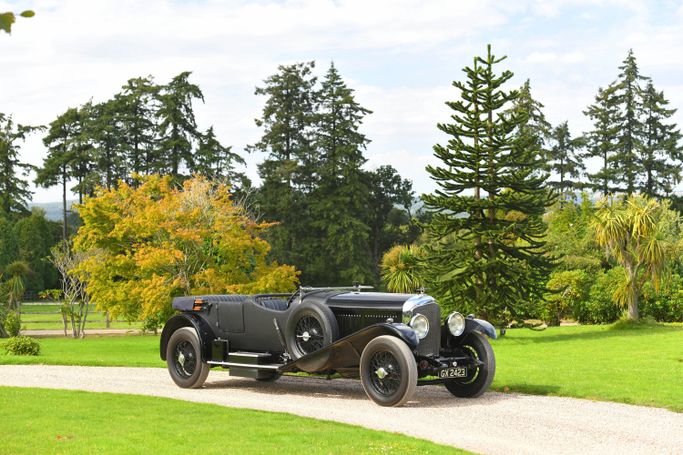
Chassis No.: YM5045
Engine No.: YM5054
Estimate: £600,000 - £800,000 GBP
- Fully matching numbers: chassis, engine, gearbox, axles, steering column, differential
- Fully restored in 1972 by Elmdown Engineering
- Extensive recent refurbishment by VBE Restorations
As it is, only 100 examples of the 8-Litre model had been produced before bankruptcy overtook the original Bentley company; had they been in a stronger financial position it might well have been a different story. With a chassis price of £1,850, the 8-Litre Bentley was in direct competition with the Rolls-Royce Phantom II while offering better performance, and the contemporary motoring press was lavish with its praise for the 8-Litre model. The latter had debuted at the 1930 London Motor Show and was the largest-engined car made in the UK at that time and arguably the fastest.
Bentley's advertising claimed '100mph without noise' and tests bore out that claim, the 8-Litre being fully capable of the 'ton' even when burdened with weighty formal coachwork. As W O Bentley himself said: "I have wanted to produce a dead silent 100mph car, and now I think we have done it."
The 8-Litre represents an evolutionary step in the development of the Vintage-era Bentley, combining proven features of the 6½-Litre model with the latest engineering advances. Rather than trying to extract more power from the existing 6½-Litre engine, W O Bentley followed his long-preferred method of improving performance and simply enlarged it, increasing the bore size from 100 to 110mm. Although the 8-Litre's engine followed conventional Bentley practice, its gearbox - designated 'F-type' - was radically different from its predecessors, the redesign having been necessitated by the greatly increased power and torque it was required to transmit, as well as the quest for silence.
The massive chassis frame likewise was entirely new, being of the 'double drop' design that enabled overall height to be reduced and the centre of gravity lowered, these aims also dictating the use of a hypoid-bevel rear axle. Seven tubular cross members resulted in a much stronger and less flexible frame than hitherto, which was available in a choice of two wheelbases: 12' or 13'. Revised suspension incorporating longer road springs, out-rigged at the rear, together with Bentley & Draper shock absorbers made for increased smoothness and stability, both vital considerations when designing a large and weighty vehicle capable of three-figure speeds. The 8-Litre's steering and braking systems also featured numerous detail improvements.
"Motoring in its very highest form," eulogised


The Autocar
in December 1930, having recorded a top speed of 101.12mph in W O Bentley's own saloon-bodied 8-Litre over the half-mile. Between 1930 and 1939, Britain's foremost motoring magazine bettered that figure only once, while testing an Alfa Romeo 8C 2300. The 8-Litre was destined to remain the fastest production Bentley until the R-Type Continental's arrival in 1953.
Today, 78 examples of W O Bentley's magnificent swansong 8-Litre model are known to survive worldwide out of the 100 produced, with many having had their original saloon bodies replaced by replica tourers. This is the case with chassis 'YM5045', which started life with a Freestone & Webb saloon body. Delivered new to Major C H Stevens and owned by him until 1949, the Bentley was then purchased by Leyland Motors who used it as a test mule for an experimental diesel engine before selling it on in 1964.
The car then passed through several more UK owners before being fully restored in 1972 by marque specialists Elmdown Engineering in Wiltshire, where it received its current Vanden Plas replica tourer body. Finally, in 1981, 'YM5054' was purchased by a Bentley enthusiast in Sydney, Australia, arriving on the appropriately named SS Prestigious in January 1982.
Under its most recent ownership the 8-Litre has been to noted experts VBE Restorations whose bills for recent works total close to £50,000. These works included the following:


Remove body, clean chassis and bolt check
Touch up chassis paint were necessary
Cover whole body with new wadding and calico and then new black Everflex
Reupholster complete interior with Ingleston black hide
Fit new Wilton carpets bound in leather


Cover dashboard in black Everflex
Fit body and wings back to chassis
Renovate headlamps and re-chrome rims
Fit modern spin-on oil filter
Fit new electric fans


Fully service car and carry out anything that needed doing
VBE Restorations also carried out a full inspection and report in April 2015 prior to sale by the last owner. VBE's report stated: "The inspection of the numbered parts confirmed that all major mechanical components are as supplied by Bentley Motors and correct to the car. Although some of the minor ancillary parts have been changed, this detracts very little from the overall originality of the Bentley made components." The report concluded: "Overall YM5045 is a superb car which drives extremely well and requires no major work. The body, although not original, is well made and far more usable than it's original heavy coachwork.
With the exception of the Autovac and the Bosch magneto, the car has all of its significant original mechanical components and all major castings are correctly numbered. The car is a fantastic example of an 8-Litre Bentley and has the performance to go with it." VBE's detailed report is far too lengthy to reproduce here but may be found in the history file (perusal recommended).
Few Vintage cars can offer the performance, driveability and sheer exhilaration of an 8-Litre Bentley. While it lacks the Speed Six's racing heritage and Le Mans 24-Hour association, the 8-Litre is today one of the world's great collector cars, witnessed by its amazing survival rate.


