


When to Change the Transmission Fluid in a Toyota Tundra
Toyota Tundra
Toyota Tundra•
•65 views
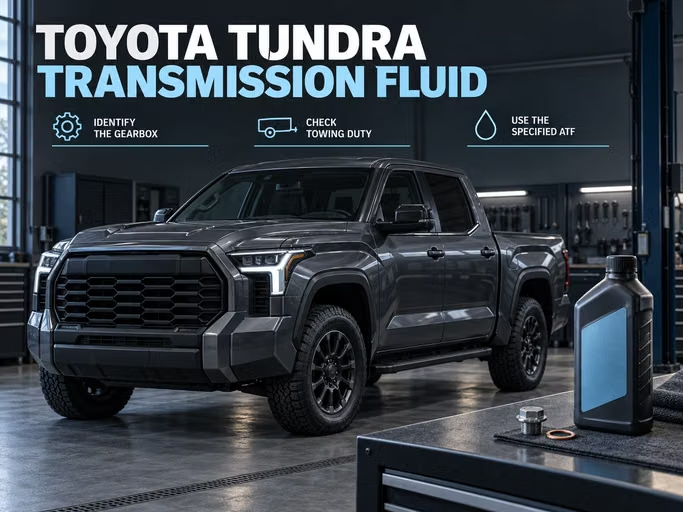
The correct time to change Toyota Tundra transmission fluid depends on the maintenance schedule for the individual truck and the work it performs. There is no single interval for every Tundra: model year, gearbox, service history and regular towing all matter. Overheating, loss of drive or a leak calls for attention before the next scheduled service.
Tundras with the 5.7-litre V8 use a six-speed automatic, while the generation introduced for model year 2022 has a ten-speed automatic. The i-FORCE MAX hybrid also uses a stepped automatic transmission. Adding an electric motor does not make it a CVT or determine which fluid belongs in it.
5 Signs That the Transmission Needs Inspection
These symptoms justify a workshop visit, but do not prove that fresh fluid will cure the fault. Record whether they occur when cold, after warming up, with a trailer or without one.
- Selecting D or R takes noticeably longer. A recurring delay before drive engages calls for checks of fluid level, fault codes and hydraulic operation. Avoid raising engine speed to force the truck to move.
- Engine speed rises during a shift but acceleration pauses. The transmission may be slipping, although engine and control faults need to be ruled out. Avoid continuing with a heavy load before diagnosis.
- A shudder appears at a steady road speed. Torque-converter lock-up is one possible cause; wheels, the propeller shaft or the engine may also be involved. Note the conditions in which it happens.
- Fresh fluid appears underneath. Inspect the sump, connections and cooler lines. A four-wheel-drive Tundra also has a nearby transfer case, so identifying the actual source matters.
- A transmission-temperature warning appears. Find a safe place to stop and follow the display and owner’s manual instructions. Repeated overheating needs investigation even if the message clears.
Load-Related Behaviour or a Fault
When towing, the gearbox may hold a lower ratio for longer or shift more frequently on an incline. Compare its behaviour with the same load and selected driving mode. New harsh shifts, loss of drive and warning messages should not be dismissed as consequences of trailer weight alone.
What Low Fluid and Overheating Can Cause
| Problem | Possible consequence | Inspection priority |
|---|---|---|
| Low fluid level | Impaired lubrication and hydraulic operation | Locate the leak and restore the correct level |
| Repeated overheating | Faster ATF deterioration and clutch wear | Assess load and transmission cooling |
| Incorrect fluid | Altered clutch operation and shift quality | Identify the product and gearbox requirements |
| Water or large metal particles | Corrosion or component damage | Assess the unit before specifying service work |
Establishing the Fluid Replacement Interval
Start with the service history: when the fluid was changed, which product was used and what work was carried out. Then check the schedule for the truck’s model year, powertrain and original specification. An inspection entry does not automatically require replacement. If records are missing, identify the gearbox and assess its condition first.
Towing, Payload and Sand Driving
Tell the workshop about regular towing, load carrying and sustained high-load driving. Sand can put substantial heat into the transmission without adding many kilometres. Match these conditions to the special operating conditions in the applicable schedule. Hot weather alone is not a basis for assigning the same shortened interval to every Tundra.
Choosing ATF for a Toyota Tundra
Why “Suitable for Toyota” Is Not Enough
ATF means automatic transmission fluid. It lubricates components, carries away heat and supports hydraulic and clutch operation. Look up the exact designation in the owner’s manual and repair information for the installed gearbox. Fluid colour, vehicle brand or a claim of universal compatibility on the bottle cannot replace that check.
| Confirm | Reason |
|---|---|
| Model year and engine | Keep early Tundra, V8 and newer-generation service data separate |
| Gearbox code and replacement history | Match the fluid to the installed unit, not just the VIN |
| Whether i-FORCE MAX is fitted | Use the procedure for the hybrid with its stepped automatic |
| ATF specification and service scope | Agree on the correct product, seals and level-check method |
Total Capacity Is Not the Drain-and-Refill Amount
A routine drain leaves fluid in the torque converter, internal passages and cooling circuit. The published total capacity is therefore not the refill quantity. Measuring what drains out is a useful cross-check, but cannot replace setting the level correctly: it may have been wrong before service. Use the temperature conditions and sequence specified for that gearbox.
Planning the Transmission Service
Agree on the scope before opening the unit. Sump removal, filter servicing and fluid exchange equipment serve different purposes and should not automatically become one package. Slipping or metal debris calls for a diagnosis before routine maintenance is prescribed.
Vehicle Handover Checklist
☐ Verify the VIN, model year, engine and gearbox identification.
☐ Record symptoms, towing use and previous overheating episodes.
☐ Confirm the exact fluid designation on the work order.
☐ Inspect the sump, plugs, connections and cooling circuit.
☐ Perform the work and fit seals according to the service procedure.
☐ Set the level at the temperature specified for this transmission.
☐ Check for leaks and assess shifts after servicing.
☐ Keep the mileage, date, product and completed work on record.
Transmission Fluid Service Mistakes
- Choosing CVT fluid simply because the Tundra is a hybrid.
- Transferring refill quantities and level-check temperatures from a six-speed gearbox to a ten-speed unit.
- Treating machine flushing as mandatory or adding treatments to cure harsh shifts.
- Ignoring overheating after a change on the assumption that fresh ATF has fixed the problem.
Conclusion
A Toyota Tundra’s workload matters alongside its mileage. The specified ATF, effective cooling and an accurately set level help the transmission handle that work. When comparing current listings, examine gearbox service records and ask the owner about towing and overheating.


