


Toyota RAV4 Fuel Filter Replacement and Diagnostics
Toyota RAV4
Toyota RAV4•
•38 views
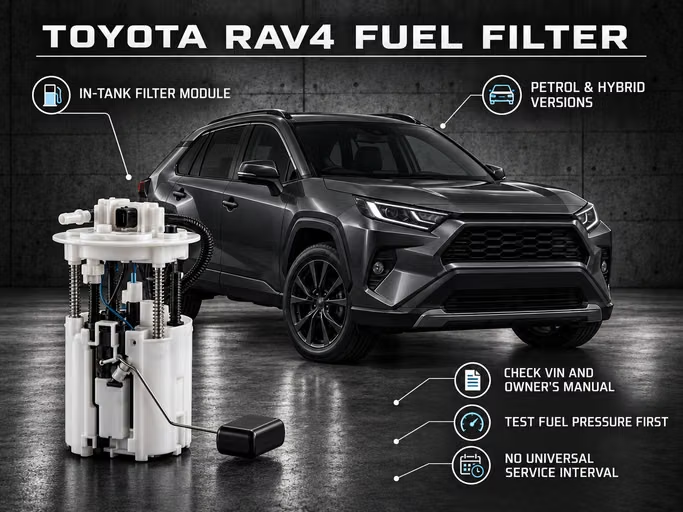
A single replacement interval cannot be assigned to every Toyota RAV4 without checking the model year, engine and destination market. A regional Toyota service programme lists the fuel filter at 80,000 km for applicable vehicles, but the exact vehicle manual remains the deciding source. Construction also varies because the filtration section may sit inside the tank as part of the fuel module.
When to Check Fuel Delivery
A loaded filter restricts flow from the tank, but a weak pump, electrical loss, injector faults and contaminated fuel can produce similar symptoms. On a RAV4 with a high-pressure circuit, diagnosis must separate low-pressure supply from the engine-driven pump. Measurements should lead the parts decision.
● Starting takes longer than usual. Pressure may recover slowly after parking because of filter resistance, pump wear or an internal loss of residual pressure. On a hybrid, observe petrol-engine starting rather than relying on the READY indication alone.
● Acceleration or a climb brings delayed response. Delivery may be adequate at light load and then fall behind demand as the engine requires more fuel. Ignition, intake, exhaust and throttle-control faults also need to be excluded.
● The engine becomes uneven when warm or with little fuel in the tank. A restricted inlet can become more noticeable as fuel level changes. Pump condition, wiring, tank ventilation and fuel quality must be checked as well.
● An unfamiliar hum comes from the tank. A difficult inlet path can increase pump noise, although motor wear, module distortion and operation at a very low fuel level can do the same. Pressure, current and voltage identify the more likely cause.
● Lean-mixture or fuel-pressure codes appear. A stored fault describes an operating condition rather than naming the failed component. Preserve freeze-frame and live data before clearing memory.
● The complaint begins immediately after refuelling. Water or suspended debris can load the filter medium quickly. Check a fuel sample, the bottom of the tank and the lines before a new element is fitted.
Why a RAV4 Fuel Filter Can Load Early
The filter retains material that has already entered the tank. Sediment may come from storage equipment, a portable container or dirt introduced during repair. Water can arrive with the fuel or accumulate during long storage and temperature changes. Clean work around an open module therefore matters as much as the quality of the replacement part.
Repeated driving at a low fuel level does not create a separate factory interval. It can, however, help explain pump heat, noise and intermittent delivery on uneven roads. If the complaint follows a particular fill or fuel level, reproduce those conditions during testing.
How Restricted Flow Affects a RAV4
A small restriction can remain hidden while the control system compensates. The fault becomes clearer when fuel demand rises. A clean filter restores flow only when the tank is free of contamination, the pump is serviceable and its electrical supply remains stable.
- Delivery reserve decreases. Idle readings may look normal while pressure fails to reach the requested value during hard acceleration.
- Fuel-trim correction increases. The control unit compensates until its usable range is exhausted and may then store a lean fault. Interpret those records with pressure and injector tests.
- Pump load rises. Restriction at the inlet or outlet increases current and heat. Comparing electrical readings with fuel pressure helps distinguish a loaded filter from pump wear.
- The high-pressure circuit receives an unstable feed. Where this circuit is fitted, inadequate tank supply can appear under load even when the engine-driven pump is healthy. Test the system from the low-pressure side forward.
- Severe restriction can cause substantial power loss or an engine stall. After contaminated fuel, inspect the remaining fuel, tank, both delivery stages, injectors and connections rather than replacing one component in isolation.
What to Confirm in RAV4 Documentation
A regional service schedule lists an 80,000 km reference for applicable vehicles. Before work, select the exact model year and engine in the manuals section and confirm the requirement against the VIN.
| Parameter | RAV4 with an 80,000 km reference | Other RAV4 versions |
|---|---|---|
| Replacement point | Confirm the 80,000 km item in the applicable regional schedule. | Use the requirement for the exact year, engine and market. |
| Construction | Use the parts catalogue to establish whether the filter is within the tank module. | Module contents can vary by generation and destination market. |
| Powertrain | Confirm the engine, injection system and operation applicability. | Do not assume petrol and hybrid configurations are identical. |
| Diagnosis | Measure low-side pressure, pump voltage and current. | Where fitted, test the high-pressure circuit after the low side. |
| Part selection | VIN, model code, engine and package contents. | A generic ‘fits RAV4’ description is insufficient. |
Using the 80,000 km Reference
Treat 80,000 km as a control point only for a RAV4 covered by the relevant regional schedule. It does not replace the service history or the document for the exact model year. If that manual specifies a time limit or another mileage, the vehicle-specific requirement takes priority.
A fuel-filter entry does not define the supplied component. One catalogue may separate the inlet strainer, filter housing, pump and level sender, while another calls for a larger assembly. Establish which part is serviceable before ordering.
Do not transfer an interval automatically between markets. XA40 and XA50 generations, petrol and hybrid powertrains, and different injection systems may use different requirements. The VIN and model code lead to the correct document and parts diagram.
Choosing the Correct Toyota RAV4 Fuel Filter
Begin with the VIN, model code, engine marking and destination market. RAV4 vehicles from the same year can differ in tank design, connector, level sender, pressure regulator and cover attachment. A generic model description does not resolve those differences.
● Identify the powertrain before ordering. M20A-FKS, A25A-FKS and the hybrid A25A-FXS represent different configurations. Matching engine capacity or body generation does not guarantee the same module.
● Confirm the contents of the package. The inlet strainer, filter housing, pump, regulator, level sender and seal may be sold separately. Compare catalogue numbers rather than relying on shape in a photograph.
● Install a new tank-cover seal. A compressed ring loses its profile, and poor seating can allow fuel odour or leakage. Clean the mounting surface before opening the tank and inspect it after assembly.
● Match operating specifications. The filter must provide the required flow at an acceptable restriction while retaining the intended particle size. An incorrect new part can still limit delivery.
● Test before ordering a complete module. Measure fuel pressure, pump voltage and current, residual pressure and fuel condition first. These checks reduce the chance of replacing a sound assembly because of a poor connection or tank contamination.
Distinguishing Filter Restriction from Another Fault
Test the vehicle in the operating state that produces the complaint. Record temperature, fuel level, load, recent refuelling and stored faults. Compare low-side pressure and electrical supply, then examine high-pressure data where the system provides it.
| Observation | Possible filter connection | Other checks | First action |
|---|---|---|---|
| Long starting | Pressure recovers slowly after parking. | Pump, supply, residual pressure and injectors. | Measure pressure build-up and retention. |
| Hesitation on acceleration | Flow is insufficient at high demand. | Ignition, intake, exhaust and high pressure. | Record pressure while reproducing the fault. |
| Noise from the tank | Restriction increases pump load. | Fuel level, current, attachment and module wear. | Compare pressure, current and voltage. |
| Lean-mixture fault | Poor delivery is one possible cause. | Air leaks, sensors, injectors and exhaust. | Preserve freeze-frame data first. |
| Complaint after refuelling | Water or sediment may have loaded the filter. | Fuel sample, tank, lines and injectors. | Assess the fuel before fitting parts. |
Checks to Complete Before Replacement
● Establish the exact variant. Record the VIN, model code, engine, powertrain type and destination market. ‘RAV4 2.5’ or ‘RAV4 Hybrid’ does not identify a part number.
● Review the service history. Find the date, mileage and part number from earlier work. If no record exists, diagnose the system rather than assuming that replacement did or did not occur.
● Relate the complaint to fuel level. Note whether the interruption appears with a full tank, after long parking or during a turn. This pattern can reveal a damaged module, strainer or wiring connection.
● Preserve codes and freeze-frame data. Engine speed, load, fuel trims and pressure show when the deviation occurred. Clear memory only after the original data has been recorded.
● Measure pressure under load. A stationary check may miss a drop that develops during acceleration. Compare the result with the specification for the selected powertrain.
● Check pump voltage and current. Contact resistance, damaged wiring or incorrect pump control can imitate a restricted filter. Record electrical values while pressure is being measured.
● Inspect the fuel and the tank interior. Plan system cleaning when water or sediment is present. Do not place a new filter into a contaminated system without removing the cause.
● Prepare a safe work area. Switch the vehicle off, keep a hybrid out of READY and relieve pressure by the specified procedure. Provide ventilation, remove ignition sources and use clean tools.
Common RAV4 Fuel Filter Service Mistakes
● Applying 80,000 km to every RAV4. The reference belongs to applicable vehicles in one regional schedule; another model year or market may use a different requirement.
● Ordering a filter by model name and photograph. Pump, connector, level sender and housing details can vary within one body generation.
● Confusing the inlet strainer with the fine filter. Replacing the screen does not establish that the whole fuel module has been serviced.
● Replacing the high-pressure pump before testing tank supply. A low-side shortage can create a similar deviation under load.
● Washing disposable filter media. Solvent and compressed air damage the structure and cannot restore the specified filtration level.
● Reusing the tank-cover seal. A ring that has lost its shape increases the risk of odour, leakage and repeat removal.
● Leaving contamination in the tank after poor fuel. Water and sediment can load the new element and bring the complaint back quickly.
Conclusion
For a RAV4 covered by the applicable regional programme, 80,000 km is a fuel-filter replacement reference. Confirm the actual interval, module design and supplied part by VIN, model year, engine and destination market. Measure fuel pressure and pump supply first because filter restriction, pump faults and contaminated fuel can look alike. Current listings help compare generations and specifications, but filter compatibility still requires the VIN and catalogue number.


