How Often Should You Change the Brake Fluid in a Toyota Land Cruiser 300?
Toyota Land Cruiser 300 Series
Toyota Land Cruiser 300 Series•
•53 views
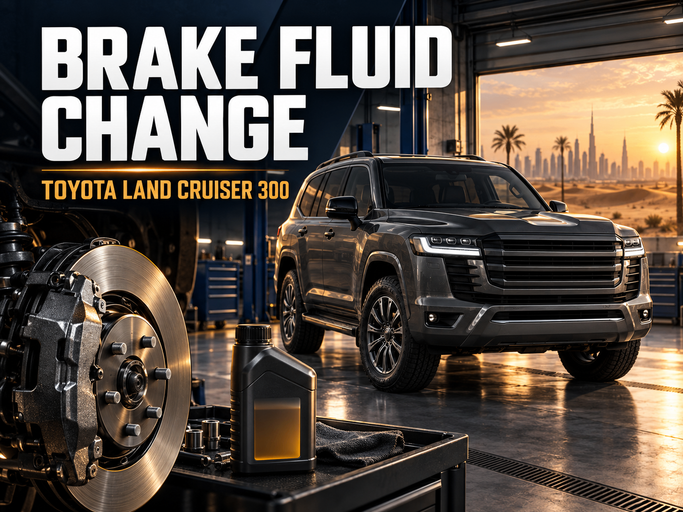
For the Toyota Land Cruiser 300, a safe routine interval is a complete brake-fluid replacement every 24 months. Mileage is secondary: the fluid ages and absorbs moisture even when the vehicle is driven infrequently. Inspect the system and replace the fluid sooner if the service history is unknown, the brake pedal feels soft, pedal travel has increased, the brakes engage later, or the hydraulic system has been opened.
How Can You Tell When the Land Cruiser 300 Needs New Brake Fluid?
Brake fluid rarely signals ageing with one obvious symptom. Pedal effort and pedal travel may still feel normal even after the boiling-point margin has declined. The calendar interval therefore remains the baseline, while the signs below are reasons not to wait for the scheduled date.
- Two years have passed with no confirmed replacement. A dated service record is more useful than the colour of the fluid in the reservoir. On a used LC300, no invoice, work order or dated entry means the history is unknown; start with a brake-system inspection.
- The brake pedal feels soft or travels farther than before. A soft or spongy pedal can result from air, overheating, a leak, a damaged hose or another hydraulic fault. Do not treat it as a reason to top up the reservoir: have the vehicle inspected before further demanding use.
- The level is near MIN or a warning appears. A small, gradual drop may accompany brake-pad wear, but a noticeable or rapid fall requires a leak check. Brake fluid should not be consumed like engine oil.
- The fluid is cloudy, contains sediment or appears contaminated. Dark colour alone does not measure boiling point, but uneven colour, particles or traces of another fluid require professional assessment and usually a complete replacement.
- A test indicates moisture or a low boiling point. An electronic conductivity tester can be useful for preliminary screening, but the reading depends on the tool and fluid formulation. A workshop should base the decision on the applicable service procedure and its approved test method.
What Happens If You Do Not Change the Brake Fluid?
In the LC300 hydraulic system, brake fluid transfers pedal force to the wheel brakes and electronically controlled hydraulic components. The fluid must remain stable under pressure and heat. Ageing gradually reduces that safety margin.
- The fluid absorbs moisture. Glycol-based DOT 3 and DOT 4 fluids are hygroscopic. Water does not enter only when the reservoir is open; small amounts of moisture pass through the venting system and flexible components throughout the vehicle's service life.
- The boiling point falls. Fresh fluid is designed for high temperatures, but absorbed water lowers that limit substantially. Nothing may feel unusual in normal urban driving; the problem can emerge after repeated hard braking.
- Overheating creates vapour bubbles. Unlike liquid, vapour compresses. Part of the pedal travel then compresses the bubbles, the pedal moves farther toward the floor, and deceleration becomes less predictable. The symptom may temporarily disappear after the brakes cool, but the system is still not safe.
- Internal components face greater corrosion risk. Moisture and ageing by-products can damage cylinders, valves, hard lines and the costly ABS hydraulic unit. Contamination can also interfere with passages designed for rapid pressure changes.
- Repairs become more complex than a fluid change. A neglected system may require caliper repairs or replacement of hoses, the master cylinder or ABS components. Routine fluid replacement does not prevent pad and disc wear, but it protects the hydraulic system from avoidable risk.
Toyota's Brake Fluid Maintenance Schedule for the Land Cruiser 300
Service documentation for the LC300 uses a calendar-based replacement interval of 24 months. The brake system calls for fluids meeting SAE J1703 or SAE J1704 and FMVSS No. 116 DOT 3 or DOT 4. Regional specifications and vehicle configuration take priority, so confirm the final choice against the VIN and owner's manual. To book service or verify the requirements for a specific version, visit toyota.ae.
| Item | Land Cruiser 300 guideline | How to apply it |
|---|---|---|
| Routine replacement | Every 24 months | Count from the last confirmed full fluid replacement, not from the date you bought the vehicle. |
| Condition check | At every scheduled service, and whenever the brake pedal feels soft, pedal travel increases, or the brakes engage later | Check the level, leaks, hoses and hard lines. If necessary, test moisture content or boiling point. |
| Permitted specification | SAE J1703 or SAE J1704; FMVSS No. 116 DOT 3 or DOT 4 | Confirm the exact fluid from the reservoir cap, the owner's manual and the vehicle's VIN data. |
| Quantity | No universal top-up quantity is specified | For a full replacement, the workshop allows enough fluid to flush every circuit; the final level must remain between MIN and MAX. |
| After repairs | Replace and bleed according to the Toyota procedure | If the circuit was opened or air entered it, replacing only the fluid in the reservoir is not enough. |
The table is a safe guide to interpreting the schedule, but it does not replace the documentation for your specific vehicle. The LC300 was supplied to multiple markets, and fluid requirements may differ in wording, type and service procedure. Check imported vehicles especially carefully.
Which Brake Fluid Does Toyota Specify for the Land Cruiser 300?
DOT 3 and DOT 4 identify performance classes, not a brand and not universal compatibility between every product and every vehicle. LC300 technical information refers to SAE J1703/J1704 and FMVSS 116 DOT 3/DOT 4. Choose a product that explicitly states compliance with the required standard.
- Read the reservoir cap first. The under-bonnet marking applies to the specific vehicle configuration and helps rule out an obviously unsuitable class.
- Then check the owner's manual and VIN. Requirements can vary by regional version. If the information differs, ask a specialist with access to current Toyota service data to confirm the correct fluid.
- Do not switch to DOT 5 because the number is higher. Silicone-based DOT 5 has different chemistry and is not an automatic substitute for glycol-based fluid. Using it incorrectly can damage the system and alter brake operation.
- Do not choose DOT 5.1 without approval either. Its name resembles DOT 5, although its chemistry is usually glycol-based. A higher advertised boiling point does not override Toyota's requirements for compatibility, viscosity and electronic valve operation.
- Use only a new, sealed container. An opened bottle begins absorbing moisture from the air. Fluid of unknown age should not be used in the safety-critical brake system of a heavy SUV.
Old Brake Fluid: Why the Land Cruiser 300 Can Lose Braking Performance
Brake failure may sound sudden, but the chain of events usually begins earlier. A heavy LC300 generates substantial energy while slowing down: the brakes convert it into heat, and the fluid must retain its properties near hot calipers.
When the Risk of Overheating Is Highest
- A long mountain descent. Holding the vehicle back with continuous pedal pressure quickly heats the pads, discs and fluid. Select a suitable gear early and use engine braking instead of maintaining uninterrupted pressure on the pedal.
- Towing or carrying a heavy load. More mass means the brakes must dissipate more heat. After several hard stops, the difference between fresh fluid and moisture-saturated fluid becomes especially important.
- Driving in dunes with frequent stops. Low speeds, high loads and repeated stability-control intervention can work the brakes harder than the odometer suggests. After the drive, inspect around the wheels and check for an overheating smell or fluid leaks.
- Aggressive driving. Repeated braking without enough cooling time rapidly consumes the system's thermal margin. Good fluid cannot compensate for overheated pads and discs, so assess the entire brake system.
How Climate Affects Brake Fluid Life
High ambient temperature alone does not mean the fluid needs replacement every few months. Age, humidity and thermal load matter together. Coastal humidity increases moisture exposure, while summer heat reduces the cooling margin. Treat the two-year interval as the limit, not a reason to postpone inspection until the final day.
Sand should never enter the sealed hydraulic system. The risk arises during careless service: dust around the reservoir cap can fall inside. Clean the area before opening the reservoir, and never leave the fluid container uncapped in the workshop.
How to Replace Brake Fluid Correctly on an LC300
A complete replacement flushes old fluid from every working circuit with controlled bleeding. Extracting only the reservoir contents renews a small part of the total volume and leaves old fluid in the lines, calipers and hydraulic control unit.
- Confirm the specification. The technician checks the VIN, owner's manual and reservoir marking, then prepares enough fresh fluid from a sealed container.
- Inspect the system before starting. Check the fluid level, reservoir, hard lines, flexible hoses, connections, calipers, pads and discs. If there is a leak, repair its cause first.
- Replace the fluid in the correct sequence. Flush the old fluid through the bleed points without allowing the reservoir to run dry. If air enters, routine maintenance becomes a more involved air-removal procedure.
- Account for ABS and electronic controls. After hydraulic repairs or air entry, the LC300 may require a service mode and diagnostic equipment to bleed the valves and pump assembly according to the factory procedure.
- Verify the result. After the work, check the level, confirm there are no leaks, and verify normal pedal travel with no warnings. Perform a safe, low-speed brake test before returning to busy traffic.
Can You Replace Brake Fluid Yourself?
It is technically possible to bleed the fluid without dismantling most components, but an error directly affects safety. Do not let the reservoir run dry, contaminate the fluid, use the wrong sequence or spill the fluid on painted surfaces. On a vehicle with ABS and complex electronic hydraulics, DIY work is reasonable only with the exact procedure, suitable tools and relevant experience.
If the pedal already sinks too far, the system was opened after a collision, or a hydraulic component was replaced, use a qualified workshop. The diagnostic scan tool is not used to reset a brake-fluid timer; it supports Toyota procedures for operating hydraulic actuators.
Checking a Used Land Cruiser 300
On a used vehicle, the details on the work order matter as much as the last service date. A line stating 'brake inspection' does not mean the fluid was replaced, and a top-up does not prove the system was flushed. Ask for a document showing the date, mileage, product specification and completed operations.
- No confirmation within the past two years — schedule a complete replacement after the system has been inspected.
- Fluid level below the specified range — do not top up blindly; first assess pad wear and rule out a leak.
- Very light-coloured fluid — this does not prove a recent replacement; appearance does not reveal moisture content or replace service records.
- An unusually soft brake pedal — do not continue a test drive with hard acceleration; diagnose the cause first.
- Previous collision repair — check which hydraulic components were replaced and whether the factory bleeding procedure was completed.
Mistakes to Avoid
- Using mileage as the only trigger. Brake fluid ages with time. An LC300 that has covered little distance on four-year-old fluid is not safer than one driven every day.
- Filling to MAX when the pads are worn. The level may fall as the caliper pistons move outward. After new pads are fitted, the level rises again and excess fluid can overflow the reservoir.
- Mixing products of unknown origin. The same DOT class does not guarantee that a fluid meets every requirement for the vehicle or retained its properties during storage.
- Judging condition by colour alone. Clear fluid does not prove a high boiling point, and dark fluid does not identify the cause. Use the interval, service records, an inspection and, when needed, a proper test.
- Ignoring the pads and discs. Fresh fluid cannot repair overheated, oil-contaminated or worn friction components. Treat brake maintenance as a complete system inspection.
Conclusion
For the Toyota Land Cruiser 300, 24 months is a sensible maximum interval between complete brake-fluid replacements. Confirm the specification by VIN, do not substitute a top-up for proper bleeding, and inspect the system sooner if the brake pedal feels soft, pedal travel increases, the brakes engage later, the fluid level falls or the brakes show signs of overheating.