How Often Should You Change the Brake Fluid in a Toyota Land Cruiser 200?
Toyota Land Cruiser 200 Series Рестайлинг 2
Toyota Land Cruiser 200 Series Рестайлинг 2•
•60 просмотров
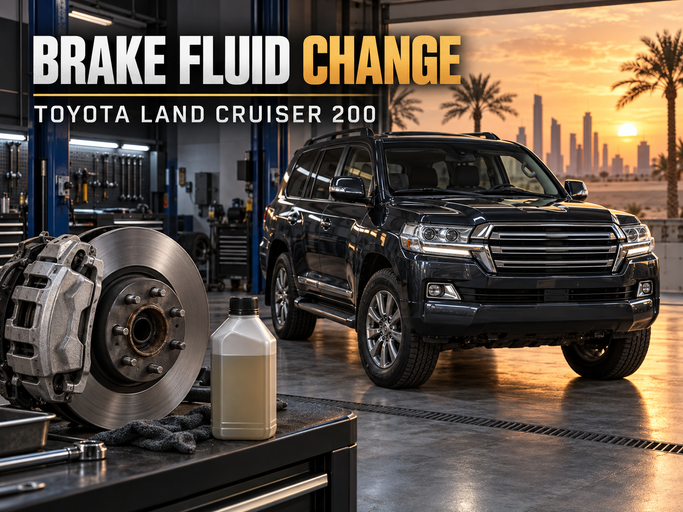
For the Toyota Land Cruiser 200, Toyota's manual calls for a brake-fluid inspection every 10,000 km or 6 months and a complete replacement every 40,000 km or 24 months, whichever comes first. This time limit matters even when the SUV covers little distance: fluid can absorb moisture and lose boiling-point margin while the vehicle is parked or used only occasionally.
How Can You Tell When the Land Cruiser 200 Needs New Brake Fluid?
Do not wait for an obvious symptom before carrying out routine replacement. The fluid may already contain excessive moisture while pedal effort and travel still feel normal. Start with the time-and-distance schedule, then act sooner when a specific fault or sign of contamination appears.
- The fluid has covered 24 months or 40,000 km. Replace it when the first of these limits is reached. Count from the last confirmed full replacement, not from the date you bought the vehicle.
- The brake pedal feels soft or travels farther than before. Possible causes include air in the circuit, overheating, a leak, a damaged hose, a master-cylinder fault or a hydraulic-control problem. Adding fluid does not correct any of them.
- The brakes engage later. If the pedal must move farther before the vehicle begins to slow as expected, avoid high-speed or high-load driving until the system has been inspected.
- The level drops quickly or a red warning illuminates. A small reduction can accompany pad wear, but Toyota's manual states that frequent top-ups indicate a serious problem. Rule out a leak first.
- The fluid is cloudy, uneven in colour or contains sediment. Colour does not provide an exact boiling-point reading, but particles or signs of another fluid call for a system inspection and usually a complete replacement.
What Happens If You Do Not Change the Brake Fluid?
The LC200's hydraulic system transfers pedal force to the wheel brakes and ABS unit through brake fluid. Because liquid barely compresses, the pedal should produce a clear and repeatable response. Moisture and ageing by-products gradually reduce that margin.
- The fluid absorbs moisture. Glycol-based DOT 3 and DOT 4 fluids are hygroscopic. Small amounts of moisture pass through the reservoir vent and flexible components even when the hydraulic system has no obvious leak.
- The boiling point falls. As water content rises, the fluid can boil sooner near hot calipers. Normal city driving may not reveal the loss of thermal margin.
- Overheating produces vapour. Vapour compresses, so the pedal travels farther and deceleration becomes less predictable. The pedal may feel normal again after cooling, but the underlying problem remains.
- Internal corrosion accelerates. Moisture and contamination can damage cylinders, hard lines, valves and the ABS hydraulic unit. On an older LC200, this risk combines with the natural ageing of seals and flexible hoses.
- Routine maintenance becomes a repair. A neglected system may need caliper work or replacement hoses, a master cylinder or ABS components. Fresh fluid cannot restore worn pads and discs, so inspect the brakes as a complete system.
Toyota's Brake Fluid Maintenance Schedule for the Land Cruiser 200
The Toyota PZ49X-60R60 owner's manual specifies a brake-fluid inspection every 10,000 km or 6 months and replacement every 40,000 km or 24 months, whichever comes first. Its technical data lists SAE J1703 or FMVSS No. 116 DOT 3, as well as SAE J1704 or FMVSS No. 116 DOT 4.
| Item | Land Cruiser 200 guideline | How to apply it |
|---|---|---|
| Inspection | Every 10,000 km or 6 months | Check the level, leaks, hard lines, hoses and overall brake condition; use whichever limit comes first. |
| Routine replacement | Every 40,000 km or 24 months | Count from the last complete replacement and bleeding procedure, not from a top-up or vehicle purchase. |
| Permitted specification | SAE J1703 / FMVSS No. 116 DOT 3 or SAE J1704 / FMVSS No. 116 DOT 4 | Confirm the exact class from the reservoir cap and the manual for the individual vehicle. |
| Quantity | No universal top-up quantity is specified | For a complete replacement, allow enough fluid to flush and bleed every circuit; set the final level between MIN and MAX. |
| After repairs | Bleed according to the Toyota procedure | If the circuit was opened or air entered it, replacing only the reservoir contents is not enough. |
Manual PZ49X-60R60 applies to one of the later LC200 versions. Wording and intervals may differ for other model years and markets. Check the documentation for the exact vehicle before service, and do not automatically transfer LC300 requirements to an LC200.
Which Brake Fluid Does Toyota Specify for the Land Cruiser 200?
Toyota specifies performance standards rather than a brand: SAE J1703 or FMVSS 116 DOT 3, and SAE J1704 or FMVSS 116 DOT 4. The chosen product must explicitly match the reservoir-cap marking and the vehicle's manual.
- Start with the reservoir cap. LC200 hardware can vary by model year and market. The cap identifies the required class for the individual vehicle.
- Check the manual against the VIN and model year. No single recommendation should be treated as universal for every 200 Series version.
- Do not choose DOT 5 because the number is higher. Silicone-based DOT 5 uses different chemistry and is not a substitute for glycol-based DOT 3 or DOT 4 fluid.
- Do not switch to DOT 5.1 without confirmation. A higher boiling point does not override requirements for viscosity, seal compatibility and ABS valve operation.
- Open a new container only. Once unsealed, brake fluid begins to absorb moisture from the air. Fluid of unknown age does not belong in the safety-critical brake system of a heavy SUV.
Old Brake Fluid: Why the Land Cruiser 200 Can Lose Braking Performance
The LC200's mass means its brakes must dissipate substantial heat during deceleration. If the fluid has already absorbed moisture, its boiling margin is smaller. The problem often appears after repeated braking rather than on the first press of the pedal.
When the Risk of Overheating Is Highest
- A long descent. Continuous pedal pressure heats the discs, pads, calipers and fluid. Select a suitable gear early and use engine braking.
- Towing or carrying a full load. Extra mass increases thermal demand. After repeated stops, aged fluid can approach its boiling point sooner than fresh fluid.
- Dune driving and frequent electronic intervention. Low speeds, high tractive load and stability-control operation can heat the brakes more than the distance travelled suggests.
- Repeated hard braking. With little cooling time, the thermal margin disappears quickly. Assess the discs, pads and calipers as well as the fluid.
How Climate Affects Brake Fluid Life
Hot weather does not require fluid replacement every few months, but it reduces the brakes' cooling margin. Coastal humidity increases moisture exposure, while high temperatures add load during descents, towing and fully laden driving. Treat 40,000 km or 24 months as a maximum interval.
Dust and sand pose the greatest risk during service. Clean the cap and surrounding area before opening the reservoir. Do not leave the fluid bottle uncapped in the workshop: the fluid absorbs moisture, and contamination can enter the hydraulic unit's narrow passages.
How to Replace Brake Fluid Correctly on an LC200
A complete replacement means flushing old fluid from every circuit with controlled bleeding. If only the reservoir is emptied, most of the old fluid remains in the lines, calipers and hydraulic control unit.
- Confirm the specification. The technician checks the reservoir cap, owner's manual, model year and vehicle data, then opens a new container of the correct fluid.
- Inspect the system. Check the reservoir, hard lines, flexible hoses, connections, calipers, pads and discs. Repair any leak before bleeding.
- Follow the correct sequence. Flush the old fluid through the bleed points while maintaining the reservoir level. If the reservoir runs dry, air enters the system.
- Account for ABS and electronic hydraulics. After repairs, hydraulic-component replacement or substantial air entry, diagnostic equipment and the factory valve-and-pump procedure may be required.
- Verify the result. The level must be correct, with no leaks or warnings and stable pedal travel. Then perform a safe brake test at low speed.
Can You Replace Brake Fluid Yourself?
A bleeding mistake directly affects safety. Do not let the reservoir run dry, introduce dirt, use unverified fluid or spill it on painted surfaces. Some LC200 versions also have other hydraulic reservoirs, so identify the brake-fluid reservoir before opening anything.
If the pedal sinks too far, the circuit was opened during repairs, or ABS components were replaced, use a workshop with suitable diagnostic equipment. The scan tool supports Toyota's actuator procedures; it is not merely used to reset a service interval.
Checking a Used Land Cruiser 200
The age of most LC200s makes brake-service records especially valuable. A line stating 'brake inspection' does not prove the fluid was replaced, and a top-up does not confirm that the system was bled. A useful work order shows the date, mileage, fluid specification and completed operations.
- No confirmation within the past 24 months or 40,000 km — schedule a complete replacement after inspecting the system.
- Fluid level below the specified range — do not top up blindly; check pad wear and rule out a leak.
- A soft pedal or increased pedal travel — stop an intensive test drive and diagnose the cause before purchase.
- Evidence of brake repairs — ask which components were replaced and how the system was bled.
- Cracked or swollen hoses — fresh fluid alone is not enough; damaged components must be replaced.
Mistakes to Avoid
- Using mileage as the only trigger. If the LC200 has travelled little but more than two years have passed, the fluid has still exceeded the routine limit.
- Filling to MAX with worn pads. When new pads are installed, the pistons move back, the level rises and excess fluid can overflow the reservoir.
- Mixing products of unknown origin. The same DOT marking does not confirm the condition of a product or its compliance with every requirement for the vehicle.
- Judging the fluid by colour alone. Clear fluid does not reveal moisture content, and dark fluid does not identify the cause. Use the interval, an inspection and a proper test when needed.
- Ignoring old hoses and seals. New fluid cannot repair cracking, swelling, corroded hard lines or seized calipers.
Conclusion
For the Toyota Land Cruiser 200, manual PZ49X-60R60 sets a brake-fluid inspection every 10,000 km or 6 months and complete replacement every 40,000 km or 24 months, whichever comes first. Arrange immediate diagnosis if the brake pedal feels soft, pedal travel increases, the brakes engage later, the fluid level falls or a red brake warning illuminates.