


How Often Should Toyota Highlander Rear-Drive Oil Be Changed?
Toyota Highlander
Toyota Highlander•
•29 просмотров
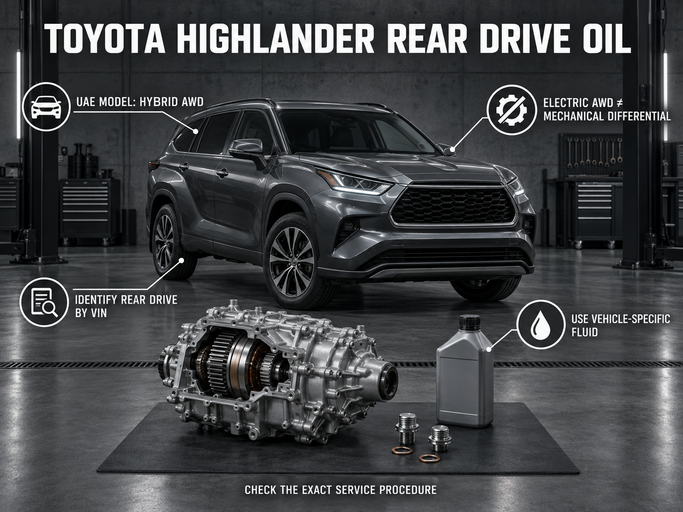
Toyota Highlander does not have one rear-differential oil interval that applies to every vehicle carrying the name. The current UAE-market Highlander Hybrid uses an electrically driven rear axle. Imported petrol AWD versions may have a mechanical driveline, while front-wheel-drive examples have no separate rear drive unit. Correct service therefore starts with the VIN, original market and powertrain—not an assumed mileage figure.
How Do You Identify the Rear-Drive System in a Toyota Highlander?
An AWD badge says that the rear wheels can deliver traction; it does not describe how torque reaches them. A hybrid Highlander uses a dedicated electric unit at the rear axle and needs no propeller shaft from the front transaxle. A petrol AWD model from another market may use a transfer assembly, propeller shaft and conventional rear differential. A front-wheel-drive Highlander has neither rear driveline layout.
- Confirm the VIN, model code, model year and original sales market.
- Establish whether the vehicle is Hybrid AWD, petrol AWD or FWD.
- Inspect underneath: a propeller shaft indicates a mechanical connection, while high-voltage cables identify an electric rear drive.
- Do not transfer specifications from Grand Highlander or from a same-year vehicle sold in another region.
- Match the exact Toyota fluid designation and level procedure to the unit that is actually fitted.
Body shape is not enough to select a lubricant. Vehicles from the same generation can use different powertrains and AWD architectures. When the car's history is uncertain, decode the VIN and photograph the unit identification before ordering oil or opening a plug.
Electric Rear Drive Versus a Mechanical Differential
The hybrid rear module combines an electric traction motor, reduction gearing and differential functions. Control software brings the rear axle into operation without a mechanical shaft from the engine. Its fluid works around a different set of materials and components, so a familiar hypoid gear-oil label is not sufficient proof of suitability.
A mechanical AWD system sends torque through a rotating propeller shaft to the rear final drive. It may contain two separately filled service points: a transfer unit at the front and a differential at the rear. Replacing fluid in one does not automatically service the other.
On an FWD Highlander, the rear suspension, hubs and brakes remain, but there is no oil-filled final drive. A workshop offering rear differential service for such a vehicle should be able to identify the housing, its service plugs and the applicable procedure.
When Does a Highlander Rear Drive Need Its Fluid Checked?
A mileage number detached from the exact variant is a poor decision rule. Use the schedule that belongs to the vehicle, its documented service history and its actual operating conditions. UAE heat, towing, sand, sustained high speed and heavy loads justify closer inspection, but they do not justify inventing a replacement interval.
1. Fluid traces on the housing, subframe or around a plug should be cleaned and rechecked before the source is declared.
2. A new whine, hum or load-related vibration calls for a level, mounting and condition check—not an unapproved thicker oil.
3. An AWD, hybrid-system or overheating message requires fault-code diagnosis before mechanical work begins.
4. After deep-water exposure, inspect breathers, connectors and possible contamination when the relevant procedure calls for it.
5. With an unknown history, identify the assembly and inspect for leakage first; preventive replacement is sensible only when the correct fluid and level method are confirmed.
A slight film around a joint is not automatically an active leak. Airflow can move residue from another component, and old service work may leave a stain. Level checking must be performed with the vehicle positioned, conditioned and measured as required for that specific unit.
Stop driving when there is a confirmed significant leak, metallic noise, abnormal heat or an AWD warning. Hybrid rear-drive work also involves high-voltage precautions. Untrained personnel must not disconnect orange cables or open the electric drive assembly.
New fluid cannot repair damaged gear teeth, bearings or mounts. Record exactly when a noise appears before service. If it starts immediately after a fluid change, verify the part number, level, plug sealing and signs of loss before assuming a new internal failure.
Which Oil Belongs in a Toyota Highlander Rear Unit?
There is no all-purpose Highlander fluid. The hybrid electric rear drive and a petrol model's mechanical differential both propel the rear wheels, but their lubrication requirements are not interchangeable. An FWD vehicle has no rear driveline fluid to replace.
| Item | UAE Highlander Hybrid AWD | Imported petrol Highlander AWD | Highlander FWD |
|---|---|---|---|
| Rear assembly | Dedicated electric drive with reduction gearing | Mechanical differential; may also have a propeller shaft and transfer unit | No separate rear drive |
| Torque path | Electric motor mounted at the rear axle | Mechanical path from the front drivetrain | Front wheels only |
| Fluid | Exact designation confirmed by VIN and electric-unit service data | Specification selected by differential code and market | Not applicable |
| Capacity | Unit-specific; no universal figure | Varies by generation and configuration | Not applicable |
| Schedule | Exact-vehicle documentation plus inspection findings | Treat rear differential and transfer unit separately where fitted | No rear-drive operation |
| Common mistake | Pouring in ordinary hypoid oil without evidence | Assuming the transfer unit and rear differential share one fill | Paying for a component that is absent |
Why Model Year Alone Cannot Select the Fluid
A single model year can include vehicles built for different regions with different engines and drivetrains. An oil application guide that asks only for make, model and year may combine an electric rear drive, a mechanical differential and an FWD vehicle. A matching viscosity number alone does not confirm additive or material compatibility.
Mechanical AWD vehicles can also specify different products for the rear differential and the front transfer assembly. Their capacities and level-setting steps may differ. For the hybrid module, the phrase conventional axle oil is particularly unsafe unless supported by the exact service data.
If trustworthy information for the VIN is unavailable, postpone draining the unit. Experimenting after the plug is removed can leave the vehicle immobilised without a verified way to refill it correctly.
Checks to Complete Before Service
- Keep the vehicle level and provide safe access underneath.
- Match the VIN, model code, engine type and factory drive-system designation.
- Locate the unit identification and confirm that the plugs belong to that assembly.
- Make sure the fill plug can be opened before removing the drain plug.
- Prepare new sealing washers and the correct tightening torque.
- After filling, inspect for leaks and repeat the road test under the original conditions.
Inspect drained fluid in good light. Fine dark paste on a magnet is different from needle-like swarf, large fragments or an obvious bronze sheen. Interpretation is design-specific, however; an electric drive should not be judged by the plug layout and debris expectations of a conventional axle.
When researching a used vehicle, current listings can help show which powertrains and model years are available locally. This comparison remains only a starting point; the individual Highlander still needs VIN verification and an underbody inspection.
Why Does a Toyota Highlander Hum at the Rear—and Is Oil Always to Blame?
Noise perceived behind the seats does not prove that the rear drive is failing. Tyre, hub and even front-transmission sounds travel through the floor and can appear to come from another corner of the vehicle. Diagnosis should track road speed, drive or coast, steering input, temperature and surface type.
| Possible cause | Typical clue | First check |
|---|---|---|
| Uneven tyre wear | The hum changes substantially with road surface or after tyre rotation | Inspect tread pattern, pressure and alignment |
| Rear wheel bearing | Pitch follows speed and changes during gentle left-right load transfer | Check play, roughness and hub temperature |
| Hybrid AWD electric rear drive | Noise coincides with rear-axle engagement or a system message | Scan for faults and compare sound with AWD operating data |
| Mechanical differential on an import | Whine differs between drive and coast; leakage may be visible | Check level, play, breather and leak source |
| Propeller shaft or mount | Vibration strengthens under load or within a narrow speed range | Inspect joints, centre bearing and mountings |
| Brake shield or dragging caliper | Rotational scraping is present and one wheel may run hotter | Check shield clearance, pads and free movement |
| Front drivetrain or exhaust | Structure-borne sound is mistaken for a rear source | Localise it during a controlled road test and lift inspection |
What to Check Before Authorising a Repair
Start by recording speed, throttle position, coasting, steering direction and vehicle temperature. Inspect tyres and hubs next because they are common and quick to verify. On a Hybrid AWD model, diagnostic data can show whether the electric rear unit was producing torque when the noise occurred.
If the sound continues while the rear axle is inactive, the electric module should not automatically be the leading suspect. In a mechanical AWD system, a difference between acceleration and overrun helps direct attention toward gear contact or bearings, but the conclusion still requires level, backlash and fluid inspection.
A vibration that starts after recent work should prompt checks of mounts, propeller shafts, drive shafts and wheels. Oil cannot balance a rotating part or repair a damaged support. Noise-suppressing additives may hide evidence and make later diagnosis harder.
Before approving disassembly, ask the workshop to demonstrate the noise or leak, document the level check and identify the applicable fluid specification. That sequence avoids replacing a healthy assembly without overlooking genuine fluid loss.
Conclusion
The current UAE Toyota Highlander Hybrid AWD uses an electric rear drive and must not be serviced as a conventional mechanical axle. Imported petrol AWD and front-wheel-drive versions are different again. Identify the assembly by VIN first, then use only its specified fluid and procedure; one universal Highlander interval is not valid.


