


Toyota Fortuner 2.7 or 4.0: which engine should you choose?
Toyota Fortuner
Toyota Fortuner•
•18 views
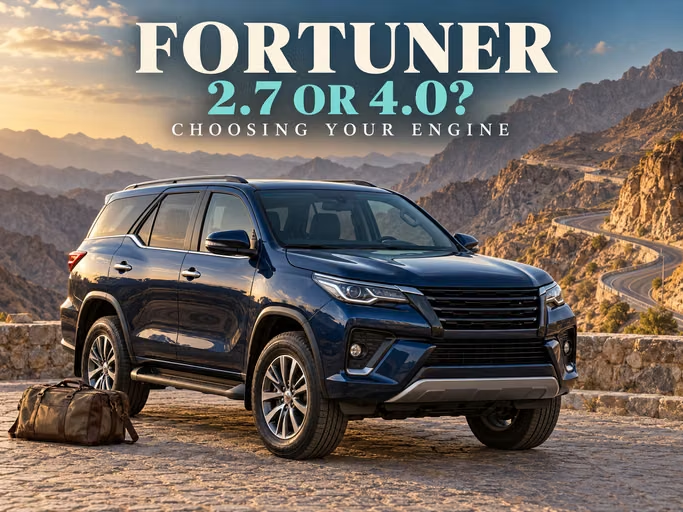
Illustration: vehicle appearance and equipment vary by trim.
The Toyota Fortuner 2.7 is worth considering if reducing the purchase cost matters most and its performance suits your usual journeys. The 4.0 V6 provides substantially more power and torque, making it worth testing with passengers and luggage aboard. However, the premium also buys additional equipment: choosing an engine means choosing a trim as well.
Consider the official UAE range for the 2026 model year. On toyota.ae, the EXR 2.7 is listed at AED 128,900 and the GXR 4.0 at AED 154,900. That creates an AED 26,000 gap. Before buying, establish which of your actual needs would justify paying it.
How do the Fortuner 2.7 and 4.0 specifications differ?
Engine output is the main distinction. Both versions retain seven seats, a six-speed automatic transmission and selectable four-wheel drive. Choosing the smaller engine does not mean giving up those features.
| Specification | Fortuner EXR 2.7 | Fortuner GXR 4.0 |
|---|---|---|
| Price, AED | 128,900 | 154,900 |
| Engine | 2.7 litres, 4 cylinders | 4.0 litres, V6 |
| Output | 164 hp | 235 hp |
| Torque | 245 Nm | 376 Nm |
| Transmission | 6-speed automatic | 6-speed automatic |
| Four-wheel drive | Part-time | Part-time |
Figures come from the 2026 Fortuner specification sheet. Prices include VAT but exclude shipping and handling; some colours may cost extra. Request a complete quotation covering registration, insurance and your selected options before comparing the final totals.
Is the 2.7 engine sufficient for everyday driving?
That depends on the load you carry and your expectations of acceleration. A short drive with only the driver aboard will not show whether the vehicle suits regular family trips. Test it in conditions that resemble your intended use, with the air conditioning operating, passengers aboard and a representative route.
Check acceleration when joining a faster road, the automatic transmission's response to the accelerator and progress on an incline. Notice whether maintaining your preferred pace requires frequent heavier accelerator inputs, and whether the accompanying engine noise bothers you. One driver may accept this behaviour while another finds it tiring.
If your Fortuner usually carries one or two people and the test drive reveals no concerns, the EXR's lower purchase price may be more useful than extra output. However, buying the 2.7 simply because someone calls it sufficient for everyone overlooks differences in passenger loads, routes and expectations. Your own driving needs should decide.
When does paying more for the V6 make sense?
The 4.0 produces an additional 71 hp and 131 Nm. Buyers who frequently carry family and luggage, travel on faster roads or use routes with sustained climbs should assess that extra output. These figures explain the V6's appeal, but they do not establish a particular vehicle's acceleration time.
Drive both versions consecutively on the same route. Look for predictable accelerator response, comfortable progress at your intended speed and passenger comfort. If the difference matters during journeys you make regularly, the premium has a clear purpose. If you appreciate it only in situations you rarely encounter, the case for paying more becomes weaker.
Does the V6 bring additional off-road equipment?
The GXR and VXR specification includes a rear differential lock; the EXR does not list one. The differences therefore extend beyond engine capacity. The differential lock addresses particular traction situations, while engine output contributes to a different aspect of the vehicle's capability.
Part-time four-wheel drive is a selectable system. Do not treat it as an automatically operating AWD system. Read the vehicle's manual for mode selection and operating restrictions. Driver preparation and choosing a route appropriate to the vehicle also matter when leaving straightforward road surfaces. An equipment list alone does not establish readiness for difficult terrain.
How much does fuel consumption differ?
The specification lists 10.4 km/l for the 2.7 and 9.6 km/l for the V6. Converted, these are approximately 9.6 and 10.4 litres per 100 km respectively. A higher km/l figure means less fuel is needed over the same distance; it is easy to confuse the two measurement systems.
At an illustrative annual distance of 20,000 km, the published figures imply a difference of about 160 litres. Using an assumed petrol price of AED 3 per litre gives approximately AED 481 a year. This is a calculation example, not a current fuel price or a prediction of your spending. Traffic, vehicle load and driving style affect actual consumption.
What does the premium buy beyond the engine?
Moving from EXR to GXR adds three-zone automatic climate control, a reversing camera, front parking sensors and push-button start. Treating the entire AED 26,000 difference as the cost of the V6 alone would therefore be misleading. List the features you need and check them on the vehicle.
At AED 173,900, the VXR costs another AED 19,000 above the GXR while retaining the same quoted engine output. Examples of its additional equipment include ventilated front seats, a panoramic view monitor and blind-spot monitoring. If your main requirement is the 4.0 engine, the GXR provides it without requiring the most expensive trim.
Which Fortuner drawbacks should you check before buying?
Assess potential drawbacks against your intended use. More engine power does not change the body length: both versions measure 4,795 mm. Check garage access, turning into your usual parking space and getting out when adjacent spaces are occupied. Parking assistance can help with manoeuvring, but it cannot reduce the vehicle's dimensions.
Test the seven-seat layout as well. Ask the intended passengers to try the third row, check access and examine the luggage space left behind it. If you regularly need every seat and several large suitcases, check that the luggage fits with all passenger seats occupied. Assess ride comfort from the second row during the test drive.
How should you compare used 2.7 and 4.0 models?
Start with condition and service history. A desirable trim cannot compensate for unexplained damage, gaps in documentation or a seller refusing an independent inspection. Have a specialist assess the body and underside, perform diagnostics and check transmission operation.
When comparing current offers, select similar model years, mileages and specifications. Do not apply the new EXR-to-GXR price gap to every used vehicle. Nor should you assume that resale will recover the full V6 premium: the eventual selling price depends on condition and demand at that time. Budget for the car you are buying, rather than a guaranteed future return.
What should you confirm before deciding?
☐ Both engines have been tested on comparable routes with a typical load.
☐ Passenger and luggage space meets your needs without awkward compromises.
☐ The premium has been assessed against engine performance and useful equipment.
☐ A complete vehicle quotation and an insurance quotation are available.
☐ An independent condition inspection has been completed for a used car.
Conclusion
Choose the Fortuner 2.7 when keeping the purchase cost down matters and its performance meets your needs in realistic conditions. The GXR 4.0 merits the premium when you regularly need more power with a load and value its additional equipment. A comparative test drive will show which V6 benefits you would actually use every day.


