


Used Toyota Crown in the UAE: what should you check before buying?
Toyota Crown
Toyota Crown•
•7 views
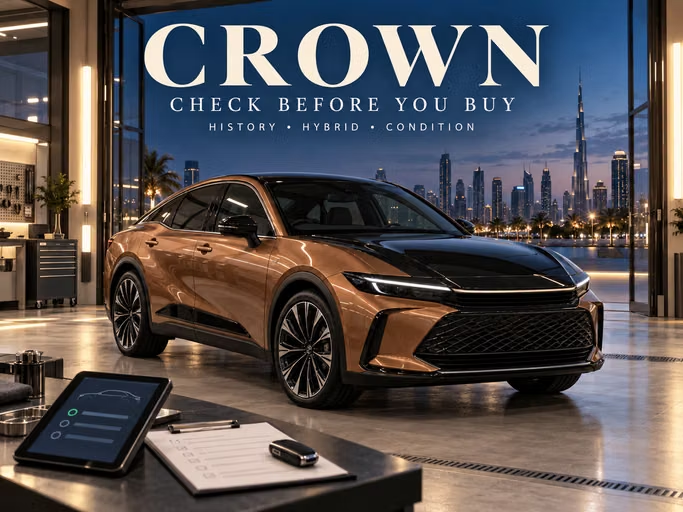
Illustrative cover: appearance may differ by specification and model year.
Start a used Toyota Crown purchase by confirming the version and history, then arrange diagnostics. An attractive price, low mileage and well-equipped cabin do not answer the main questions: what is being sold, how was it maintained and what will need spending after purchase? For the modern turbo hybrid Crown, it is worth checking the hybrid system, suspension and electronic equipment alongside the engine.
This approach separates a suitable example from a car that merely photographs well. Request documents and agree on an independent inspection before visiting the seller. That helps establish whether the particular offer deserves more of your time.
How can you identify the Toyota Crown you are viewing?
The Crown name alone is insufficient. Record the year, body, engine, transmission and original regional specification. Match the vehicle identification number, or VIN, on the car to its documents. Treat the advertised trim name as a useful starting point that still needs confirmation.
As a reference, consider the 2026 Crown 2.4 Turbo Hybrid Platinum in the official specification. These figures help identify this version; they do not describe every Crown on the used market.
| Specification | Crown Platinum 2.4 Hybrid 2026 |
|---|---|
| Engine | 2.4-litre turbo hybrid |
| Combined system output | 345 hp |
| Transmission | 6-speed automatic |
| Drive | AWD (E-FOUR) |
| Suspension | Adaptive, AVS |
| Wheels | 21-inch |
Which documents should you request before viewing?
Ask for registration details, maintenance history and repair records. Check workshop invoices for dates, mileage, work descriptions and a link to the correct VIN. A service stamp is useful, but an itemised invoice better explains what was completed and which recommendations remained outstanding.
Ask about substantial gaps in the history and inconsistencies between dates and odometer readings. Clarify previous body repairs, glass replacement and work on electronic equipment. A repair does not automatically make a car a poor purchase: its nature, quality and documentation matter. A verbal assurance that it was “nothing serious” cannot replace inspection.
Establish who is selling the car and who will sign the paperwork. If the seller mentions a warranty or service package, request its terms and confirmation that it applies to this vehicle. Do not assume a package transfers to the next owner until its provider confirms that.
How should you check the hybrid system and battery?
Use a workshop familiar with this Crown version and equipped to assess it. Request written findings showing which systems were checked, any faults found and further investigation needed. “The scanner found nothing” offers little help without an explanation of the inspection’s scope.
Discuss assessment of the traction battery, its cooling and available diagnostic data. The dashboard charge indicator is not a measure of remaining battery life. An absence of warnings during a brief viewing does not establish that every component is healthy. If the workshop reports a health percentage, ask how it was calculated and what the result cannot establish.
The inspection should include checks for damage, moisture and unauthorised modifications, alongside fault-code reading. Do not open high-voltage components yourself. If a problem is found, obtain a diagnosis and repair estimate before deciding whether the price still makes sense.
How long is the hybrid battery warranty?
The published UAE warranty terms state eight years or 160,000 km, whichever comes first. This defines coverage; it does not promise that the battery must be replaced at a particular age or establish its present condition.
For a used Crown, confirm coverage by VIN, the warranty start date, remaining mileage allowance and applicable exclusions. Do not automatically apply local terms to any imported vehicle. If the seller supplies a separate warranty, clarify who pays for repairs and which components the contract covers.
What should you assess beyond acceleration on a test drive?
Begin with seating, visibility and controls. Then assess gentle acceleration, slowing down, low-speed manoeuvres and behaviour once warm. There is no need to test the published performance figures. Repeated jolts, vibration, unusual noises or warnings are more useful observations to pass to the technician.
The selected Platinum has adaptive suspension and 21-inch wheels. Drive over typical road joints and uneven surfaces, assessing comfort and unusual noises. Ask the workshop to inspect the suspension and wheels on a lift. Wheel diameter alone proves neither a fault nor an expensive repair; actual condition and a specific quotation determine the cost.
Run the air conditioning and check seat adjustments, cameras and parking sensors. Connect your own phone, inspect the screen image and try the functions you need. Match equipment to the actual car: a catalogue list does not establish that every feature is fitted and working on this example.
Where should you search, and how should you assess the price?
Dealers and private sellers are both possible sources, but documents, transaction terms and inspection determine the purchase’s quality. Use a marketplace to find candidates rather than to replace vehicle checks. When reviewing current offers, first select comparable versions, then assess year, mileage, history and equipment.
On toyota.ae, the new 2026 Crown Hybrid starts at AED 199,900. That is a new-car reference, not a ready-made valuation of a used Crown. An asking price is also not a completed sale price. One unusually cheap example does not define the market; investigate why it differs.
Add confirmed immediate expenses, registration and insurance to the asking price. Separate necessary repairs from optional improvements. If a significant fault remains undiagnosed, a modest discount does not make the unknown costs predictable. Resolve the uncertainty before negotiating a final figure.
When should you postpone the purchase?
Pause if identification details conflict, the seller refuses independent inspection or promises to explain a warning only after payment. Significant differences between promised and confirmed warranty terms also need attention. These situations call for documents and investigation rather than a rushed payment.
Ordinary wear and clearly defined work may lead to a different decision. Obtain a repair quotation and timeframe, then consider them alongside the price. The purpose of inspection is to understand condition and future spending, not to demand that a used car has no wear whatsoever.
What should be checked before buying?
☐ VIN, year, engine and trim match the documents.
☐ Maintenance history and disclosed repairs are supported by records.
☐ Written hybrid diagnostics and body-inspection findings are available.
☐ Suspension, wheels, climate control and essential features have been checked.
☐ Warranty, immediate expenses and handover terms are clear.
Conclusion
Choose a used Crown on the verified condition of the individual car. An identified version, clear history, hybrid diagnostics and a documented repair estimate provide a basis for discussing price. If major questions remain unanswered, continuing the search is more useful than accepting uncertainty alongside an attractive specification.


