


Does a Toyota Corolla Need Transfer Case Oil Changes?
Toyota Corolla
Toyota Corolla•
•23 مشاهدة
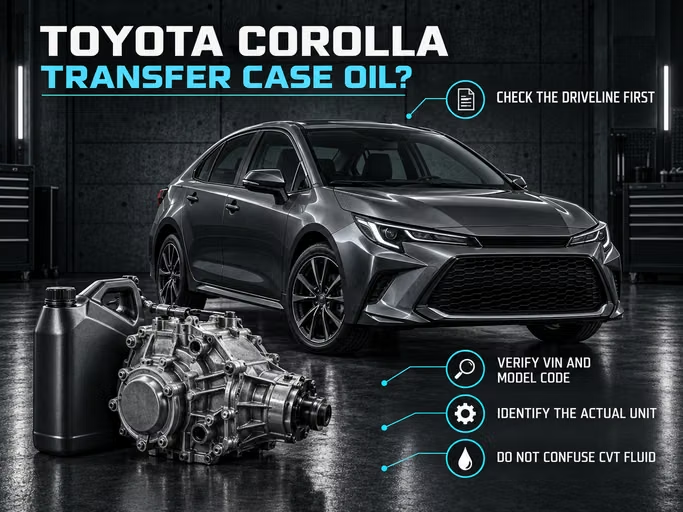
A transfer case oil change must not be assigned to a Toyota Corolla from the model name alone. The current UAE Corolla 2026 range presents 1.6 CVT and 2.0 Direct Shift-CVT versions, while the public material does not identify a separate four-wheel-drive configuration or a transfer case service item. If the vehicle has no separate unit, there is no transfer case oil to change.
Begin by establishing the actual driveline layout. This is especially important for imported cars, uncommon derivatives, and modified vehicles: the Corolla badge does not guarantee the same set of assemblies. CVT fluid, transmission oil, and lubricant for a separate angle drive or transfer unit are not one product.
Identify the Installed Assembly First
Before buying fluid, match the VIN, complete model code, model year, original market, and actual underbody layout. An AWD label in a listing or a seller’s description is not identification. You need to verify the physical route by which torque is delivered and whether a separate housing with its own plugs exists.
- Current UAE Corolla 1.6 CVT. The official model information specifies a 1.6-litre engine and CVT, but it does not list a separate 4WD system or transfer case. Do not add that service to the repair order without different evidence for the individual VIN.
- Current Corolla 2.0 Direct Shift-CVT. The public specification describes the engine and transmission but contains no separate transfer-unit entry. CVT service must not be relabelled as a transfer case oil change.
- Imported vehicle carrying an AWD description. Determine whether the rear axle receives torque mechanically through a separate assembly or by another layout. Only then can the correct fluid, level procedure, and schedule be researched.
- Special, performance, or converted version. Do not carry ordinary-sedan data over to it, and do not apply information for another member of the model family to a standard Corolla. The documentation must match the installed driveline.
- Vehicle origin is unclear. Do not drain fluid by guesswork. Decode the VIN, photograph the complete model-code plate, and ask a specialist to identify the housings, shafts, breathers, and plugs underneath.
Why an AWD Label Does Not Prove a Transfer Case Exists
All-wheel drive can be implemented in different ways. A mechanical layout passes torque to the other axle through gears and a shaft; an electrified layout may drive the rear axle without a conventional mechanical connection to the front transmission. The term AWD therefore establishes neither the fluid type nor the presence of a serviceable housing.
During an inspection, look for a separate torque-transfer unit, a propeller shaft, fill and drain plugs, a breather, and joints to neighbouring assemblies. Underbody shields and old residue can be misleading. Find a leak after cleaning rather than assuming that its source is the lowest wet point.
When the Driveline Needs an Unscheduled Inspection
Unusual symptoms still require diagnosis of the assemblies that are actually fitted, even when there is no separate transfer case. If a mechanical transfer unit is confirmed, an early check is reasonable after any event that could affect its level, sealing, or lubricant condition.
- Fresh fluid residue appears. Clean the transmission and shield, then inspect the plugs, case joints, seals, and breathers. Rechecking after a short drive helps reveal an active source.
- The car has travelled through deep water. Moisture can enter a serviceable housing through a breather or damaged seal. Cloudiness, foam, or pale emulsion calls for correction of the entry path and replacement of fluid in the affected assembly.
- The underbody has been struck. A distorted shield, cracked housing, or damaged plug can cause a slow loss of level. Check for leakage and unintended contact before the car returns to service.
- A hum, shudder, or knock appears as torque changes. The source may be the transmission, driveshafts, a propeller shaft where fitted, a differential, mounts, or wheel bearings. Locate it before deciding between repair and fluid service.
- Service history is unknown. A note without a date, mileage, and exact product does not confirm the work performed. Establish a new baseline only after the assemblies have been identified and checked for leakage.
What the Official Corolla 2026 Information Confirms
According to toyota.ae, the current Corolla 2026 is presented with either a 1.6-litre engine and CVT or a 2.0-litre engine and Direct Shift-CVT. The public model page and specification do not identify a separate 4WD configuration or transfer case service operation. Those materials describe the current range but do not replace identification of an imported or special vehicle.
| Situation | Correct action |
|---|---|
| Current-range Corolla 1.6 CVT | Do not add transfer case service without VIN and hardware confirmation of a separate unit |
| Current-range Corolla 2.0 Direct Shift-CVT | Check CVT requirements separately; do not call that work a transfer case oil change |
| Imported vehicle carrying an AWD description | Identify the AWD layout and a mechanical housing before selecting fluid |
| Special or performance version | Use information for that exact model, year, and original market |
| Converted vehicle | Follow documentation for the components that were actually installed |
| No exact document | Do not invent an interval or select fluid from a general catalogue or another version |
Establish the exact procedure from the VIN, complete model code, model year, and original market. If the specific manual for the vehicle cannot be found, do not invent a universal interval, choose fluid from another Corolla, or treat a general catalogue as proof of the hardware.
What to Do When There Is No Separate Transfer Case
Do not put a nonexistent assembly into the maintenance plan. Instead, check the requirements for the components the car actually has: the engine, CVT or transmission, drive shafts, and other relevant units. Fluid designation, level-setting method, and interval are established separately for each one.
Heat, sand, short journeys, and dense urban traffic can increase the duty imposed on real vehicle components, but they cannot create a transfer case where none is fitted. Read the severe-service notes for the exact configuration. If a matching document cannot be found, record workshop advice as preventive guidance rather than a Toyota factory schedule.
Avoiding Confusion Between Driveline Fluids
Choose fluid from the identity of the specific assembly, not from the vehicle make or the term AWD. Then verify the fluid type, viscosity and performance standard, level-setting method, seals, and plug torque. Reference capacity helps with preparation, but it does not replace the prescribed level check.
- Do not buy gear oil merely because the car is described as all-wheel drive. First confirm a separate mechanical housing and its specification.
- Do not put transfer case oil into a CVT or transmission. Similar locations and the broad term “driveline” do not make the fluids interchangeable.
- Do not apply requirements for a special Corolla, Corolla Cross, or another model to the ordinary sedan. A related name does not establish identical construction.
- Do not use the container capacity as the fill quantity. Residual fluid, temperature, and vehicle position affect the result, while overfilling can cause foaming and leakage.
Assessing Noise and Fluid Traces
Fluid on a shield may have travelled from an assembly above it, and a hum does not necessarily come from gears. Record whether the sound changes under acceleration, on overrun, in a turn, or during braking; compare its frequency with engine speed and road speed. After cleaning, inspect the driveline again and check the tyres, wheel bearings, driveshafts, mounts, and nearby housings.
| Observation | Possible meaning | Next step |
|---|---|---|
| Fluid on an underbody shield | The source is above it or residue remains from earlier work | Clean the surfaces and inspect again after driving |
| Cloudiness or emulsion | Water is probably present | Find the entry path and service the affected assembly |
| Overheated odour | High temperature or oxidation | Check the level, duty cycle, and housing condition |
| Large metallic particles | Possible gear or bearing wear | Do not stop at a fluid change; inspect internally |
| Hum follows road speed | Tyres, wheel bearings, driveshafts, or transmission may be involved | Locate the sound in several driving states |
| Leak after service | Level, seal, thread, or ventilation error | Stop the leak and verify the level again |
Practical Inspection Checklist
☐ Record the VIN, complete model code, model year, and original market.
☐ Confirm the installed engine, transmission type, and drive designation.
☐ Inspect the torque path underneath and look for a separate serviceable housing.
☐ Do not treat the CVT, final drive, and transfer unit as one assembly.
☐ Match every plug, breather, and seal to its housing before draining anything.
☐ Inspect shields, joints, and shaft exits for leakage or impact evidence.
☐ If a separate unit is confirmed, loosen its fill plug before the drain plug.
☐ Use only the verified fluid and the sealing parts required by the procedure.
☐ After the work, check the level, sealing, and result of a short road test.
Mistakes to Avoid
- Scheduling transfer case oil service for every Corolla. The operation does not exist on a car without a separate unit.
- Treating an AWD label as a complete specification. It does not reveal the drive layout or identify a fluid.
- Copying an interval from another model or market. Closely related names can still cover different assemblies and schedules.
- Trying to mask a hum with thicker oil. Fluid cannot restore bearings, splines, mounts, or damaged gear teeth.
- Stopping at a fluid change after leakage, water, or an impact. Correct the source first, restore the proper level, and perform a follow-up check.
Conclusion
Plan a Toyota Corolla transfer case oil change only after confirming that a separate mechanical unit is actually fitted. The public information for the current 1.6 CVT and 2.0 Direct Shift-CVT sedans does not identify one, so service begins with driveline identification rather than an oil purchase. Leakage, water, an impact, or a new noise requires diagnosis of the real source. Current offers for Toyota Corolla can assist with vehicle selection, but the drive type and service data for each example still need confirmation from its VIN, records, and actual construction.


