When Should You Change the Transfer Case Oil in a Toyota Camry?
Toyota Camry
Toyota Camry•
•68 просмотров
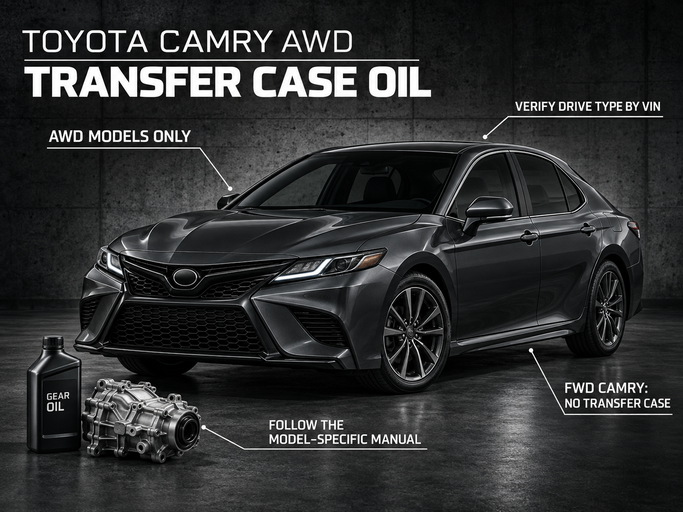
Most front-wheel-drive Toyota Camry models do not have a separate transfer case, so there is no transfer case oil to replace. This service applies only to selected mechanically driven all-wheel-drive versions, including XV70 Camry AWD models sold in certain markets. The correct interval comes from the maintenance guide for the exact model year; one figure for every Camry would be misleading.
Identify the driveline by VIN and model code before ordering lubricant. A mechanically driven Camry AWD has an angle-transfer unit and a rear differential, while some newer hybrid AWD versions drive the rear axle with a separate electric motor. A schedule written for one architecture cannot be carried over to another merely because both cars display an AWD badge.
When Does the Camry Driveline Need an Unscheduled Check?
The transfer unit normally works without attracting the driver’s attention, yet its condition depends on sealing, temperature, and actual workload. The maintenance record should be supplemented by an inspection after an underbody impact, visible leakage, or the purchase of a car with an uncertain service background.
- The drive type has not been confirmed. Before any service, establish that the vehicle truly has mechanical AWD. Stability-control switches, trim names, and badges do not replace a VIN, model-code, and underbody check.
- Oil traces are visible on the housing. Damp dust around plugs, case joints, or shaft seals can indicate a gradual loss of level. Clean the area and inspect it again to distinguish old residue from an active leak.
- The car has encountered deep water or an underbody impact. A Camry is not intended for water crossings, but flooding, a deep pool of water, or damaged protection warrants an extra inspection. Cloudy fluid or emulsion requires correction of the entry path and complete oil renewal.
- A new hum or vibration has appeared. Noise during acceleration or overrun may come from the transfer unit, rear differential, propeller shaft, wheel bearing, or tyres. Locate the source before prescribing a fluid change from one symptom alone.
- The maintenance history is unavailable. On a used Camry AWD, unidentified lubricant and an unknown distance since the last service call for an inspection, level check, and specification review. An automatic refill with a convenient product can introduce a new fault.
How Heat, Traffic, and Load Affect the Oil
High ambient temperature raises the thermal burden on the driveline. Cooling airflow is weaker in dense traffic, while repeated acceleration can make the AWD system engage the rear axle frequently. A full passenger load and extended high-speed travel also add heat, but none of these conditions independently authorises a different viscosity. After a demanding route, checking sealing and any new odour is more useful than shortening the interval by an arbitrary distance without documentary support.
External dust does not enter a sealed unit directly, although it can conceal fresh seepage and make inspection harder. After a dirty-road journey, clean the underside without directing high-pressure water at seals or electrical connectors, then examine the housing, plugs, and shaft areas. A clean surface reveals the direction of a fresh trace and helps distinguish engine, transmission, or rear-differential oil from a transfer-unit leak.
What Happens When Camry AWD Transfer Oil Is Low or Degraded?
A lubricant problem rarely causes an immediate failure. The oil film weakens first; temperature, noise, and clearances then begin to rise. Continued driving under load can turn a local issue into bearing or gear damage, at which point routine fluid service will no longer be enough.
- Lubrication becomes uneven. A low level leaves some surfaces with less oil. The effect becomes more significant on a long journey when the housing remains hot.
- Fluid oxidation accelerates. Heat and suspended wear debris reduce the oil’s ability to retain the required viscosity and protect loaded contact surfaces.
- Bearings and gear meshes begin to run more harshly. Increased clearance may produce humming, shudder, or a change of sound as the driveline moves between drive and overrun.
- Leakage becomes both a result and a cause of wear. Heat and pressure load the seals, oil loss increases, and a contaminated housing makes the original leak path harder to identify.
- An advanced fault requires mechanical repair. Fresh oil cannot restore damaged bearings, seating surfaces, or gear teeth. The repair scope is established through diagnosis and strip-down inspection.
What Toyota Specifies for the Camry AWD
Toyota’s maintenance guide for the Camry and Camry AWD marks transfer case oil operations as AWD-only items. The schedule separates standard maintenance from additional work for defined operating conditions, so each interval must be read together with the note attached to that entry.
| Parameter | What to Confirm for a Toyota Camry |
|---|---|
| Applicability | Only mechanical-AWD versions with a separate transfer unit |
| Front-wheel drive | No separate transfer case is fitted |
| Electric AWD | Different architecture; use its own maintenance schedule |
| Normal service | Follow the inspection entries in the model-year maintenance guide |
| Special conditions | Perform additional replacement only where the schedule requires it |
| Oil and quantity | Confirm by VIN, model code, and the specified level procedure |
Select the appropriate document for the model year, destination market, and drive type from Toyota’s manuals directory. Vehicle-specific VIN data takes priority over a general retailer recommendation or the label on a conveniently selected container.
How to Apply the Camry AWD Maintenance Schedule
Count from the last documented inspection or replacement, not from the date on which the next owner purchased the car. When no record exists, first identify the hardware, examine sealing and fluid condition, and then establish a reliable new maintenance baseline. A repair order should record the date, mileage, and exact product used; that evidence is more useful than a previous owner’s verbal assurance that the work was completed recently.
Additional maintenance may apply during prolonged high-load use and other conditions defined by Toyota for the relevant market. This does not make every urban vehicle a severe-service car. Base the decision on the real duty cycle and the correct edition of the maintenance guide. For mixed use, consider repetition rather than one isolated event: an occasional full passenger load and constant intensive operation do not affect the service plan in the same way.
Choosing Oil for Different Camry Drivelines
The Toyota Camry name alone cannot identify the product. A front-wheel-drive car has no separate transfer case; a mechanical AWD version has a dedicated angle-transfer unit; and an electrically driven rear axle uses a different architecture. Confirm the specification, quantity, and level-setting procedure by VIN. Also compare the plug design and unit location; this can expose a selection error before the lubricant container is opened.
- Do not borrow a lubricant specification from another Toyota model. Units that appear similar may use different viscosity, additives, fill quantities, and sealing washers.
- Do not confuse transfer-unit oil with ATF. Automatic transmission fluid serves the transmission, but that does not automatically make it suitable for a separate angle drive.
- Do not select a thicker oil simply because the climate is hot. Climate affects how closely sealing and fluid condition should be monitored, but the factory approval changes only when Toyota explicitly says so.
- Do not use the container size as a fill target. Published capacity is a reference; set the final level using the procedure for the exact unit with the vehicle positioned correctly.
What Can the Oil and Camry AWD Behaviour Reveal?
Driveline noise in an AWD Camry should not automatically be assigned to the transfer unit. Diagnosis also covers tyres, wheel bearings, the propeller shaft, rear differential, mounts, and transmission. The appearance of drained oil adds evidence but cannot replace a physical inspection. Fine paste on a magnetic plug and large reflective fragments are interpreted differently; the final judgement should account for mileage, the character of the sound, and the condition of neighbouring parts.
| Condition | Effect | Possible Driver Observation |
|---|---|---|
| Leak or low level | Lubrication and cooling deteriorate | Oily dust, a new hum, or overheated-oil odour |
| Water contamination | The oil film weakens and corrosion risk rises | Cloudiness, foam, or emulsion |
| Incorrect fluid | Viscosity and additives do not meet the requirement | Noise, heat, or no early warning |
| Elevated temperature | Oil oxidation accelerates | A change of colour or odour after heavy use |
| Bearing or gear wear | Clearance and impact loading increase | Hum, shudder, or a sound change on overrun |
| Another noise source | A neighbouring driveline or chassis part is faulty | Noise varies with speed, tyres, or steering input |
Practical Service Checklist
☐ Confirm by VIN and hardware that the Camry has mechanically driven AWD.
☐ Record the model year, model code, destination market, and vehicle mileage.
☐ Locate the maintenance guide for this exact version and read its operating-condition notes.
☐ Confirm the date of the previous inspection or change and identify the oil used.
☐ Inspect the housing, plugs, joints, shaft seals, undertray, and nearby components.
☐ Before draining, make sure the fill plug can be removed with the correct tool.
☐ Check the drained oil for water, an overheated odour, and visible metallic debris.
☐ Use the verified specification and new seals where the procedure requires them.
☐ Set the level and tighten the plugs as specified, then check carefully for leakage.
Mistakes to Avoid
- Changing oil in a transfer case that is not present. A front-wheel-drive Camry has no separate unit of this type, so confirm the vehicle layout first.
- Applying a mechanical-AWD schedule to electric all-wheel drive. The same AWD label does not prove that the construction or service fluids are identical.
- Ordering lubricant by the Camry name alone. Model year, model code, destination market, and exact transmission version matter more than the general model name.
- Trying to hide a hum with thicker oil. This cannot repair a bearing, propeller shaft, rear differential, or damaged gear mesh.
- Treating a fluid change as complete diagnosis. After leakage, impact, or contamination, find the underlying cause or the fresh oil may be lost or damaged again.
Conclusion
There is no universal Toyota Camry transfer case oil interval because most front-wheel-drive versions have no such unit. The operation belongs to mechanically driven Camry AWD models and must follow the maintenance guide for the exact model year and market; electric AWD requires a separate schedule. Verify the VIN before service and arrange an unscheduled inspection after leakage, impact, or water contamination. Toyota Camry current listings can be reviewed separately, but drive type and fluid requirements must be confirmed from the selected vehicle’s documents.