Toyota Camry Coolant Replacement: Intervals, Capacities and System Checks
Toyota Camry
Toyota Camry•
•110 views
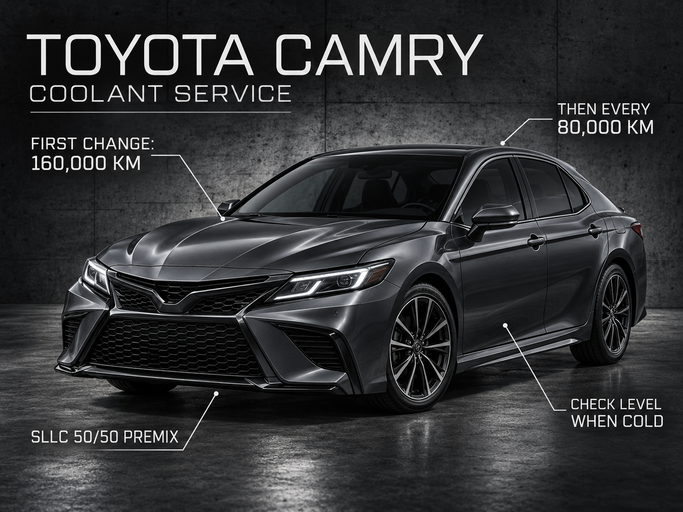
The current Toyota Camry schedule for factory-filled Toyota Super Long Life Coolant places the first planned replacement at 160,000 km and later replacements every 80,000 km. Those figures belong to specific documentation, so confirm the model year, sales market, engine and powertrain before servicing the car.
Across Camry generations, common choices include the M20A-FKS, A25A-FKS and 2GR-FKS petrol engines and the A25A-FXS hybrid. A hybrid cools both its engine and power electronics, which rules out one universal capacity for every version.
When a Camry Needs an Unscheduled Cooling-System Check
Scheduled mileage is only one part of the assessment. Also consider the cold-level trend, fluid clarity, heater consistency and temperature behaviour in slow traffic.
- There is no record of the last replacement. A top-up does not renew all the coolant. If the paperwork is missing, identify the existing fluid and inspect the circuit for leakage or contamination first.
- The level keeps moving downward. If it returns to L or below after a top-up, inspect the reservoir, radiator, hoses, caps and water pump instead of repeatedly adding fluid.
- The coolant has changed appearance. Cloudiness, sediment, an oily film, foam or a brown tint can indicate mixed chemistries, corrosion or an internal fault. Establish the cause before flushing.
- Cabin heat alternates between warm and cool. With unchanged climate settings, this can point to a low level, trapped air or inconsistent circulation.
- Temperature rises at low road speed. When the symptom appears in congestion with the air conditioning running, inspect fan operation, the condenser and radiator stack, thermostat, pump and pressure retention.
How to Check the Level Correctly
Park on level ground and allow the vehicle to cool fully. The reservoir level should sit between F and L; at L or below, add the specified coolant to F. Never open a hot pressure cap because steam and boiling liquid can escape violently.
What Old or Incorrect Coolant Can Damage
Coolant transfers heat, protects metals, supports water-pump lubrication and resists freezing and boiling. Its additive package is gradually consumed even when the dye still looks normal.
- Corrosion attacks hidden passages and joints. Aluminium parts, steel components and mixed-metal interfaces may deteriorate internally before an external leak becomes visible.
- Deposits reduce radiator efficiency. Minerals from unsuitable water and residue from incompatible additives coat surfaces and interfere with heat transfer.
- The pump and thermostat face harsher conditions. Contamination, cavitation and the wrong concentration accelerate seal wear and can disturb circulation.
- Trapped air creates isolated hot areas. After an incomplete refill, the reservoir may look correct while passages—or a separate hybrid circuit—still contain air.
- Overheating can escalate quickly. Continuing after a red warning risks head distortion, gasket failure and damage to hybrid powertrain components.
Choosing Coolant for a Toyota Camry
The standard choice is premixed Toyota Super Long Life Coolant: 50% coolant and 50% deionised water. A substitute must be a fully comparable ethylene-glycol product that is non-silicate, non-amine, non-nitrite and non-borate and uses long-life hybrid organic acid technology. Similar colour alone proves nothing.
Select the document for the relevant year and market from Toyota's catalogue of manuals. The vehicle-specific chemistry and procedure take precedence over a broad compatibility claim on the container.
Intervals and Capacities for Common Camry Versions
The table combines current regional data for petrol models with a separate 2025 hybrid reference. Total capacity is not the same as a routine drain quantity because coolant remains in passages, the heater and heat exchangers.
| Parameter | Petrol versions | A25A-FXS hybrid |
|---|---|---|
| First SLLC replacement | 160,000 km* | Follow the variant-specific schedule* |
| Later replacements | Every 80,000 km* | Follow the variant-specific schedule* |
| Engine circuit | M20A-FKS / A25A-FKS — 6.9 L; 2GR-FKS — 9.4 L in GCC markets | 6.1 L for the 2025 reference vehicle |
| Separate liquid circuit | No inverter cooling circuit | Power control unit — 1.8 L |
| Factory mixture | Ready-to-use 50/50 SLLC | Ready-to-use 50/50 SLLC |
| Permitted alternative | A fully compliant chemical equivalent | A fully compliant chemical equivalent |
* The 160,000 and 80,000 km figures belong to the SLLC schedule in the referenced documentation. The A25A-FXS values are 2025 reference capacities; confirm its maintenance schedule separately. Generation, market and equipment can change the numbers, so check the manual, service record and VIN data before work begins.
Why a Hybrid Camry Needs a Separate Calculation
A hybrid uses two independent liquid circuits: one removes heat from the petrol engine and the other cools the power control unit. The 2025 reference vehicle specifies 6.1 L and 1.8 L respectively.
Each circuit has its own reservoir and bleeding sequence. A correct reading in one says nothing about the other, and running an electric pump with insufficient coolant can leave air around the power electronics. Check both levels only after a full cool-down.
Why Temperature Can Rise in Urban Traffic
At speed, ram air passes through the heat exchangers. In congestion, electric fans do most of the work while the air-conditioning condenser adds heat ahead of the radiator. Dust and sand trapped between the two can remove cooling reserve even when the visible grille looks clean.
| Possible cause | Typical sign | Inspection points |
|---|---|---|
| Low level or trapped air | Cabin heat varies or temperature changes after repairs. | Cold level, leaks and completion of the bleeding routine. |
| Debris between heat exchangers | The car runs normally at speed but warms in congestion. | The condenser-to-radiator gap and the cleanliness and condition of the fins. |
| Insufficient fan output | The symptom appears sooner with air conditioning operating. | Control commands, wiring, shrouding and actual fan speed. |
| Restricted circulation | Temperature rises despite a normal reservoir reading. | Thermostat, water pump, hoses and temperature distribution. |
| Pressure loss or leakage | Odour, residue or repeat top-ups are present. | Caps, reservoir, joints, radiator, pump and a controlled pressure test. |
| Aged or mixed coolant | Cloudiness, sediment or an unusual film is visible. | Product identity, concentration, top-up history and contaminant source. |
How to Set the Next Service Date
- A full-replacement invoice is available. Count forward from its date and odometer reading, retaining the product name and refill quantity in the record.
- No evidence survives. Record the engine code and powertrain, assess concentration and clarity, inspect the circuit and pressure-test it if symptoms justify that step. The results establish a new baseline.
- The radiator, pump or a hose was replaced recently. Confirm which fluid was used, whether the complete circuit was filled and whether the specified air-removal routine was completed.
- Different coolants or oil are present. Remove the source of contamination first. Choose the cleaning method from the diagnosis so incompatible residue is not left behind and seals are not harmed.
Pre-Replacement Checklist
- Identify the generation, engine code and powertrain. A “Camry 2.5” label alone does not determine the exact quantity or filling sequence.
- Separate the circuits on a hybrid. Locate the engine and power-control-unit reservoirs and never combine their readings in one calculation.
- Inspect before draining. Record the cold level, fluid appearance and dried pink residue around joints, the pump and pressure caps.
- Verify the complete coolant specification. Do not dilute premixed SLLC, supplement it with additives or substitute plain water except as a brief emergency measure.
- Work only on a cold system. Fill according to the exact variant; on a hybrid, use the prescribed pump and bleeding routine for each circuit.
- After warm-up, confirm stable temperature, cabin heat and leak-free operation. Let the vehicle cool completely before comparing both levels with their marks again.
Checks Between Replacements
- Compare levels under repeatable conditions: first thing in the morning, on the same level surface and with the system cold. A small loss becomes visible sooner than a dashboard warning.
- Inspect airflow through the heat exchangers, fan operation, hoses and caps. On a hybrid, repeat the level and leak checks for both the engine and power-electronics circuits.
Conclusion
For a current petrol Camry, Toyota’s baseline is the first SLLC replacement at 160,000 km followed by 80,000 km intervals. The exact decision still belongs to the documentation and condition of the individual car, including both circuits on a hybrid. When evaluating a used vehicle, compare its cooling-system history with current listings for the Toyota Camry: clear records reduce the risk of hidden overheating damage.