


How Often to Change the Engine Oil in a Toyota Camry XV70: Intervals, Specifications and Capacities
Toyota Camry
Toyota Camry•
•75 views
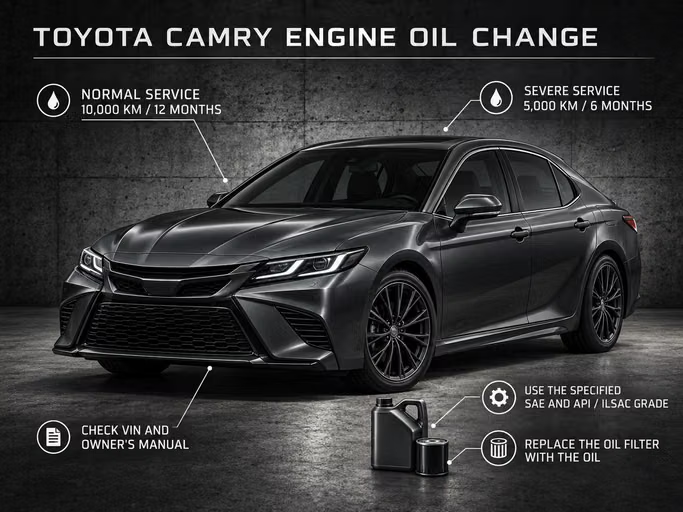
For a Toyota Camry XV70, 10,000 km is a practical maximum distance between oil changes. The calendar limit depends on the original market and service booklet and is commonly 6 or 12 months. Repeated short journeys, long periods of idling, high ambient temperature, and dense urban traffic justify planning around 5,000 km or 6 months. Establish the final requirements from the VIN, engine code, and documentation for the exact vehicle.
5 Cases When a Camry Should Not Wait for the Next Scheduled Service
Base the decision on distance, elapsed time, and operating pattern. Dipstick colour is only supporting information: clear oil does not prove that its additives remain effective, while darkening does not automatically identify a fault.
- The distance or time limit has arrived. Even a low-mileage engine experiences heating and cooling cycles and contact with moisture and combustion residue. Service it at whichever limit comes first.
- The level repeatedly needs correction. A leak, normal consumption, or a crankcase-ventilation fault may be involved. Check the dipstick on level ground after warming the engine and observing the waiting period in the manual.
- The level rises or the oil smells of fuel. This combination may follow repeated short runs or indicate an injection problem that allows fuel into the sump. It calls for diagnosis, not merely a fresh fill.
- Unfamiliar noise lasts longer after start-up. Low level, unsuitable viscosity, a loaded filter, or mechanical wear may be responsible. Rule out dangerous pressure loss and leakage first.
- The red oil-pressure warning illuminates. This is an emergency warning rather than a maintenance reminder. Stop safely, switch off the engine, and follow the manual; do not keep driving if the alert returns.
Why Urban Camry Use Shortens Oil Life
In congestion, engine hours rise faster than vehicle mileage. Short journeys provide less time at stable operating temperature, while hot weather and air-conditioning load add heat. Use the shorter interval for this pattern. Do not select a thicker grade solely because of climate: the permitted SAE range is specific to the engine and market.
How Oil Properties Change Beyond the Service Interval
Engine oil must reach friction surfaces quickly, maintain a film under load, transfer heat, and suspend contamination. With use, additive reserves decline and the effects of fuel, moisture, and oxidation products become more significant.
- Cold-start protection loses margin. Aged or unsuitable fluid can fill passages more slowly, extending the time before a stable lubricating film forms.
- Varnish deposits begin to accumulate. They can affect oil passages, piston rings, and variable-valve-timing hardware, particularly when long intervals are combined with short trips.
- The filter holds an increasing contaminant load. Restriction rises as the element fills. If the bypass valve opens, part of the flow may circulate without normal filtration.
- Efficiency and smoothness may deteriorate. Additional friction, unstable viscosity, and contamination in valve-timing controls can affect response, although these signs are not a diagnosis by themselves.
- Insufficient pressure causes component damage. Oil starvation threatens bearings, crankshaft journals, the piston assembly, and camshaft mechanisms. Stop operating the engine until the cause is established.
Reference Data for Common Camry XV70 Engines
The XV70 generation used several petrol and hybrid powertrains. The table covers common 2.5-litre versions and the V6; cars with a 2.0-litre engine require a separate check. These quantities help plan supplies. Establish the final level with the dipstick after start-up, a leak inspection, shutdown, and the specified waiting period.
| Item | A25A‑FKS 2.5 / A25A‑FXS 2.5 Hybrid | 2AR‑FE 2.5 / 2GR‑FKS 3.5 V6 |
|---|---|---|
| Normal operation | Up to 10,000 km; 6–12 months by market | Up to 10,000 km; 6–12 months by market |
| Severe operation | About 5,000 km / 6 months | About 5,000 km / 6 months |
| With a new filter | Approximately 4.5 L | 2AR: about 4.4 L; 2GR: about 5.4 L |
| Without filter change | Approximately 4.3 L | 2AR: about 4.0 L; 2GR: about 5.1 L |
| Typical viscosity | Usually 0W‑16 or 0W‑20 by year and market | 2AR: 0W‑20 or 5W‑30; 2GR: commonly 0W‑20 |
| Oil quality | The vehicle-specific API/ILSAC standard | The vehicle-specific API/ILSAC standard |
The model year and trim can first be compared with current listings. Before servicing, open the manual for the exact VIN; its requirements take priority over universal product advice.
How to Use the Reference Table Correctly
Identical displacement does not mean identical engine design. The Camry XV70 may use the 2AR‑FE, A25A‑FKS, A25A‑FXS, or 2GR‑FKS, with 6AR‑FSE and M20A‑FKS versions in some markets. Refill capacity and preferred viscosity differ between them.
A hybrid Camry starts and stops its combustion engine automatically, yet the lubricant still ages with time and heat cycles. The hybrid system is not a reason to extend the service interval without a matching instruction in the vehicle documentation.
Matching the Interval to Real Journeys
- Regular long-distance travel. When the engine reaches operating temperature, extended idling is uncommon, and the service history is documented, remain within 10,000 km and the calendar limit in the service booklet.
- Dense urban traffic. Hours of congestion and stationary air-conditioning use add engine time without comparable mileage. A 5,000 km or 6-month planning point better reflects this load.
- Several short trips each day. Repeated cold starts encourage moisture retention and fuel dilution. Here, the calendar limit matters more than forcing the car to reach the maximum distance.
- Hot weather and sustained high speed. Both raise oil temperature. Check the level more often, apply the shorter schedule when this load is routine, and stay within the approved viscosity range.
Problems Made More Likely by Old Oil
Overdue lubricant is rarely the only cause of a failure. Level, filter quality, cooling performance, sealing, and injection condition also matter. When symptoms appear, diagnose the system instead of expecting one oil change to correct everything.
| Condition | What changes inside | Possible signs |
|---|---|---|
| Oxidation | Flow, heat transfer, and deposit control deteriorate. | Start-up noise, rougher operation, or additional heat. |
| Fuel dilution | Viscosity and film strength fall on loaded components. | Fuel odour, a rising level, or unstable idling. |
| Loaded filter | Restriction rises and flow may pass through the bypass valve. | There may be no clear symptom before noise or a warning. |
| Varnish in passages | Supply to valve-timing controls and other lubricated parts is disrupted. | Uneven running, faults, or weaker engine response. |
| Level below MIN | The pump may draw air, reducing pressure and component cooling. | A red warning, knocking, or overheating requires shutdown. |
| Level above MAX | Foaming, higher crankcase pressure, or oil entering the intake may occur. | Leaks, smoke, rough running, or new oil traces. |
Checks Before the Oil Change
- Identify the engine code. Match the data plate, VIN, and records; instructions for an A25A‑FKS cannot automatically be transferred to a 2AR‑FE or 2GR‑FKS.
- Confirm viscosity and quality. SAE, API, and ILSAC details must belong to the same model year and market rather than being combined from unrelated sources.
- Prepare the filter and drain-plug seal. Do not select a replacement solely by appearance; confirm the part number against the VIN-specific parts information.
- Begin below the reference refill quantity. After the filter fills and the engine has completed a control run, approach the correct level gradually without exceeding MAX.
- Record the completed maintenance. Keep the date, mileage, operating pattern, product, viscosity, quality standard, and installed filter number.
- Inspect the sealing points after start-up. Confirm that the pressure warning goes out and that the filter and drain plug remain dry, then measure the level once more.
Four Camry Service Mistakes
- Choosing oil by viscosity alone. The same 0W‑20 label does not guarantee the required API or ILSAC quality. Check both the grade and the performance standard.
- Filling above the MAX mark. Excess fluid can foam and raise crankcase pressure. Remove the surplus instead of leaving it as a reserve.
- Treating a top-up as a complete change. Added oil restores level but does not remove the oxidised base fluid or contamination retained by the filter.
- Extending a hybrid interval without verification. Reduced engine operation on some journeys does not cancel calendar ageing or the requirements of the service documentation.
Conclusion
For a Toyota Camry XV70, build the plan around a 10,000 km ceiling and the 6- or 12-month calendar limit specified for the original market. Repeated short journeys, congestion, and persistent high temperature reduce the planning point to 5,000 km or 6 months. Confirm the engine code from the VIN before buying supplies, then select refill quantity, viscosity, and oil quality from the vehicle manual.


