Willys-Overland AgriJeep CJ-2, 1944
Willys CJ
Willys CJ•
•46 views
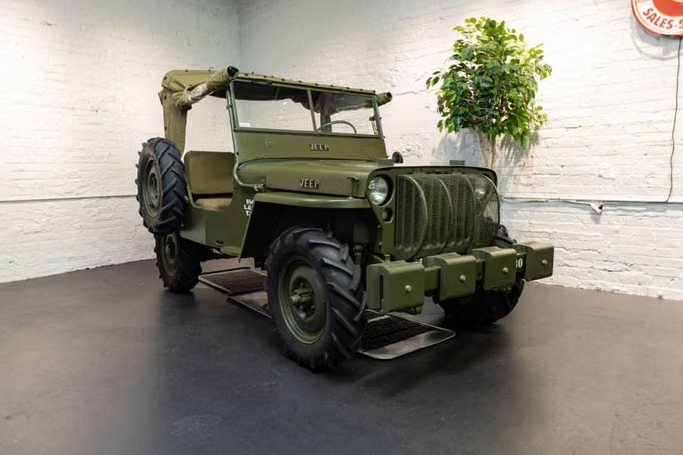
Chassis No.: CJ206
Auction: Larry's Legacy 2025
Auction date: September 21, 2025
Lot No.: U343
$66,000 | Sold
- Odometer: 31,461 miles
- Engine: Inline 4-cylinder
- Transmission: Manual
- Exterior: Green
- Interior: Green/Tan
- Body: SUV
- No. 6 of approximately 40 built by Willys-Overland
- Experimental no. X30 pre-production example, the earliest serial-numbered AgriJeep known to exist
- This Jeep was assigned to Cornell University
- Sometimes referred to as CiviJeeps or Peace Jeeps as they were produced in early 1944 while World War II was still going on
- Comprehensive restoration over the course of 20 years by Tremaine Cooper and Brian Hainer utilizing an original blueprint and parts where available
- Feature display vehicle at the 2015 Midwest Willys Reunion
- Displayed at the 2023 Chicago Auto Show
- Inline 4-cylinder engine
- Carter carburetor
- 3-speed manual transmission
- 4-wheel drive with twin-stick transfer case
- PTO
At one time assigned to Cornell University, this 1944 Willys-Overland AgriJeep CJ-2 is No. 6 of approximately 40 built by Willys-Overland and noted as Experimental No. X30, a pre-production example and the earliest serial-numbered AgriJeep known to exist. Tremaine Cooper and Brian Hainer undertook a comprehensive restoration of the AgriJeep over the course of 20 years, using an original blueprint and parts when available. A unique piece of Jeep and automotive history, this AgriJeep was a feature display vehicle at both the 2023 Chicago Auto Show and the 2015 Midwest Willys Reunion.
The inline 4-cylinder engine is fitted with a Carter carburetor and backed by a 3-speed manual transmission, and the 4-wheel drive system is equipped with a twin-stick transfer case. The Jeep is rounded out with a side-mounted spare, color-matched wheels and a canvas top and curtains. In the full swing of World War II, John Willys felt strongly that the War wouldn’t last forever. With that in mind, he thought of various ways in which Jeeps could remain viable outside of military life. With a number of ideas on the table, he felt one of the most important was that of serving the agricultural industry. He engaged with famous farmer and writer Louis Bromfield and the U.S.


Department of Agriculture for demonstrations and testing as a practical farm vehicle. With a narrower track than a tractor and lower-than-necessary ground clearance, the Jeep at first proved to be more challenging at farm work than helpful. Through 1943 and part of 1944, a Washington state university performed additional tests and engineering changes, so much so that by the latter part of 1944, Willys-Overland was advertising ways in which a Jeep could help around the farm and ranch. When the War ended, other colleges and agencies stepped in to assist in development, including Cornell and Nebraska Tractor Testing.
Slightly prior to farmers becoming interested in purchasing Jeeps dedicated to land work, various tractor manufacturers began using Jeep parts to produce tractors. Conversely, manufacturers began working with Jeep to adapt equipment from a tractor to a Jeep. The idea was to create a kind of universality between the two, making both efficient work tools for farmers. By 1949, the CJ-3A had replaced the CJ-2A with various changes, most notably that it was larger and more capable of meeting an assortment of farm standards. With this, the Farm Jeep and Jeep Tractor were introduced, each with a plethora of equipment unique to serving farms and ranches.


Ultimately, though, it all started with the experimental AgriJeep.
https://www.mecum.com/lots/1151416/1944-willys-overland-agrijeep-cj-2/
Cost
242,385 AED