
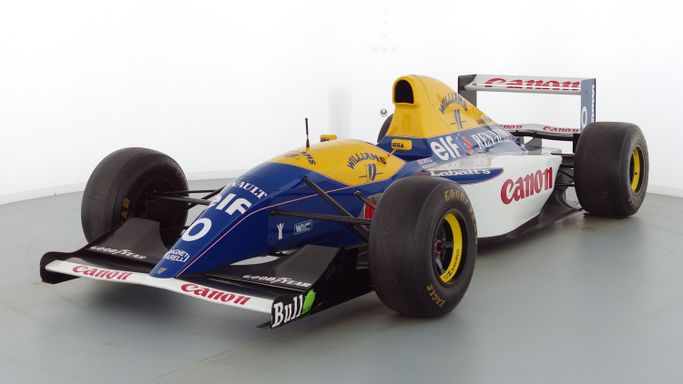
Williams-Renault FW15 Display Single-Seater, 1993
Renault 15
Renault 15•
•60 views
€52,448 | Sold
- THE RENAULT ICONS
- Display vehicle
- Represents the 1993 World Championship-winning single-seater
- Evokes the Prost-Senna duel of the 1993 season
- Comes directly from the manufacturer
In the early 1970s, Frank Williams began building his own racing single-seaters. In 1977, he joined forces with the young engineer Patrick Head and founded Williams Grand Prix Engineering. This marked the beginning of a remarkable adventure that continues today under the name Williams F1 Team, despite Frank Williams's death in November 2021. Between 1980 and 1997, the team won the Formula 1 Constructors' World Championship nine times and the Drivers' World Championship seven times, with Alan Jones, Keke Rosberg, Nelson Piquet, Nigel Mansell, Alain Prost, Damon Hill and Jacques Villeneuve, in that order.
Although Williams designed and built its single-seaters, it relied on outside manufacturers for its engines. After losing Honda in 1987, it turned to Renault, whose new V10 engine arrived in 1989. The team regained its momentum halfway through the 1991 season and, in 1992, won the world title with Nigel Mansell. In 1993, Williams-Renault changed drivers, with Alain Prost taking Mansell's place and being joined by Damon Hill, son of the famous champion Graham Hill. Meanwhile, the talented Ayrton Senna stayed with McLaren, powered by a Ford V8. The Prost-Senna battle promised to be close!
On the technical side, the new regulations required designers to make some delicate adjustments, keeping the outcome of the championship uncertain. At Williams, the FW15 was designed as a continuation of the previous season's FW14, built around a sturdy monocoque chassis. It was equipped with the Renault RS5 engine, radically different from the RS4 in its cylinder heads, combustion chambers, valve train and crankshaft assembly, and it continued to evolve from one Grand Prix to the next. At the very first Grand Prix, Prost beat Senna. The rest of the season was more turbulent, and it was only halfway through the season that the Frenchman established a decisive lead over his rivals, going on to win his fourth Drivers' World Championship title.
His team-mate Damon Hill finished third, with Ayrton Senna in second place. Williams-Renault won its second Constructors' World Championship title. The car presented here is a display model, similar to the machine that enabled Alain Prost to win in 1993. Built by Renault for promotional purposes, it is mechanically incomplete and not operational, but it is a superb evocation of one of the finest achievements by the Williams team and Renault in Formula 1, during the historic duel between two of the greatest drivers of the time, Alain Prost and Ayrton Senna.
Display vehicle - Represents the 1993 World Championship-winning single-seater - Recalls the Prost-Senna duel of the 1993 season - Coming directly from the constructor It was at the start of the 1970s that Frank Williams began to build his own racing single-seaters. In 1977 he joined forces with the young engineer Patrick Head and founded Williams Grand Prix Engineering. This was the start of a formidable adventure that, despite the death of Frank Williams in November 1921, continues today under the name Williams F1.


Between 1980 and 1997, the team won the Formula 1 Constructors' World Championship nine times and the Drivers' World Championship seven times, with Alan Jones, Keke Rosberg, Nelson Piquet, Nigel Mansell, Alain Prost, Damon Hill and Jacques Villeneuve, in that order. Although Williams designed and built its own cars, it turned to other manufacturers for its engines. After losing Honda in 1987, it switched to Renault, whose new V10 engine appeared in 1989. The team rediscovered its winning ways halfway through the 1991 season and won the world title with Nigel Mansell in 1992.
In 1993, Williams-Renault changed drivers, with Alain Prost taking Mansell's place and being supported by Damon Hill, son of the celebrated champion Graham Hill. Meanwhile, the talented Senna stayed at McLaren, powered by a Ford V8 engine. The Prost-Senna battle promised to be close! On the technical side, the new regulations required some tricky adjustments, keeping the outcome of the championship uncertain. At Williams, the FW15 was designed along the lines of the previous season's FW14, around a sturdy monocoque chassis.
It was equipped with a Renault RS5 engine, radically different from the RS4 in its cylinder heads, combustion chambers, valve train and connecting rods, and which continued to be developed from one race to the next. At the first Grand Prix, Prost finished ahead of Senna. A closer battle followed, and it was halfway through the season before the Frenchman took a decisive lead over his rivals, going on to win his fourth Drivers' World Championship title. His team-mate Damon Hill finished third, with Ayrton Senna in second place. The Williams-Renault team won its second Constructors' World Championship title.
The car presented here is a display model, similar to the machine that gave Alain Prost his victory in 1993. Built by Renault for promotional purposes, it is mechanically incomplete and does not run, but it is a superb evocation of one of the Williams team's and Renault's finest achievements in Formula 1, during the historic duel between the two best drivers of the day, Alain Prost and Ayrton Senna. Photos © Renault Communication
Cost
215,412 AED


