


Maybach SW-38 Drophead Coupé, 1939
Maybach SW38
Maybach SW38•
•60 просмотров
Chassis No.: 2186
Engine No.: 11660
€304,750 EUR | Sold
- Unique SW-38 à carrosserie danoise
- Autrefois exposée au musée automobile du château d'Egeskov au Danemark
- Aux mains de l'actuel propriétaire depuis le début des années 1970
- Châssis roulant restauré à la fin des années 1970
- Carrosserie d'origine offerte pour restauration
- Unique Danish-bodied SW-38
- Formerly displayed in the Egeskov Castle motor museum, Denmark
- Present ownership since the early 1970s
- Rolling chassis restored in the late 1970s
- Original body offered for restoration
Maybach SW-38 cabriolet 1939
Carrosserie J. H. Jensen
Châssis n° 2186
Moteur n° 11660
On peut considérer Gottlieb Daimler et Wilhelm Maybach comme les grands-pères du transport mécanisé et les deux sociétés Daimler Motoren Gesellschaft et Maybach Motorenbau ont eu une influence décisive sur les débuts de l'histoire de l'automobile. Wilhelm Maybach avait travaillé aux côtés de Gottlieb Daimler au développement des toutes premières automobiles à peu près au moment où Karl Benz mettait au point sa Patentmotorwagen.
Maybach était un ingénieur exceptionnellement doué, qui, parmi ses nombreuses inventions, comptait le radiateur en nid d'abeille et le carburateur vaporisant. Avant et pendant la première guerre mondiale, il mit au point des moteurs d'avion tout en perfectionnant son propre moteur V12 de grosse cylindrée qui équipaient les dirigeables, inventés par le comte Zeppelin. L'idée initiale de Maybach était de rester un concepteur de moteurs, mais il avait du mal à trouver des débouchés pour ses produits, techniquement supérieurs, mais toujours complexes et onéreux.


La première automobile Maybach, la W3, fut présentée en 1921 et son évolution au cours des années qui suivirent culmina avec les fabuleuses DS-7 et DS-8 à moteur V12 au début des années 1930. Chefs-d'œuvre de technologie à leur époque, ces modèles étaient d'une part énorme, nécessitant généralement un chauffeur, et d'autre part incroyablement chers, exclusifs et dispendieux à entretenir avec leurs nombreux cylindres et leur boîte à 8 rapports par présélecteur avec assistance pneumatique. Peu avaient besoin d'une telle sophistication et encore bien moins avaient les moyens de se l'offrir.
La SW, plus petite, fut dévoilée en 1936. Ce fut le dernier modèle lancé avant la seconde guerre et il était proposé en trois versions avec des moteurs à six cylindres en ligne à arbre à cames en tête de 3.5 litres (SW-35), 3.8 litres (SW-38) et 4.2 litres (SW-42). Les autres caractéristiques techniques remarquables de cette conception de pointe étaient la boîte de vitesse manuelle à cinq rapports et la suspension à quatre roues indépendantes. Sa technique relevait du tour de force et ses 6 cylindres capables d'atteindre près de 160 km/h, une vitesse exceptionnelle pour l'époque, étonnèrent le monde automobile.
La qualité de construction était au même niveau que celle des plus grosses DS et la qualité d'exécution du moindre détail ne laissait rien au hasard. Les clients étaient fascinés par ce nouveau modèle, plus léger et plus maniable qui se vendit bien, malgré son prix élevé et connut un succès commercial mérité. Un total de 520 châssis fut construit entre 1936 et 1939, une quantité substantielle pour Maybach. Seulement 152 de ces fabuleuses Maybach sont encore en existence de nos jours, leur possession reste donc encore très exclusive.
La SW-38 était censée être une nouvelle Maybach plus « petite », mais c'est seulement lorsqu'on la compare à ses sœurs gigantesques qu'elle peut être considérée comme une voiture compacte. Par tous ses autres aspects, le cabriolet SW-38 proposé ici est un cabriolet quatre places grand et imposant. Cette voiture est équipée du moteur 3,8 litres de 140 ch.
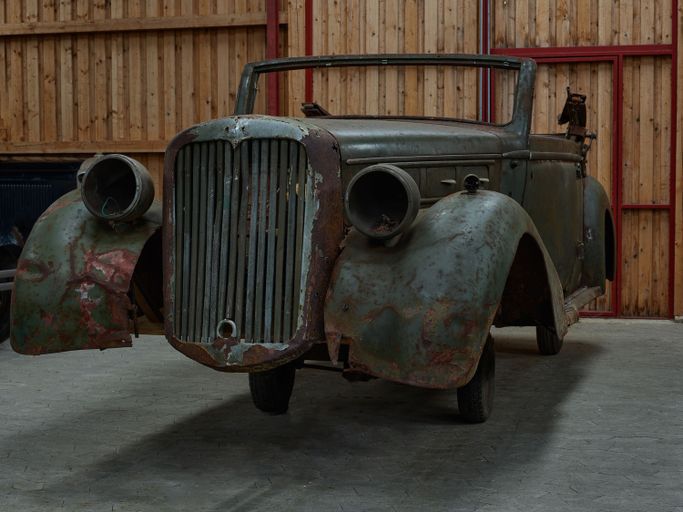
Avec son châssis roulant et sa mécanique magnifiquement restaurés, cette Maybach SW-38 est dotée d'une rare et originale carrosserie danoise qui mériterait une restauration. La carrosserie est due à un artisan peu connu, J. H. Jensen de Hojer. Hojer se trouve dans la région frontalière du Jutland, près de la frontière allemande, et a de ce fait connu des changements de nationalité et de nom au cours de l'histoire passant du danois Hojer à l'allemand Hoyer, puis à nouveau à Hojer. L'origine de la carrosserie Jensen remonte au tout début des années 1900, quand son activité principale était les voitures à cheval de toutes sortes.
En 1920, la société se lança dans une nouvelle aventure, se spécialisant dans la production de carrosseries automobiles, la première étant une Stoewer qui fut exposée cette année-là. M. Jensen faisait de fréquents voyage dans la toute proche et très en vogue île allemande de Sylt où il récolta de nombreuses commandes de riches clients. Les registres de la famille Jensen indiquent qu'au plus fort de son activité, la société produisait environ 20 voitures par an, soit un total d'environ 250. Un livre édité par la famille en 2014 montre les nombreuses carrosseries construites sur divers châssis qui vont de Rolls-Royce à MG. La carrosserie assembla également un temps des Adler.


On sait relativement peu de choses sur l'histoire de cette voiture, bien qu'elle ait été photographiée à l'hôtel de ville de Frederiksberg, à Copenhague un jour dans les années 1950, ayant encore belle allure. Même si ses plaques affichent l'immatriculation A5887, de la région de Copenhague, on n'a pas pu retrouver son propriétaire de l'époque. Malheureusement, les autorités danoises ont reçu l'ordre de détruire toutes leurs archives papiers lorsqu'elles sont passées au digital il y a environ 10 ans.
La Maybach est arrivée en la possession du père du vendeur au début des années 1970, après avoir résidé dans un musée au château historique entouré de douves d'Egeskov. Une coupure de presse au dossier montre le défunt comte Claus Ahlefelt avec la voiture qui avait déjà grand besoin d'une restauration. Le père du vendeur a restauré le châssis de la Maybach de façon à pouvoir la conduire sur le parvis de son garage, assis sur un siège d'emprunt. À partir de 1979, le châssis restauré fut exposé dans le musée. Malheureusement, il décéda avant d'attaquer la restauration de la carrosserie.
Une fois celle-ci restaurée et réinstallée, cette Maybach SW-38 unique sera indéniablement la bienvenue aux plus prestigieux concours d'élégance du monde. Une rare opportunité d'acquérir une automobile unique, exceptionnelle et aristocratique.
1939 Maybach SW-38 Drophead Coupé
Coachwork by J H Jensen
Chassis no. 2186


Engine no. 11660
Gottlieb Daimler and Wilhelm Maybach are considered grandfathers of mechanical transportation, and both Daimler Motoren Gesellschaft and Maybach Motorenbau greatly influenced the automobile's early development. Wilhelm Maybach worked closely with Gottlieb Daimler during the development of the very first automobile at around the same time that Karl Benz was developing his Patentmotorwagen.
Maybach was an exceptionally gifted engineer, among whose many inventions were the honeycomb radiator and atomising carburettor. Prior to and during World War I, he worked on developing aircraft engines while perfecting his own large-displacement V12 used to power Count Zeppelin's dirigibles. Maybach's intention was to remain an engine manufacturer, but he had difficulty finding a market for his technically superior products, which were always complex and expensive.
The first Maybach W3 automobile was introduced in 1921, and development over the ensuing years culminated in the early 1930s with the fabulous V12-engined DS-7 and DS-8. While pinnacles of automotive engineering, these models were both very large, usually requiring a chauffeur, and very expensive and demanding on maintenance, with their multiple cylinders and eight-speed pre-selector vacuum-assisted gearboxes. Few had the need for such an over-the-top car, and even fewer could afford one.
The smaller type SW was introduced in 1936. This was the final model released before WW2 and was available in three versions with overhead-camshaft straight-six engines of 3.5 litres (SW-35), 3.8 litres (SW-38) and 4.2 litres (SW-42) respectively. Other noteworthy technological features of this most advanced design included a five-speed manual gearbox and independent suspension all round. The engineering was a tour-de-force and the automotive world was stunned by the SW-38, which was capable of reaching speeds close to 160km/h, a performance benchmark at the time.
The build quality remained on par with Maybach's larger DS models, and the exquisite manufacture of even the smallest accessories left absolutely nothing to be desired. Customers were captivated by this new lighter and more manageable model, which sold well despite its high price and was a deserved commercial success. In total, 520 chassis were built between 1936 and 1939, which was a substantial number in Maybach terms. Only around 152 of these fabulous Maybachs are known to exist today, so ownership continues to be very exclusive. While the SW was a new smaller Maybach, 'small' is a relative term, and it is only when compared with its gargantuan siblings that it can be considered compact.


By any other standard, the SW-38 drophead offered here is a large, imposing, four-passenger convertible. This particular car has the 3.8-litre engine producing 140bhp.
Its rolling chassis and mechanicals beautifully restored, this Maybach SW-38 comes with its rare and original Danish body, the latter in need of restoration. The body is by the little-known coachbuilder J H Jensen of Hojer. Hojer is in the border region of Jutland, close to the German border, and as such has a history of changes of nationality and name from the Danish 'Hojer' to 'Hoyer' when German and back again. Jensen Coachbuilding dates back to the very beginning of 1900, when the main core of the business was horse-drawn carriages of all kinds.
In 1920 the company embarked on a new venture, focusing on the production of building bodies for motorcars, the first one being a Stoewer, which was exhibited that same year. Mr Jensen frequently travelled to the nearby fashionable German island of Sylt, where he received many orders from wealthy clients. Jensen family members' records indicate that at the height of the business the company produced around 20 car bodies per year and around 250 in total. A book produced by the family in 2014 depicts many of the various bodies made on different chassis ranging from Rolls-Royce to MG. At one time the company also assembled Adler cars.
Relatively little is known of this car's history, though it was photographed at Frederiksberg Town Hall, Copenhagen at some time in the 1950s, still looking very grand. Although the numberplates show the registration 'A5887', consistent with the Copenhagen region, it has so far not been possible to verify the owner at that time. Unfortunately, the Danish authorities were instructed to destroy old paper files when they went digital around 10 years ago.
The Maybach came into the vendor's father's possession at some time in the early 1970s, having resided in the museum at the historic moated castle of Egeskov, Denmark. A newspaper cutting on file depicts the late Count Claus Ahlefelt with the car, which was already in need of restoration. The vendor's father restored the Maybach chassis to a stage where it could be driven around the forecourt of his garage business, with him sitting on a makeshift seat from another car. From 1979 the restored chassis was displayed in his motor museum. Unfortunately, the owner died before getting around to restoring the body.
Once the latter has been restored and reinstalled, this unique Maybach SW-38 will surely be worthy of admission to the world's most prestigious concours d'élégance events. This is an incomparable opportunity to acquire an exceptionally unique and aristocratic motorcar.
Стоимость
1 301 041 AED


