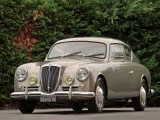
Lancia Aurelia B20GT Pre-Series Coupe, 1951
Lancia Aurelia
Lancia Aurelia•
•40 مشاهدة
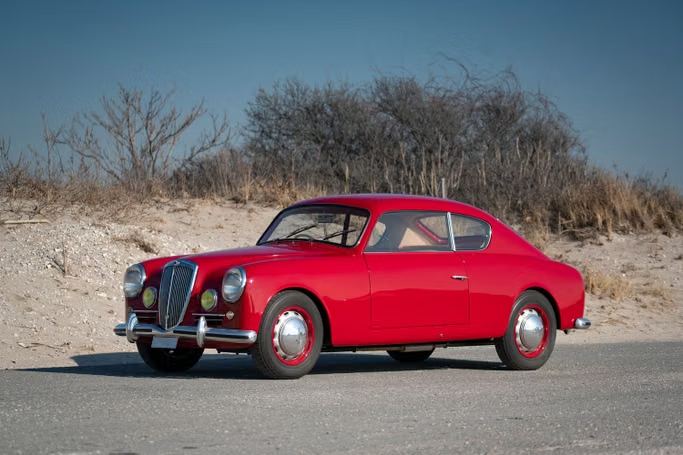
Chassis No.: 1047
Engine No.: 1001
Estimate: US$175,000 - US$225,000 USD
- 1,991cc OHV All-Alloy V-6 Engine
- Single Weber Twin-Choke Carburetors
- 75bhp at 5,000rpm
- 4-Speed Manual Transaxle
- Sliding Pillar Front - Independent Rear Suspension
- 4-Wheel Drum Brakes - Inboard Rear
- Exceptionally rare 'pre-series' B20 GT
- Recently redone by respected specialists
- One of the earliest B20s known
The product of two great engineers, Francesco de Virgilio and Vittorio Jano, the all-aluminum V6 employs a 60-degree v-angle and a central camshaft with short pushrods for inherent balance and compactness. The chassis, too, emphasizes balance by locating the transaxle and inboard rear drum brakes close to the vehicle's centerline, under an innovative unitary body. The tenacious poise of 4-wheel independent suspension was achieved through Lancia's proven sliding pillars at the front and trailing arms at the rear, and the Aurelia was the first car fitted with radial tires as standard equipment.
The Aurelia berlina (sedan) was followed a year later by the more sporting B20 GT coupé, with a larger and more powerful engine installed in a shorter and lighter chassis. The 2 + 2 coachwork, attributed to Felice Mario Boano, was initially built by
Carrozzeria Viotti
but production was soon transferred to Pinin Farina.
While the B20 GT is widely acknowledged to be the world's first Gran Turismo, it is less recognized that the car's sporting reputation rests mostly upon accomplishments of the first two of the six different series that Lancia produced. Most famous is Giovanni Bracco's second place in the 1951 Mille Miglia, in which he outpaced the winning Ferrari over the mountain passes. In the 1951 event B20s took three of the first seven places, and in the 1952 Mille Miglia, four of the first eight.


Early B20s are also significantly different in appearance, most visibly in their elegant rounded tail fins, streamlined headlights, pivoting door handles and other fascinating details. The combination of performance, luxury and engineering refinement was unparalleled for its era.
It is worth noting that like many Italian high-performance cars of the era, all B20 GTs through the first three series are right-hand drive.
THE MOTORCAR OFFERED
This very early B20GT 67th example produced, putting it firmly within the initial run of 98 "pre-series" cars that were contracted to Ghia but later subcontracted to Pinin Farina and the relatively small coachbuilder Viotti (it should be noted, however, the records are unclear as to which cars were necessarily bodied by which coachbuilder during the construction of these first 98 B20s). Originally finished in


Biege Metallizzato
(metallic beige) over a
nocciola
(hazelnut) interior, it was ready for sale on June 8, 1951. The earliest history on the car is confirmed by a May 1990 letter from the


Registro Avrelia Italiano
- -a copy of which is with the car. Sold new to Europe, it is believed to have found its way to Britain in 1960 and remained there for around a quarter of a century before returning to the land of its birth in 1988.
S/n 1047 was first restored around 2000 by Gianni Sala of Reggio Emilia. The work included a full mechanical rebuild, bare-metal repaint, and freshly reupholstered interior. The current owner acquired the car in 2014 and commenced another refurbishment of the car. Again, taken down to bare metal, the body work was perfected and repainted in the classic, racy Italian shade of Rosso Corsa while the interior was refinished in beige upholstery. Some mechanical service was also completed. Receipts on file total over $100,000 for the most recent work.
Among the earliest surviving B20 GTs extant, it must also be said that it is one of the finest as well. As it stands, this rare early Aurelia is ready and eligible for the most exclusive driving events and concours, not least the Mille Miglia where early B20s were so successful.