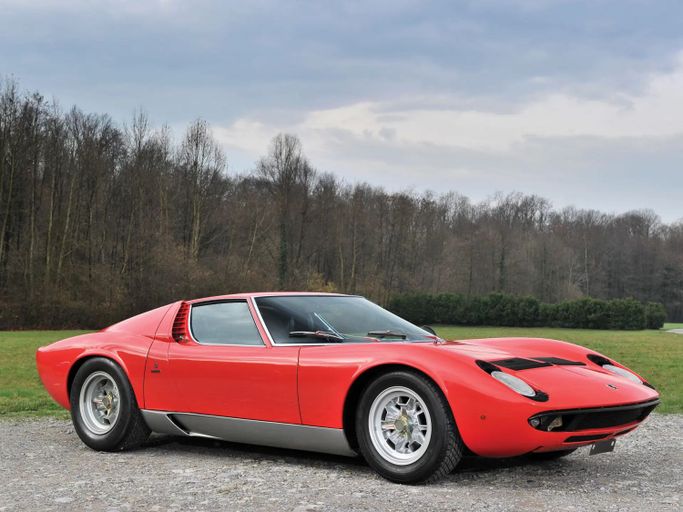
Lamborghini Miura P400S by Bertone, 1969
Lamborghini Miura
Lamborghini Miura•
•104 views
Chassis No.: 4155
Engine No.: 30409
Location: Monte Carlo, Monaco
€840,000 EUR | Sold
- Desirable early-production S variant
- Matching-numbers drivetrain
- Single ownership for 31 years
- Includes FIVA and ASI passports
370 bhp, 3,929 cc DOHC transverse mid-mounted alloy V-12 engine with four Weber 40 IDL-3C carburettors, five-speed manual transaxle, independent front and rear suspension with A-arms, coil springs, tubular shock absorbers, and anti-roll bars, and four-wheel hydraulic disc brakes. Wheelbase: 2,500 mm
3,929 cc all-alloy transverse V-12 engine, 370 hp, twin overhead camshafts per bank, four Weber 40 IDL-3C carburettors, five-speed manual transaxle gearbox, independent front and rear suspension with wishbones, coil springs, telescopic shock absorbers, anti-roll bars, and hydraulic disc brakes on all four wheels. Wheelbase: 2,500 mm.
Lamborghini’s beguilingly handsome, awesomely powerful, and ground-breaking mid/rear-engine Miura set a new bar for performance cars, and it is now widely recognised as the opening salvo of the Italian supercar battle that emerged over ensuing decades. With Touring, of Milan, falling on tough financial times, Lamborghini called upon Nuccio Bertone to create coachwork for Gianpaolo Dallara’s innovative chassis. A relatively unknown Bertone stylist named Marcello Gandini, then just 28 years old, penned one of automotive design’s most enduringly popular sports cars of all time, and a legend was born.
After the Miura P400, named for a breeder of fierce Spanish fighting bulls, debuted at the 1966 Geneva Motor Show, it posed an undeniable challenge to Ferrari’s longstanding supremacy of the premium high-performance market, just as Ferruccio Lamborghini intended when he originally set out to make his own sports car. With a low volume of hand-built production and the careful input of renowned test driver Bob Wallace, the Miura was steadily improved from car to car, and some experts contend that no two examples are exactly alike.
Coachwork modifications to be found on the Miura S were rather minor, with a revised Bertone badge and the use of chrome headlight bezels constituting the more obvious exterior refinements. The changes were more pronounced in the interior, with the use of superior upholstery, a revised instrument layout, power windows, and the first availability of optional air conditioning in a Lamborghini. Whilst the revered four-litre V-12 remained essentially unchanged from the original P400, the camshafts and tuning were modified to develop an improved 370 horsepower, which was capable of pushing the car to 168 mph, as demonstrated by a road test in the April 1970 issue of Road & Track.
As the Miura S was manufactured in a modest quantity of no more than 338 examples (with early registers contending that as few as 140 cars were built), it is considered by many marque enthusiasts to be the definitive Sant’ Agata model, and the car continues to hold a special place in the hearts of sports car connoisseurs far and wide.
It is believed that chassis number 4155 was completed on 6 August 1969, making it one of the earlier S examples manufactured. This Lamborghini, wearing Bertone production number 401, was factory-finished in Rosso Miura paint over a black and beige interior. It was sold new to an Italian enthusiast named Breviglieri and was later acquired by well-known collector Pier Paolo Apicella, who in turn sold it in 1983 to the current collector.
Chassis 4155 has been seldom driven and carefully garaged over the intervening 31 years, and it continues to display in overwhelming originality. It desirably retains its original matching-numbers V-12 engine and driveline, and other than being fitted with wider rear wheels from the subsequent Miura SV, it is correctly equipped as per its original factory specifications.


This superb Lamborghini remains every bit as arresting as it was in August 1969, and as it is currently accompanied by a FIVA Passport and ASI papers, it is warranted entrance to some of the world’s most discerning vintage events. A sensationally presented Miura displaying such dutiful care and mild use would make a noteworthy addition to any sports car collection. This Miura P400S is a wonderfully original example of one of the most rhapsodised speed machines ever constructed, and it is the distinctive forerunner of a long line of “Raging Bulls”.
The revolutionary mid-engined Lamborghini Miura, incredibly alluring and extremely powerful, set a new benchmark for performance in the sports car market. It is now widely recognised as the first to open the supercar battle that would rage over the following decades. With Milanese coachbuilder Touring facing financial difficulties, Lamborghini turned to Nuccio Bertone to design the bodywork around Gianpaolo Dallara’s highly innovative chassis. At Bertone, a relatively little-known stylist, just 28 years old, named Marcello Gandini, created the body design for the most iconic sports car of all time: a legend was born.
When the Miura, named after a breed of fierce Spanish bulls, was unveiled at the 1966 Geneva Motor Show, it posed an undeniable challenge to Ferrari’s long-standing supremacy in the high-end sports car market. This was exactly what Ferruccio Lamborghini wanted when he decided to create his own car bearing his name. With limited-volume hand-built production and valuable input from test driver Bob Wallace, the Miura was continually improved, and some experts claim that no two examples are identical.
The bodywork modifications on the Miura S were not very significant; a revised Bertone badge and chrome headlight surrounds were the main exterior differences. The changes were more substantial inside, with higher-quality upholstery, a revised dashboard, electric windows and, for the first time in a Lamborghini, the option of air conditioning. The excellent 4-litre V-12 engine changed little from the original P400, but a new camshaft and revised tuning raised output to 370 hp.
Thus, top speed reached 270 km/h, as shown in a Road & Track road test in the April 1970 issue. Since only 338 Miura S cars were produced (early records claim the figure was as low as 140), many marque enthusiasts consider it the definitive version of the Sant’Agata car, and it continues to hold a special place in the hearts of connoisseurs.
Chassis number 4155 is believed to have left the factory on 6 August 1969, making it one of the earliest S versions produced. This Lamborghini, bearing Bertone production number 401, was finished in Rosso Miura with a black and beige interior. It was sold new to an Italian enthusiast named Breviglieri, before being acquired by the well-known collector Pier Paolo Apicella, who in turn sold it in 1983 to the current owner.
This car, number 4155, was driven infrequently and carefully stored indoors for 31 years, and it continues to present in astonishingly original condition. It still has its original V-12 engine and transmission, as confirmed by the matching numbers, and apart from the wider rear wheels as fitted to the Miura SV, it conforms to factory specifications.
Still as captivating as it was in August 1969, this superb Lamborghini comes with a FIVA passport and ASI documents, guaranteeing access to the world’s most prestigious historic events. A Miura like this, beautifully presented, superbly preserved and lightly used, would make a remarkable addition to any sports car collection. This Miura P400S is a wonderfully original example of one of the most admired high-performance machines ever built, and it represents the first of a famous line of “Raging Bulls”.
https://rmsothebys.com/auctions/mc14/lots/r116-1969-lamborghini-miura-p400s-by-bertone/
Mileage
270 km
Cost
3,456,196 AED