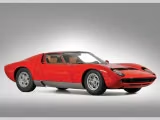
Lamborghini Miura P400 SV by Bertone, 1971
Lamborghini Miura
Lamborghini Miura•
•66 просмотров
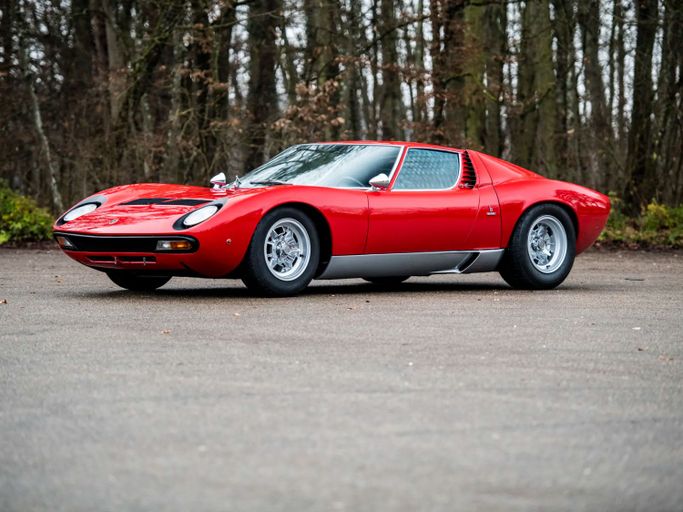
Chassis No.: 4840
Engine No.: 30628
Registration: Cancelled German Fahrzeugbrief
Location: Karlskron, Germany
€2,423,750 EUR | Sold
- Recent restoration by Italian marque specialists to original specifications
- Delivered new to Germany
- One of only 150 Miura SVs built
- Lamborghini Polo Storico Certified, accompanied by its black certification box and documents
Addendum
Please note this car is titled as 1972.
“For the rest of my life I'll feel happy whenever I look at my Miura. This car left its mark on its age, and I say that nobody has built anything better since.” - Ferrucio Lamborghini.


Whether it really was the world’s first supercar or not, it is irrefutable that the appearance of the Miura P400 prototype on the Lamborghini stand at the 1966 Geneva Salon changed the automotive landscape forever. It was quite simply unlike any production car that gone before, both in its appearance and its construction and it introduced a design language that has dominated the supercar ethos for the past 50 years.
The earthquake-esque effect that it had is perhaps surprising given that a rolling chassis of the car had already been displayed the year before at the Turin Motor show, which clearly showed the trailblazing two-seater, transverse mid-engine layout. The automotive press, however, had given it little attention, assuming it to either be a mere design study or the underpinning of a potential foray into the world of motorsport. This is not entirely unsurprising as one glance at the entry list for the 1965 24 hours of Le Mans would have uncovered a myriad of mid-engine racing cars, from the Ford GT40s to Ferrari’s 250 LM and onto the Porsche 904.
It was well known that the mid-engined architecture brought performance and laptime benefits, but it was also considered to be the reserve of motorsport only. Most famously, Enzo Ferrari was opposed to adopting the layout for his road cars, believing it to be inherently unstable and liable to lead to brand damaging accidents. Coupled to this was the fact that Automobili Lamborghini was barely two years old and despite the instant success of the Bizzarrini-engined 350 GT and subsequent 400 GT, few would have expected such a young company to take an enormous risk and pin their future on something quite so radical.


Ferrucio Lamborghini was not a man for conservatism though and with Enzo Ferrari’s suggestion that he should stick to building tractors ringing in his ears, he appreciated the cache it would give his young company to be the first to bring this racing technology to the road. Happily, he was also blessed with a young development team that could boast a 26 year-old Gian Paolo Dallara at the helm, who shared his boss’s exuberance and who, with the help of young engineer Paolo Stanzani and development driver Bob Wallace, created the welded steel mid-engine chassis with its central spine that in time became the P400 Miura.
For power they already had the wonderful Bizzarrini-designed 3.9-litre V-12 engine from the existing 400 GT but for the Miura they installed it transversely, to keep weight centralised, and modified it by incorporating the gearbox and differential into the same one-piece casting. The body was then entrusted to Bertone, which favourably had no formal ties with Ferrari or Maserati, with 25-year-old Marcello Gandini leading the design process. What he created was equal to the car’s radical underpinnings, with its shark nosed front, dramatically swept back windscreen and an impossibly low roofline that arched back over the V-12 and towards the car’s hips.
Bulging air intakes for the rear brakes and weber carburettors, sited behind the doors, complimented the aesthetic and did more than hint about the car’s potential, whilst on the inside the finishing touches were applied: a proud open gated gear leaver, Jaeger instruments, swathes of Italian leather and a comically large passenger grab handle. The name Miura was chosen in homage to Eduardo Miura who raised bulls for bullfighting and who’s ranch Ferrucio Lamborghini had visited in 1962. Lamborghini was so impressed by his time spent there that he also chose the fighting bull as his marque’s emblem, sitting rather well as it did with his Taurus star sign.


Six hundred and forty one Miuras were sold in a production run that lasted from 1967 to 1973, during which time the model received continuous fettling and upgrades to improve its performance. This programme culminated in the Miura ‘Sprinto Veloce’ or SV, similar to this particular example, of which 150 examples were built between 1971 and 1973. These later cars have become the most sought after of all the Miuras, and are instantly recognisable from the front for not having the peculiar headlight lashes of earlier cars and from the rear for their updated light clusters and flared arches, required to accommodate the new 9-inch-wide wheels.
Less visible improvements included a new rear suspension setup with a regular lower A-arm taking the place of the inverted A-arm and trailing link arrangement, as well as substantial chassis stiffening. Both changes dramatically improved handling, especially on the limit. Under the rear louvres the V-12 was also fettled and outfitted with four Weber 40 IDL30 triple carburettors for the first time, unlocking 385 bhp at 7,850rpm, a 0-60 mph time of 5.8 seconds and a top speed of 180 mph.


Chassis number 4920 was delivered to its first owner in Germany in May 1972, specified in Rosso Corsa with a dark blue interior. Conspicuously, between 1972 and being acquired by its second owner in 1977, it underwent an aesthetic conversion to resemble the one off 1970 Miura ‘Jota’. The Jota, or SV-J was a test bed built at the behest of Lamborghini’s chief test driver Bob Wallace, with the ultimately unsuccessful intention to take the car racing under the FIA’s appendix J regulations. In spite of this, a handful of SV-J Miuras were commissioned for particular owners from the factory, whilst others underwent conversion at a later date at their owner’s request.
Changes to resemble the Jota included the installation of fixed headlights with plexiglass covers, the cutting of large air exhausts for the radiator into to the bonnet and a central opening created for a racing specification fuel filler cap. The front air dam was also changed for an aluminium variant, whilst further back the exhaust system was modified to have centralised tailpipes, necessitating an alteration inside the boot to accommodate their new placement.
The car changed hands once again in 1978 and then remained with its third owner until 1997 whereupon it came into the possession of its fourth owner, by which time it had covered a little over 30,000km. Under his supervision, from 1997 to 2001, the car underwent an extremely thorough chassis-up, bare-metal restoration. The bodywork, chassis and interior were returned to as-new condition whilst the engine and gearbox were completely stripped and rebuilt by Instinsky of Stuttgart, who also converted it to run on unleaded fuel.


The car retained its Jota bodywork and exhaust specification and was finished in a beautiful dark green, with gold wheels and details, trimmed inside with cream and black leather and was a regular showpiece including an appearance at the 2012 Essen Techno Classica, by which time it had become part of the Dr. Oetker collection.
Its current owner acquired the car in 2015 from the Dr. Oetker collection and after careful consideration decided to embark upon a cosmetic restoration of the car to the specification in which it was in when it left Sant'Agata Bolognese in June 1971. The restoration of the body and paintwork was carried out by Carrosserie Battaglia-Bolognesi in Ferrara, who took the bodywork back to bare-metal once again, removing the Jota elements, including the installation of original retractable headlights, before repainting the car in Rosso Corsa.
The interior was also retrimmed in dark blue by Auto Interni and the mechanical elements, including the installation of a non-Jota exhaust system, were given a thorough once over by marque specialists Top Motors, run by ex-Lamborghini foreman Orazio Salvioli and his son Luca. The work was completed in 2016 and the car has covered less than 500 km since, with a most recent service having taken place in 2019.


As one would expect given its provenance, the car presents in stunning condition and its sale is accompanied by a plethora of period and restoration photographs, detailed first-hand accounts of the love and attention that has been bestowed upon it over the years, as well as multiple appraisals attesting to its superlative condition. Historic sale documentation is also present, along with the complete leather-bound toolkit.
The Miura SV is a must-have for any collector and this exquisite example is ready to be enjoyed on tours, drives along the Riveria or exhibited at concours events. An opportunity not to be missed.
https://rmsothebys.com/auctions/pa21/lots/r0021-1971-lamborghini-miura-p400-sv-by-bertone/
Пробег
30 000 км
Стоимость
10 369 337 AED