


When to replace spark and glow plugs in a Nissan X-Trail
Nissan X-Trail
Nissan X-Trail•
•14 views
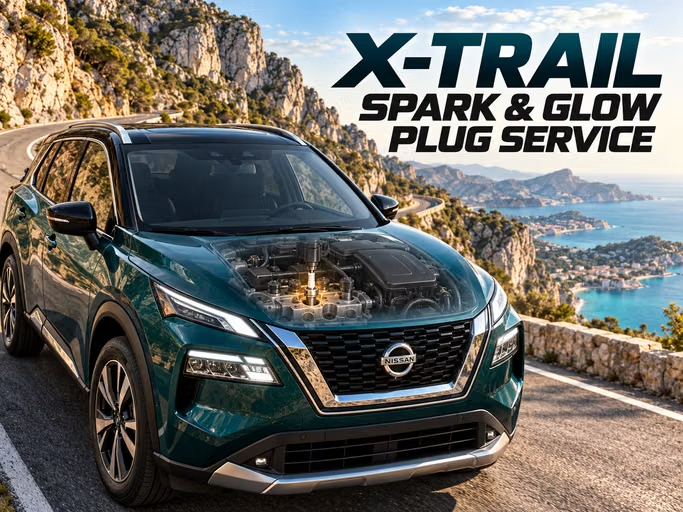
Nissan X-Trail plug servicing depends on the engine. Petrol models need scheduled spark-plug replacement, with earlier checks if rough running develops. On diesels, assess glow plugs together with the preheating control system. These components perform different jobs and should not be assigned the same replacement interval.
This article covers petrol X-Trails across several generations, earlier diesel versions and e-POWER. Before ordering parts, confirm the VIN, model year, engine code and vehicle specification. The X-Trail name or engine capacity alone is insufficient.
The cover illustrates a spark plug in the engine-bay area of a petrol vehicle. The cutaway indicates its installation location; it is not an engine dismantling diagram.
Which plugs the different X-Trail versions use
The badge on the tailgate does not identify the engine design. Cars with the same displacement can have different injection systems, plugs and access arrangements. Identify the version before choosing a set.
| Version | Plug type | What to confirm |
|---|---|---|
| Earlier petrol 2.0 and 2.5 | Spark plugs | Generation and engine code |
| T33 with petrol 2.5 | Spark plugs | Part number specifically for T33 |
| Petrol hybrids and e-POWER | Spark plugs | Exact hybrid powertrain |
| Earlier diesel versions | Glow plugs | Diesel code and preheating system |
Petrol models and hybrids
A spark plug produces the spark inside a cylinder. Four-cylinder 2.0 and 2.5 models require a set matched to their particular engine. Moving from T32 to T33 does not mean the old part number carries over. Other turbocharged petrol engines also require their own application check.
In the X-Trail e-POWER, electric motors drive the wheels while the petrol engine supplies energy through a generator. The version with a three-cylinder 1.5 engine uses three spark plugs. Electric propulsion does not remove the need to service them; this petrol engine does not need glow plugs.
Diesel versions
Glow plugs help diesel X-Trails establish suitable combustion conditions during starting and warm-up. They are heaters rather than spark-producing components. Match them to the specific diesel engine: identical threads do not establish compatibility.
When an earlier inspection is needed
- A petrol engine runs unevenly, hesitates under load or takes longer to start.
- A diesel struggles to start after standing, then runs unevenly or produces smoke during its first moments of operation.
- A warning appears and diagnosis identifies misfires or glow-circuit faults.
Record when the symptom occurs: with a cold engine, after warm-up or during acceleration. The battery, injectors, intake leaks and mechanical faults can produce similar complaints. On CVT versions, investigate jerking using both engine and transmission data.
How to establish the replacement interval
The petrol engine maintenance schedule
Nissan’s regional schedule specifies 120,000 km for iridium spark plugs in GCC-specification X-Trail T32 models. The row uses [R], indicating mileage-based replacement. This is not an interval for every X-Trail.
The Nissan maintenance schedule contains the table on pages M-8–M-9. Confirm the engine, plug type and notes before applying it. For T33, e-POWER and other versions, use their own maintenance schedules.
Where the applicable schedule also gives a time limit, follow whichever comes first. Smooth running does not justify extending the interval. Equally, hot weather and urban journeys do not establish a single shorter interval for every vehicle.
When service history is missing
When browsing current listings for the Nissan X-Trail, ask for records showing the date, mileage and part numbers of previous plug replacements. An oil-change entry does not establish ignition servicing. If records are missing, agree an inspection and an initial maintenance plan.
How to choose compatible plugs
| Parameter | Spark plugs | Glow plugs |
|---|---|---|
| Application | VIN, engine and model year | VIN and exact diesel code |
| Geometry | Thread, reach and seat | Thread, heater length and seat |
| Operating specification | Heat range, electrodes and gap | Voltage, heater type and control |
| Confirmation | Original part number or verified equivalent | Part number for the preheating system |
Check official part-number supersessions and the required quantity. A similar photograph, matching socket size or a claim that a part fits every X-Trail does not replace application verification. Discuss plug requirements separately if the engine calibration has been modified.
The X-Trail T33 manual section on iridium platinum-tipped plugs says not to reuse them after cleaning or regapping. Do not substitute advice to restore a worn set with abrasive paper.
Glow plugs in a diesel X-Trail
When to inspect and replace them
Do not apply the petrol spark-plug interval to glow plugs. Replacement depends on the specific diesel’s requirements and diagnostic findings. Difficult cold starting or a preheating fault calls for investigation, but does not establish that every heater has failed.
The problem may be less noticeable in warm weather. That does not make the system unnecessary: on applicable diesels, post-glow continues after starting and helps stabilise combustion. Injection or compression problems can also cause smoke and rough running.
What to check besides the plug
A workshop should relate fault codes to the glow controller, supply and wiring. Battery condition and starting conditions also matter. A damaged connection or failed control channel will not be repaired by fitting a new heater.
NGK’s technical guidance describes glow-plug resistance testing and advises against connecting a plug directly to the battery until it glows red. An unsuitable voltage can damage the heater. Compare measurements with the requirements for that component rather than one universal value.
Why removal needs care
Assess access and connection condition before removal. Do not keep increasing force on a seized glow plug: its body or tip can break. Engine temperature, preparation and permissible force must follow the repair procedure for that diesel. If breakage is likely, use a specialist equipped for extraction.
Ceramic heaters need particularly careful handling. Never fit a damaged plug. Check that the removed component is complete; if part of its tip is missing, do not start the engine until the fragment has been accounted for.
One plug or a full set
Decide after checking the remaining plugs, their age and access requirements. A full set may be reasonable where deterioration is widespread, but first rule out a control-system fault. Do not mix unverified heater types simply because they screw into the cylinder head.
Diagnosing and replacing spark plugs
What inspection can reveal
First save fault codes and the conditions in which they occurred. Then check cylinder misfires, connectors, coils and plug wells. If ignition is healthy, continue with the injection system, intake and mechanical engine condition.
| Observation | Possible meaning | What to check |
|---|---|---|
| Dry dark deposits | Incomplete combustion or unsuitable operating conditions | Mixture, part number and journey pattern |
| Oil in the plug well | An external sealing problem | Seals and coil boot |
| Oil on the firing end | Oil entering the cylinder | Oil consumption and engine condition |
| Damaged insulator | Installation error or mechanical damage | Plug, tools and installation |
Keep removed plugs in cylinder order. Compare each with the others and with test results: insulator colour alone is not a diagnosis. If a new set fouls quickly, another replacement without addressing the cause will provide only temporary relief.
Pre-installation checklist
☐ Confirm VIN, engine, part number and required quantity.
☐ Switch the vehicle off and prevent accidental starting; on hybrids, confirm READY mode is off.
☐ Clean the work area and prepare a suitable spark-plug socket.
☐ Confirm the access procedure, required seals and exact tightening torque.
☐ After assembly, check operation and record the date, mileage and parts fitted.
Start plugs squarely with the engine prepared as specified in the repair procedure. Use a torque wrench and the correct specification. Do not add thread lubricant without the relevant instruction: it changes tightening conditions. Secure coils and connectors correctly.
On e-POWER, a silent engine does not mean the vehicle is switched off. Work around high-voltage components belongs with a trained technician; do not use orange cables and connections as supports or disconnect them to gain access to plugs.
Mistakes and signs of an urgent fault
- Applying the T32 interval to T33 or e-POWER without checking the documentation.
- Ordering by model name without identifying the engine.
- Automatically replacing coils with plugs without checking their condition.
- Clearing codes instead of investigating recurring misfires or preheating faults.
If the engine warning flashes, the vehicle shakes severely or power drops sharply, stop accelerating and pull over safely. Severe misfires can overheat the catalytic converter. If rough running continues, arrange diagnosis and transport to a workshop.
Frequently asked questions
Does the X-Trail e-POWER need spark plugs
Yes. Its petrol engine requires spark ignition even though electric motors turn the wheels. Select the set and maintenance interval for that particular powertrain.
Should plugs be replaced at every service
No. Spark plugs have a separate operation in the maintenance schedule; glow plugs follow the diesel’s requirements and inspection findings. An oil change alone is not a reason to replace either type.
Can just one spark plug be replaced
Scheduled servicing normally involves a complete set. If one recently fitted plug is damaged, establish why and assess the others first. Repeated misfires in one cylinder require diagnosis even after a new plug is fitted.
Does a smooth start rule out a glow-system fault
No, if a fault code is already present or the complaint returns after a long stop. An apparently normal warm-weather start does not establish that every heater and control channel is working.
Conclusion
For a Nissan X-Trail, first identify the engine and plug type. Petrol versions, including e-POWER, need spark-plug replacement under their own schedules. On diesels, check glow plugs together with their supply and control system. Accurate parts selection, careful installation and retained service records help avoid repeat work and unnecessary replacement of healthy components.


