How Often Should You Change Differential Oil in a Nissan Patrol?
Nissan Patrol
Nissan Patrol•
•73 views
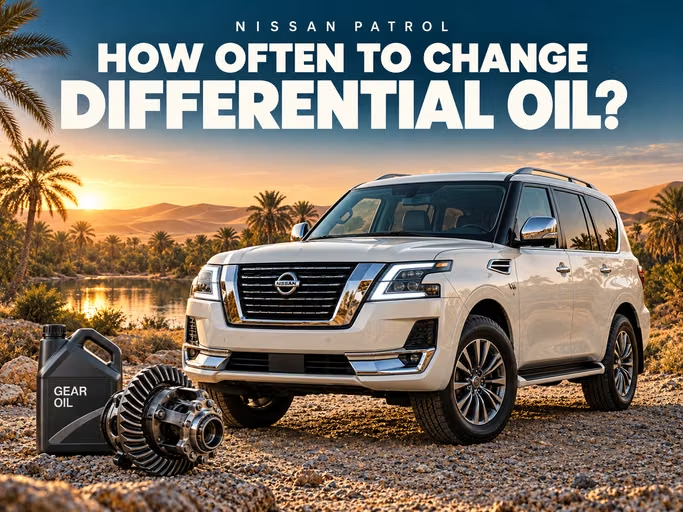
For Nissan Patrol Y62 models covered by the published regional schedule, differential oil replacement is due every 40,000 km or 24 months, whichever comes first. Confirm that schedule against your vehicle’s documents before servicing. Y61, Y63 and modified assemblies need separate checks. Leaks, water entry or a new hum call for an unscheduled inspection.
What Is the Patrol Y62 Service Interval?
The Nissan maintenance schedule has a dedicated Y62 differential-oil row on pages M-18–M-19. Replacement is marked at 40,000 km or 24 months, then 80,000 km or 48 months, continuing at the same interval. Intermediate inspections are scheduled every 10,000 km or six months.
An I in the table means inspection and correction as necessary; R means replacement. An inspection entry does not prove that the oil was drained and renewed. Establish whether both differentials were serviced. An automatic-transmission fluid change does not record that work.
This schedule applies to the Y62 versions covered by the document. The applicable service documents and Nissan’s VIN-specific instructions take priority for the actual year and specification. Do not automatically apply the table to a newer Y63 or a Patrol Safari Y61. On a used vehicle, also establish whether an axle or differential has been replaced with a different assembly.
Should Desert Driving Bring Servicing Forward?
Tell the workshop about regular towing, sand routes, deep ruts and water crossings. Nissan’s regional document identifies towing and rough, muddy or desert roads as conditions relevant to differential servicing. Off-road use may require additional maintenance; there is no single shorter interval that covers every route.
What Happens When Differential Oil Is Low or Contaminated?
Final-drive gears and differential bearings carry load during acceleration, climbing and towing. Oil protects the contact surfaces and helps remove heat. A low level or water contamination compromises that protection. Continued use can turn a small leak into an assembly repair.
| Finding | Possible cause | Action |
|---|---|---|
| Oil on the housing or flange | A leaking seal or plug, or a ventilation problem. | Locate the source and check the level. |
| Cloudy or emulsified fluid | Possible water contamination. | Check the fluid, seals and breather. |
| Large metal fragments when draining | Possible gear or bearing damage. | Assess the debris and internal condition. |
| Humming, grinding or vibration | A differential or another drivetrain component may be faulty. | Diagnose the cause before further loading. |
Colour alone cannot establish the oil’s remaining useful life. Assess it alongside level, contamination, particle type and symptoms. A light deposit on a magnet needs a different interpretation from large sharp fragments. Fresh fluid cannot restore damaged gear teeth or bearings.
When Should You Arrange an Earlier Inspection?
- After flooding, a deep water crossing or an impact to a differential housing.
- If there are fresh oil traces, drops under the vehicle or oil on an underbody guard.
- When a journey is followed by a new noise, vibration or jerking during turns.
- When maintenance records are missing or the previously used oil is uncertain.
A dusty route alone does not establish that sand entered a sound housing. After demanding off-road use, however, have the seals, ventilation and assembly protection inspected. Topping up a leaking differential without addressing the cause leaves the risk of another low-oil condition.
How Do You Choose Front and Rear Differential Oil?
The linked Patrol Y62 owner’s manual specifies different fluids for the front and rear differentials. These are examples from that edition: confirm the match to your year, specification and fitted assemblies before buying. This table is not a ready-made fluid selection for a Y61 or Y63.
| Y62 unit in the manual | Requirement | Selection detail |
|---|---|---|
| Front differential | GL-5 80W-90 | Nissan Hypoid Super or equivalent mineral oil. |
| Rear differential | GL-5 75W-90 | Nissan Hypoid Super-S or equivalent synthetic oil. |
A gear-oil label does not establish interchangeability. The gearbox, transfer unit and differentials have their own requirements. The API category, viscosity and suitability for the actual mechanism must match the documentation. A thicker lubricant does not become correct simply because the climate is hot.
Why Does Differential Type Matter?
For a Patrol Safari Y61, identify the fitted rear differential first. If it is an LSD, or limited-slip differential, select oil that meets the requirements of its friction elements. A selectable differential-lock switch does not establish that an LSD is installed. Do not add a friction modifier just in case or select fluid from another owner’s vehicle description.
A Y63 requires its own VIN-specific selection using documentation for the newer generation. Do not transfer Y62 capacities and fluids based on similar appearance or the shared Patrol name. An aftermarket locking mechanism may also have requirements from its manufacturer.
Checklist After an Oil Change
☐ The invoice separately names the front and rear differentials if both were serviced.
☐ The product name, viscosity, specification and quantity are recorded for each unit.
☐ Ventilation, plugs and seals have been checked, and any leak cause addressed.
☐ Unusual metal particles or signs of water have been documented.
☐ The level has been set to the procedure and oil tightness checked after filling.
☐ The date, mileage and next service due are recorded.
Will Fresh Oil Stop a Differential Hum?
Locate the sound first. Tyres, wheel bearings, the propeller shaft and a differential can all produce noise. Note whether it changes under acceleration, while coasting, during turns or after warming up. For jerking, also check the tyres, selected four-wheel-drive mode and other drivetrain components. An oil change should not replace diagnosis.
When browsing current listings for a Nissan Patrol, request service records for both differentials and an underbody inspection. Ask about off-road use and any assembly replacements. A freshly cleaned housing or recently changed oil does not establish that the components are unworn. Stop driving if there is severe grinding, knocking or substantial oil loss, and arrange suitable recovery.
Conclusion
The regional Y62 schedule gives 40,000 km or 24 months, subject to vehicle applicability. Check the specific requirements for a Y61 or Y63. Select oil separately for each differential, repair leaks and arrange prompt inspection after water exposure or the onset of noise.