


When to replace spark plugs and glow plugs in the Nissan Pathfinder
Nissan Pathfinder
Nissan Pathfinder•
•18 views
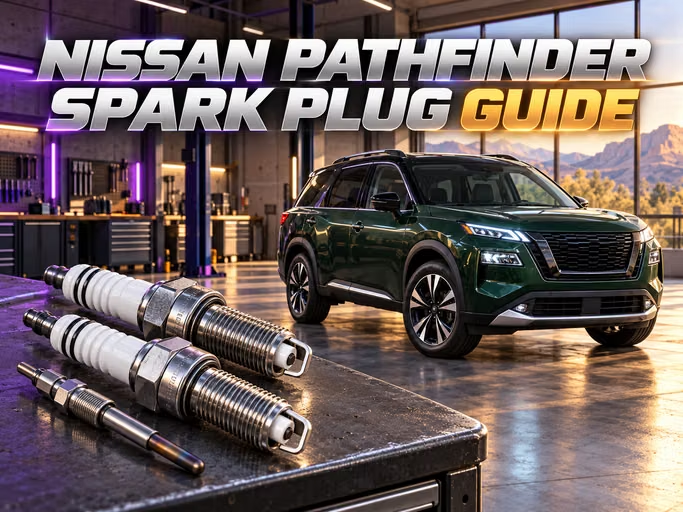
Nissan Pathfinder plug replacement depends on the generation, engine and vehicle specification. For the R53 with iridium plugs, the regional schedule specifies replacement at 120,000 km based on mileage. That interval does not automatically apply to other Pathfinders.
Petrol versions use spark plugs to ignite the mixture, while diesel glow plugs help heat the combustion area. The Pathfinder Hybrid also has a petrol engine with spark plugs. Each system needs its own parts and testing methods.
This guide explains the differences between common versions, fault symptoms and servicing considerations. Before ordering a set, confirm the VIN, model year, engine code and previous replacement records.
Which plugs different Pathfinders need
The Pathfinder name spans vehicles with different layouts and powertrains. Engine capacity alone is insufficient; the engine code matters too. Even two 3.5-litre petrol V6 versions may require different plugs.
| Version | Plug type and quantity | What to check |
|---|---|---|
| R53 3.5 V6 | 6 spark plugs | Schedule and part number for its model year |
| R52 3.5 V6 | 6 spark plugs | VQ35 version and injection system |
| R51 4.0 V6 | 6 spark plugs | VQ40DE application |
| R52 Hybrid 2.5 | 4 spark plugs | Supercharged QR25DER petrol engine |
| R51 2.5 dCi / 3.0 dCi | Glow plugs | YD25DDTi or V9X diesel |
Petrol V6 engines
The V6 engines listed use one spark plug per cylinder. Matching quantities do not make sets interchangeable. With the R52 in particular, identify the engine version: “Pathfinder 3.5” is not a complete parts specification.
For earlier generations and other petrol variants, use a VIN-based catalogue. The table does not replace an individual vehicle check or cover every engine fitted throughout the model’s history.
The Pathfinder Hybrid
The R52 Hybrid with the QR25DER uses four spark plugs. Its electric motor assists the powertrain but does not remove the petrol engine’s service requirements. A V6 plug set is not suitable for it.
Diesel versions
The R51 range included 2.5 dCi and 3.0 dCi V6 diesels. Their glow plugs must be assessed with the supply and control system. Petrol Pathfinders, including the hybrid described here, do not have glow plugs.
How often to replace spark plugs
Nissan’s regional maintenance schedule, on pages M-8–M-9, specifies replacement at 120,000 km for iridium plugs in GCC-specification R53 and R52 Hybrid models. The replacement mark is in square brackets, meaning this operation follows mileage rather than the corresponding months column.
Before applying the interval, match your model year and specification to the vehicle’s documentation. The table’s note also requires earlier replacement if the gap exceeds the limit given for the relevant engine. Inspection must suit the plug design; do not bend a fine electrode unless permitted.
Why the whole range cannot share one interval
The R52 Hybrid entry specifically refers to the hybrid. It does not establish the same interval for every R52 V6. For the R51, earlier generations and other specifications, follow their own schedules, plug types and notes.
Traffic and short journeys
Frequent short trips and low-load running can encourage deposits. Recurring rough running needs investigation regardless of mileage. However, heat or city use alone does not justify assigning one shorter interval to every Pathfinder.
When browsing current offers for the Nissan Pathfinder, ask for invoices showing the date, mileage and part numbers of replacement plugs. For a V6, confirm that the complete set was serviced. If records are missing, include ignition checks in the initial maintenance plan.
When earlier diagnosis is needed
- Idle becomes uneven or the engine shakes noticeably.
- Under load, the engine hesitates, jerks or loses power.
- Starting becomes difficult or misfire faults are recorded.
If the engine warning flashes and rough running is severe, stop accelerating and pull over safely. Unburned fuel can overheat the catalytic converter. If uneven running continues, arrange diagnosis and transport to a workshop.
Choosing plugs and tracing rough running
What to check before buying
Compare the original part number and approved alternatives, heat range, thread, reach and seat. An iridium or platinum electrode does not make a plug universal. Selecting only by engine capacity can produce an error even within one generation.
Use the exact engine and component documentation for gap and tightening specifications. Do not select a colder plug in pursuit of a promised power gain. Use only an approved inspection method for fine electrodes; cleaning or adjustment may not be permitted.
What a misfire can indicate
A fault code identifies a cylinder or operating condition but does not prove a plug failure. Check the coil, connector, injection and engine condition too. If rough running began immediately after servicing, first assess parts selection and assembly quality.
| Observation | Possible cause | What to inspect |
|---|---|---|
| Oil in the plug well | An external sealing fault | Seals and coil boot |
| Oil on the firing end | Oil entering the cylinder | Oil consumption and engine condition |
| Dry dark deposits | Poor combustion | Mixture, operating pattern and part number |
| Cracked insulator | Handling damage | Plug and installation method |
| Recurring misfire in one cylinder | Ignition, injection or a mechanical fault | Systematic cylinder diagnosis |
Retain removed plugs in cylinder order and compare them. A difference in one component helps direct the investigation but does not establish the repair by itself. Assess deposit colour together with fault codes and measurements.
Do not attribute every Pathfinder jolt to the transmission. Shaking at a standstill can involve engine mounts, while hesitation under load can involve combustion faults. Record exactly when the symptom occurs.
Glow plugs in the diesel Pathfinder
Symptoms that warrant inspection
On YD25DDTi and V9X diesels, investigate difficult starting after parking, uneven running immediately after starting and glow-circuit faults. Smoke does not prove a glow-plug failure: injection, compression and cranking speed also need consideration.
A fault may be less noticeable in warm weather. In systems with post-glow, plugs continue operating after starting. The petrol 120,000 km interval does not apply; use the diesel’s documentation and diagnostic findings to determine servicing needs.
How the system is assessed
Check the battery, supply, wiring, connections and glow controller. A single-channel fault can originate in a connection or control circuit. A new heater will not repair damaged wiring.
NGK’s glow-plug guidance describes resistance testing. Do not connect a plug directly to the battery to test it by making it glow: this can damage the element. Compare measurements with the requirements for the particular component.
Selection and careful removal
Confirm the diesel’s part number, operating voltage, geometry and controller compatibility. Do not select YD25DDTi or V9X parts using the Pathfinder name alone. Correct identified supply problems before installation.
Do not apply steadily increasing force to a seized plug. Preparation, engine temperature and allowable forces depend on the repair procedure. Where breakage is likely, use a workshop with extraction equipment. Check the tip is complete after removal.
Replace one glow plug or the complete set
Decide after checking the remaining plugs and the cause of failure. A set may be sensible where deterioration is widespread. If the supply or controller is responsible, repair it first. Locate any fragment missing after removal before starting the engine.
What to consider when replacing spark plugs
☐ Confirm the engine code, part numbers and plug quantity.
☐ Switch the vehicle off, prevent accidental starting and let the engine cool.
☐ Clean the work area and inspect the wells and coil boots.
☐ Confirm access to both cylinder banks on a V6.
☐ Prepare suitable tools and the tightening specifications.
For a V6, establish which intake components need removal and which seals the procedure requires you to replace. Difficult access is not a reason to service only the convenient bank. If the intake is opened, protect it from dirt and foreign objects.
Start each plug squarely and tighten it to the specified requirements. Excessive force damages the shell or threads; insufficient torque compromises sealing and heat transfer. Do not add thread lubricant without the relevant instruction.
On the R52 Hybrid, silence under the bonnet does not mean the system is off: the petrol engine can start automatically. Follow the hybrid vehicle procedure and do not touch high-voltage components.
Frequently asked questions about spark plugs
Should coils be replaced with the plugs
Healthy coils do not automatically need replacement. Inspect their boots, connectors and insulation. If a new plug set does not resolve rough running, continue diagnosis rather than replacing parts at random.
Can replacement wait until symptoms appear
Smooth running does not cancel scheduled servicing. Wear may show up only during acceleration or another load condition. After replacement, record the date, mileage and part numbers; after misfire repairs, confirm that the fault does not return.
Conclusion
Select Nissan Pathfinder plugs and service timing by generation and engine. The 120,000 km interval applies to the iridium-equipped versions identified in the regional schedule. Diesels need a separate glow-system assessment. Establish the cause of rough running before choosing replacement parts.


