Mercedes-Benz S-Class Brake Fluid Replacement
Mercedes-Benz S-Class
Mercedes-Benz S-Class•
•54 views
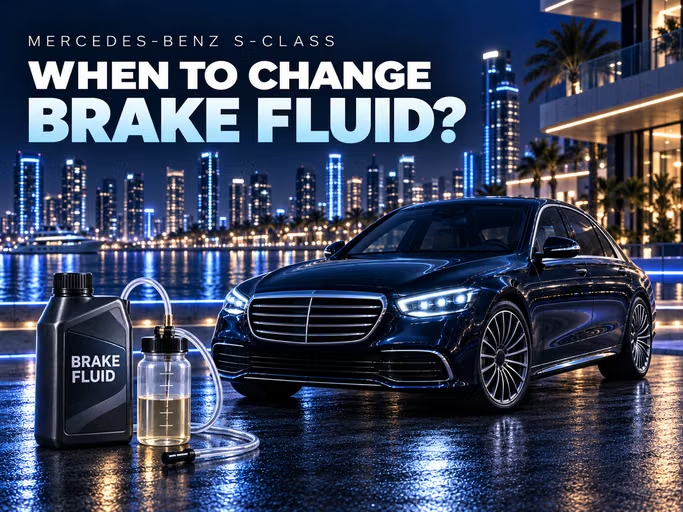
Use a two-year service cycle as a planning reference for Mercedes-Benz S-Class brake fluid replacement, then confirm the exact timing against the car’s maintenance schedule. Low mileage is no reason to postpone the work: fluid also ages while the car is parked. A sinking pedal or a noticeable loss of braking performance requires diagnosis, even if the next service is still months away.
Which symptoms call for a brake inspection?
Tell the workshop how far the pedal travels, how much pressure it needs and when braking becomes less effective. Arrange an inspection if:
- Normal slowing requires noticeably more pedal travel than before.
- The pedal slowly sinks under steady pressure while the car is stationary.
- After repeated braking, the usual pedal pressure produces less deceleration.
- The reservoir level falls quickly, or fluid appears beneath the car or near a wheel.
- A red brake system warning remains after the parking brake has been released.
Why elapsed time matters more than fluid appearance
Brake fluid operates under pressure and heats up near the wheel brakes. As moisture accumulates, its boiling point falls. Hard braking can then create vapour bubbles that impair pressure transmission. This is one possible explanation for increased pedal travel after heating, but a single symptom cannot establish the diagnosis.
An S-Class used only at weekends still needs maintenance based on elapsed time. Clear fluid reveals its appearance, not its boiling performance or the date it was last replaced. Condition checks should be considered alongside the service history, rather than used to extend the prescribed interval arbitrarily.
Topping up does not exchange the fluid throughout the system. The level may fall gradually as pads wear; a rapid drop or repeated need for replenishment calls for a leak inspection. Filling the reservoir to its upper mark corrects neither wear nor a leak.
Replacement timing and Mercedes-Benz approval
Mercedes-Benz lists brake fluid replacement within Service B, which repeats at two-year intervals. This provides a planning reference; confirm the applicable S-Class schedule using the VIN and service documents. A general service entry without an itemised record does not establish that the fluid was changed.
The owner’s manual for the August 2019 S-Class W222 specifies MB-Freigabe or MB-Approval 331.0. It also calls for regular replacement at a qualified specialist workshop. Selecting a bottle solely by its DOT designation does not fulfil that approval requirement.
| Item to verify | Confirmed reference | How to apply it |
|---|---|---|
| Timing | Two-year Service B cycle including fluid replacement | Check the individual vehicle’s schedule and previous replacement date. |
| Specification | MB-Approval 331.0 for the stated W222 | Verify product approval and the requirements for your variant. |
| Service history | An explicit fluid replacement entry | Distinguish a complete exchange from topping up or a level check. |
| Quantity | Depends on the service procedure | Do not treat reservoir capacity as the amount needed for replacement. |
What to look for on the container
Check the product against the Mercedes-Benz approved-fluid list. Claims such as “recommended for” or “meets requirements” do not, by themselves, establish official approval. For the W222 discussed here, approval 331.0 matters; a higher DOT number does not justify substituting a different fluid.
Use fresh fluid from a sealed container and clean equipment. Leftovers in a long-opened bottle with an unknown storage history should not be kept for the next service. Never pour drained fluid back into the system, and remove accidental splashes from paintwork promptly.
Running an S-Class in the UAE
Hot weather makes the condition of the whole brake system especially relevant. High ambient temperature alone, however, does not establish a different fluid replacement interval. An additional inspection before a journey involving prolonged descents is a sensible operating precaution, not a separate mandatory Mercedes-Benz schedule.
Urban driving and long descents
Frequent stops and sustained braking downhill impose different demands. Before a mountain journey, check pads, discs, hoses and the fluid replacement history. Control downhill speed using the transmission modes described in the manual: continuously holding the brake pedal increases heat loading.
If braking weakens after the system heats up, cooling alone does not confirm that everything is sound. A workshop needs to establish whether the cause involves fluid, friction components or another part. Vibration and grinding also warrant inspection, but neither indicates that fluid replacement alone will solve the problem.
Different generations, hybrids and AMG variants
The S-Class name does not imply one procedure for every car. Equipment and working methods depend on the installed braking system. A hybrid powertrain does not remove hydraulic maintenance requirements, while larger brake hardware does not authorise a different fluid approval. Verify diagnostic and bleeding instructions for the particular variant.
What a complete fluid replacement includes
When booking the work, confirm its scope: the fluid must be renewed through the specified circuits, rather than only in the reservoir. Fresh-looking contents beneath the cap reveal nothing about the fluid near the wheels. Repair documentation determines the bleeding sequence, equipment pressure and any required diagnostic functions.
- Match the car to the correct repair instructions and review its maintenance history.
- Inspect the hydraulics and brake hardware, and assess warnings or identified faults.
- Agree any necessary repairs and prepare enough approved fluid for the full exchange.
- Perform replacement and air removal using the prescribed procedure while monitoring reservoir level.
- Check for leaks and verify brake operation while stationary, then carry out a safe road check.
- Record the date, mileage, fluid product, approval and work performed.
Is a specialist workshop necessary?
A generic video and a handheld extractor are not sufficient preparation. The job requires instructions for the installed system, suitable equipment and a reliable way to verify the result. If these are unavailable, use a workshop familiar with your S-Class generation. The owner’s manual is not a substitute for the repair procedure.
Assessing the service history of a used S-Class
Recent pads, a clean reservoir and a warning-free dashboard cannot reconstruct the maintenance history. Obtain records and inspect the car before buying, rather than assuming every fluid was replaced at the last engine oil service.
☐ The last brake fluid replacement has a recorded date and mileage.
☐ The invoice identifies the product and its approval.
☐ Any subsequent hydraulic repairs are documented.
☐ Accessible connections, the reservoir and wheel areas have been inspected.
☐ Any warnings or braking complaints have an established cause.
Servicing mistakes to avoid
- Delaying maintenance because annual mileage is low.
- Treating a reset service reminder as proof of fluid replacement.
- Choosing fluid by colour, price or a DOT label alone.
- Refreshing only the reservoir and recording it as a complete exchange.
- Compensating for a falling level through repeated topping up.
Conclusion
S-Class brake fluid care depends on a documented service date, an approved product and the correct replacement procedure. Check the two-year reference against the car’s schedule, and use MB-Approval 331.0 for the W222 covered here. Brake faults require diagnosis and repair regardless of when the next service is due.
When choosing a car, current listings can help compare equipment and the stated service history. Verify the fluid replacement record when inspecting the individual S-Class.