How often to replace the cabin air filter in a Mercedes-Benz GLE Coupe AMG
Mercedes-Benz GLE Coupe AMG
Mercedes-Benz GLE Coupe AMG•
•56 views
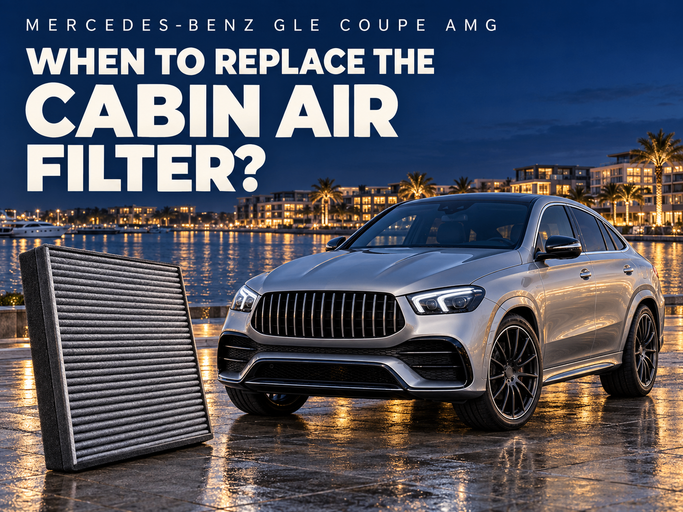
Replace the Mercedes-Benz GLE Coupe AMG cabin air filter according to the maintenance schedule for the individual vehicle. Reduced airflow, a musty smell or wet filter media calls for an earlier inspection. Start with the service history: a general service stamp does not show which ventilation filters were replaced or whether the rest of the air path was checked.
Signs the GLE Coupe AMG cabin filter needs attention
First identify what has changed: airflow, air temperature or smell. For an initial check, park the vehicle, open the vents and select a fixed fan speed. Avoid comparing a cabin that has just been parked in the sun with one that is already cool: automatic climate control changes the airflow as conditions change.
- Airflow feels weaker at the same settings. Note whether the difference affects every zone or only particular vents.
- A musty smell appears during the first few minutes of ventilation. Note whether it fades and whether switching cooling on makes a difference.
- The windows take longer to clear. Check for wet mats and review the climate settings as well as the filter.
- Inspection reveals wet pleats, torn media or a damaged frame. Ask for the cause to be checked before a replacement is installed.
Weak airflow and odours are among the signs of a dirty cabin air filter, but neither symptom establishes the cause on its own. A problem affecting just one vent also calls for a check of its opening and air distribution. A precise description is more useful to the workshop than simply saying that the air conditioning is worse.
Finding the replacement interval for your vehicle
Pages 333–334 of the GLE Coupé C167 manual call for more frequent maintenance in arduous conditions, including heavy dust, and name the cabin filter among the items concerned. That section does not specify one shortened mileage interval for every version.
Ask for the maintenance schedule applicable to your VIN and compare it with the date and mileage of the last replacement. Clarify whether the next job includes inspection, replacement of the cabin element or servicing every ventilation filter fitted. Keep the installed part numbers on the invoice so that the next workshop can establish what was actually done.
When to inspect between scheduled services
Dusty access roads, construction along your usual route and long periods with ventilation running while parked are useful details to give the technician. Distance travelled does not capture every hour of climate system use. If a new symptom starts after a change of route, mention it even when the next scheduled service is still some way off.
If the service history is unclear, ask to see the removed elements or inspection photographs. Look beyond colour: debris between pleats, moisture, damage and seal condition all matter. Activated carbon media can be dark when new, so colour alone does not establish that a filter has reached the end of its useful life.
What happens if cabin filter replacement is delayed?
A loaded filter can restrict airflow. The driver raises the fan speed and hears more noise without recovering the usual ventilation. Air at a vent may still feel cold: cooling performance and the amount of air delivered are separate aspects of the complaint.
- Restricted airflow makes cabin ventilation less effective. It can be particularly noticeable when restoring comfort after the vehicle has been parked.
- A damaged seal or incorrect fit can allow air to bypass the media. A strong flow alone does not confirm that filtration is working properly.
- Repeated wetting can bring the smell back soon after service. The workshop then needs to investigate water entry rather than repeatedly replace the same element.
The cabin filter does not serve the engine intake or repair an air conditioning compressor fault. If airflow is strong but remains warm when cooling is requested, ask for a climate system diagnosis. A filter should not become the assumed explanation for every climate complaint without an inspection.
Choosing a cabin air filter for the GLE Coupe AMG
Match the part to the VIN, production date and exact catalogue position. A listing that says “for GLE” or “AMG” is not enough: body style, generation and specification must fall within its stated application. Before buying, ask the seller to confirm the part number and everything included in the package.
Why the prefilter also matters
Page 150 of the cited C167 manual describes the cabin filter working with a prefilter in the engine compartment and directs maintenance to a qualified workshop. On a vehicle with that layout, both positions need consideration; replacing one element does not establish that the complete system has been serviced.
The ventilation prefilter and the engine intake filter are different parts. Ask the workshop to identify them on a diagram and list the completed work separately. An invoice that only says “air filter” makes it harder to confirm what was serviced or order the correct consumables next time.
| Item to confirm | What must match | How to verify |
|---|---|---|
| Vehicle | Generation, body and specification | VIN and catalogue application |
| Filter position | Purpose and installation location | Assembly diagram and part number |
| Package contents | Number and type of elements | Package description and invoice |
| Fit | Frame, seal and orientation | Instructions and housing inspection |
Choosing the media and checking the finished work
When comparing cabin filter types, consider their purpose. Particle media captures airborne particles; activated carbon adds a reduction in some odours and gaseous contaminants. Assess additional coatings using the manufacturer's technical information. Those properties only help when compatibility and installation are correct.
Do not trim a frame or add homemade seals to make an unsuitable part fit. During service, the technician checks the cover, seals and accessible housing, removes debris and looks for water marks. Installation orientation should follow the instructions for that exact position rather than a remembered procedure from another vehicle.
After reassembly, repeat the check at the original fan speed. Compare front and rear vents while allowing for any separate zone settings. Report a new whistle or rattle straight away, and retain the packaging or a photograph of the part number until the final check is complete.
Why a smell can remain after filter replacement
A persistent smell needs its source identified. It may come from the climate system, damp interior trim or outside the vehicle. Describe when it starts: initial activation, rain, washing or a change of ventilation mode. If it is present with the fan off, inspect the cabin and luggage compartment separately.
| Observation | Possible inspection area | What to tell the workshop |
|---|---|---|
| Mustiness at startup | Evaporator and condensate drainage | How long the smell lasts |
| Smell after rain | Housing, seals and water marks | When and where dampness appeared |
| Smell with fan off | Mats, trim and luggage compartment | Whether any areas feel wet |
| Whistle after service | Filter seating and cover | The fan speed at which it occurs |
Checklist before a return workshop visit
☐ Record the conditions in which the smell appears and the climate settings.
☐ Briefly compare fresh air and recirculation away from outside odours.
☐ Check for dampness inside and temporarily remove air fresheners.
☐ Bring the list of replaced elements and their part numbers.
Agree on evaporator and drain cleaning after an inspection. Do not apply household cleaning products to the filter media. If the element becomes wet again, the water entry must be addressed. Fuel, exhaust or burning smells require separate investigation and should not be dismissed as an ordinary dirty filter.
When choosing a GLE Coupe AMG from current listings, include the climate system in the inspection before purchase. Check the first startup, airflow in every zone and any smell after the drive; request records of filter replacement. Recently cleaned upholstery is no substitute for the ventilation service history.
Conclusion
Follow the maintenance schedule for your individual Mercedes-Benz GLE Coupe AMG, and arrange earlier attention when dust, moisture or changing airflow makes it necessary. Match parts by VIN, account for every filter position fitted and check the result of the service. If an odour returns, work with the workshop to find its source.