When to replace spark plugs in a Mercedes-Benz GLC
Mercedes-Benz GLC
Mercedes-Benz GLC•
•305 views
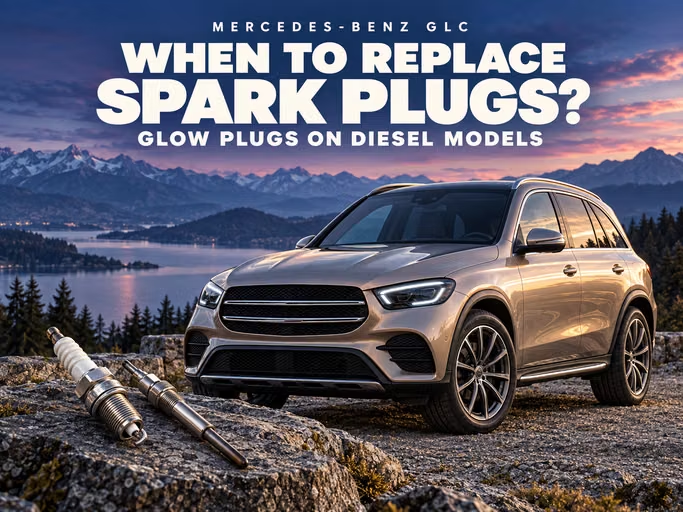
Replace the spark plugs in a petrol Mercedes-Benz GLC according to the installed engine’s schedule, observing mileage and time limits. Misfires, hesitation or difficult starting require earlier diagnosis. Diesel GLC models use glow plugs, which have their own tests and replacement criteria.
This article covers GLC models with an internal combustion engine, including hybrids and the Coupé. An all-electric GLC needs neither spark plugs nor glow plugs. For a combustion-engine car, confirm the VIN, engine and model year: the same GLC 300 badge on different generations does not guarantee the same set of plugs.
Which plugs different GLC versions need
The Mercedes-Benz GLC technical data distinguishes petrol, diesel and plug-in hybrid versions. The combustion engine determines the plug type. 4MATIC drive, AMG Line trim and body style do not replace an engine check. Each row in the table requires VIN-based parts selection.
| Version | Plug type | What matters |
|---|---|---|
| Petrol GLC | Spark plugs | Including mild-hybrid versions |
| Diesel GLC | Glow plugs | Check circuits and control |
| GLC 300 e petrol hybrid | Spark plugs | Electric driving retains maintenance |
| GLC 300 de diesel hybrid | Glow plugs | Do not confuse it with the 300 e |
| Mercedes-AMG GLC with an engine | Spark plugs | Select for the specific engine |
Petrol GLC and Mercedes-AMG versions
Spark plugs ignite the mixture in a petrol engine, including one with mild-hybrid assistance. Electrode wear increases the required voltage, so misfires may first occur under load. Mercedes-AMG GLC models have their own engines and requirements; do not transfer standard GLC parts and replacement intervals to them.
The GLC 300 e and GLC 300 de plug-in hybrids
An electric motor can move the vehicle without its combustion engine running. Once that engine starts, the petrol GLC 300 e needs spark ignition and the diesel GLC 300 de needs a working glow system. Do not subtract electric-only mileage from the odometer yourself. Time limits and the individual hybrid powertrain’s maintenance requirements still apply.
Diesel GLC versions
In a GLC 220 d, GLC 300 d or another diesel version, fuel ignites in air heated by compression. Glow plugs assist starting and may operate afterwards to support stable warm-up. Investigate the heater together with its power supply, connector and control system when a fault occurs.
When to check the plugs before scheduled replacement
On a petrol GLC
- Pronounced vibration and uneven running appear after starting.
- Hesitation, jerking or loss of pulling power repeats during acceleration.
- Starting takes longer, the engine warning appears or misfire faults are recorded.
Engine mounts or the transmission can produce similar vibration. Record whether it occurs while stationary, when changing gear or during acceleration. A cylinder misfire code does not prove that its plug has failed: the coil, injector, intake or cylinder itself may be responsible.
On a diesel GLC
Difficult starting after parking, rough initial running and glow circuit faults justify a system check. Warm weather may make a defect less obvious. Smooth running once the diesel is hot does not establish that all its glow plugs are healthy.
Why plugs can fail before their replacement is due
A repeat failure in one cylinder calls for investigation. If a new plug quickly develops deposits, another set will not repair oil consumption or an injection problem. Assess the plugs alongside coils, boots and diagnostic data. The table provides directions for those checks.
| Cause | Possible effect | Checks |
|---|---|---|
| Wear or incorrect gap | Unstable ignition | Application and plug mileage |
| Oil in a plug well | Insulation or boot damage | Seals and ignition coil |
| Combustion problems or oil consumption | Electrode deposits | Injection and cylinder condition |
| Glow supply fault | Insufficient or excessive heating | Wiring, connectors and controller |
| Installation error | Thread or seat damage | Procedure and tightening torque |
The GLC manual identifies frequent short journeys and arduous use as reasons to review maintenance. This is not a universal instruction to halve plug intervals: establish the specific work required. Tell the workshop about tuning or changes to boost pressure; do not choose a heat range based on advice for another version.
Why misfiring should not be ignored
Severe misfires can send unburned fuel into the exhaust and overheat the catalytic converter. Acceleration deteriorates and increased load may worsen the problem. Low mileage since the previous plug replacement is not a reason to postpone diagnosis.
On a diesel GLC, test the affected glow circuit and related components first. A fault may involve the plug, wiring or controller. Replacing all of them without measurements raises the repair cost without guaranteeing that the cause will be resolved.
Important. If the engine warning flashes, the vehicle shakes severely or power drops sharply, stop accelerating and pull over safely. If pronounced misfiring persists, arrange diagnosis and recovery.
How to establish the interval and select the parts
Check the schedule and service history
There is no single interval for every Mercedes-Benz GLC. Identify the spark plug replacement operation and its specified mileage and time limits by VIN. Use the schedule for the actual engine and model year. Where both limits apply, observe whichever comes first.
ASSYST PLUS displays the remaining time or distance before servicing, but a Service A or Service B entry does not prove that plugs were replaced. Obtain an itemised record with the date, mileage and part numbers. If the history is missing, agree an inspection and maintenance plan without assuming when the last replacement occurred.
The GLC SUV 2023 owner’s manual explains service messages and special operating conditions. It applies to the specified vehicle; check applicability for another generation, a Coupé, diesel or hybrid. Establish the complete work list and replacement intervals from the individual schedule, rather than inferring them from a service package name.
Match the plug specifications
| Parameter | Spark plug | Glow plug |
|---|---|---|
| Application | VIN, engine, model year | VIN, engine, glow system |
| Operating specification | Heat range, electrodes, gap | Voltage and heater design |
| Geometry | Thread, reach, seat | Thread, tip, seat, connector |
| Installation | Torque and fitting conditions | Removal and fitting procedure |
A matching thread does not guarantee compatibility. For spark plugs, check reach, seating, heat range and gap; for glow plugs, also check voltage and heater design. Confirm the part number and quantity in the catalogue for the engine, including official part-number supersessions.
Check a used car’s maintenance
When comparing current listings for the Mercedes-Benz GLC, ask about the last plug replacement and ignition or glow system repairs. On a hybrid, check operation after the combustion engine starts: smooth electric driving does not establish the petrol or diesel engine’s condition. Compare test-drive findings with diagnostic data.
What inspection of removed plugs can show
Keep spark plugs in cylinder order. If one looks markedly different, investigate its cylinder. Deposits, cracks and flashover marks help direct the search, but insulator colour alone cannot establish the precise cause.
| Observation | Possible meaning | Next check |
|---|---|---|
| Heavy deposits on one plug | A local combustion problem | That cylinder and its injector |
| Crack or flashover marks | Insulation damage | Plug, coil boot and coil |
| Oil outside the plug above its seat | Leak into the plug well | Seals; distinguish this from oil in the cylinder |
| Glow circuit fault | Plug, wiring or control fault | Electrical tests before removal |
On a diesel, perform electrical checks before removing glow plugs. Assess access and seizure risk separately. If a plug will not release using the specified method, do not extend the lever without controlling the force: it may break. A damaged tip requires locating the missing fragment.
Diagnosis and preparation for the work
The diagnostic sequence
- Save fault codes and their operating conditions, and record the owner’s complaint.
- Check the supply and connectors, followed by coils and plug wells or glow circuits.
- Follow the engine-specific diagnostic procedure, checking injection, intake sealing and cylinders where needed.
- After repairs, check for returning faults and record the date, mileage and installed parts.
Pre-work checklist
☐ Confirm the engine, plug type, part number and quantity by VIN.
☐ Prepare the correct tools and replacement procedure.
☐ Prevent automatic engine starting and follow the precautions for the particular hybrid system.
☐ Clean the work area and protect openings from sand and debris.
☐ Agree additional parts after checking their condition.
Spark plug torque matters because seating affects sealing and heat transfer. Do not borrow a torque value from another engine or apply lubricant without procedural guidance. Establish glow plug removal and installation requirements separately. Work on a 48-volt or high-voltage system requires a technician with the relevant training.
GLC servicing mistakes
- Confusing the petrol GLC 300 e with the diesel GLC 300 de.
- Buying plugs by the GLC 300 badge without checking the generation and engine.
- Extending the replacement interval yourself because the car is driven on electric power.
- Testing an unidentified glow plug by connecting it directly to the battery.
- Replacing all coils or the glow controller without checking their condition.
Frequently asked questions about spark plugs
Should spark plug replacement wait until the engine hesitates
No. Smooth running does not cancel a replacement that is due under the schedule. Hesitation requires investigation regardless of plug mileage. Diagnosis distinguishes a worn set from a fault elsewhere in the system.
Can the interval be extended on a petrol hybrid
Only where the individual vehicle’s schedule allows it. Frequent journeys without starting the combustion engine do not justify changing mileage or time limits yourself. The GLC 300 e retains a petrol ignition system.
Are coils replaced with the spark plugs
Healthy coils do not automatically need replacement at every plug service. Check them when there are misfires, boot damage or flashover marks. If the workshop proposes a full set, ask for the test findings and applicable procedure.
Frequently asked questions about glow plugs
Does the GLC 300 de hybrid need glow plugs
Yes. Its combustion engine uses diesel fuel. The electric motor does not replace the diesel glow system. Do not select parts from a petrol GLC 300 e description: it has a different powertrain.
Is replacement compulsory at a fixed mileage
Check the schedule for the particular diesel engine first. A petrol spark plug interval does not apply. Where no scheduled replacement is specified, use diagnostic findings and system condition to decide; investigate faults even in warm weather.
Why did a glow fault return after replacement
An unsuitable part, poor contact, wiring or the controller may be responsible. Establish that it is a new active fault rather than an old stored record. Replacing the plug again without checking its circuit may leave the defect unresolved.
Should all glow plugs be replaced together
Their shared age, the remaining plugs’ condition and access help inform a decision about a full set. One failed plug does not prove they have all failed. Consider the risks of removing healthy components and agree the scope after diagnosis.
Conclusion
For a Mercedes-Benz GLC, first establish the engine type and applicable maintenance schedule. Petrol versions, including the GLC 300 e, use spark plugs; diesels, including the GLC 300 de, use glow plugs. Observe the specified intervals, select parts by VIN and diagnose rough running before replacing components. Retain itemised records to plan the next service.