When to replace coolant in the Mercedes-Benz GLC
Mercedes-Benz GLC
Mercedes-Benz GLC•
•58 views
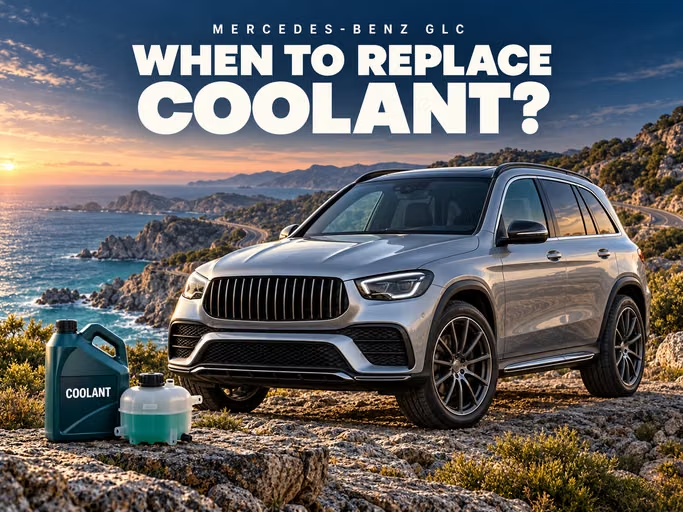
The coolant replacement interval for a Mercedes-Benz GLC should come from the service schedule for the individual vehicle and its maintenance history. The model name alone is not enough: the generation, engine and cooling system configuration also matter. Falling coolant levels, warnings or contamination call for diagnosis first. This guide explains how to prepare for coolant service on combustion-engined GLC models in the 253 and 254 families, including hybrids.
Establishing the GLC coolant replacement interval
Advice for another GLC may concern a different engine, production year or market. Start by identifying your vehicle. Give the workshop its VIN, or vehicle identification number, and ask which service requirement applies. This establishes why the proposed interval is appropriate and which maintenance record provides its starting point.
What the X254 manual specifies
The coolant section on pages 853–854 of the July 2023 GLC X254 manual refers to Specification 320.1 and requires regular replacement at a qualified specialist workshop. That section does not give a numerical interval in years or kilometres. Page 722 also assigns coolant checking and refilling to a qualified specialist workshop.
Do not turn these statements into a universal schedule for every generation. Match the document to your vehicle and obtain the next replacement date from the applicable service plan. If the workshop recommends earlier replacement, ask for the reason, such as work on the system or confirmed contamination.
Information to prepare before booking
Check the documentation separately for X253 and X254 SUVs and the corresponding C253 and C254 Coupé versions. A GLC 300 badge does not provide every detail needed to identify the cooling system and its fill. With an AMG or plug-in hybrid, agree exactly which circuits the service will cover.
| Item to check | Information to provide | Why it helps |
|---|---|---|
| Vehicle configuration | VIN, production year, engine and body style | Identifies the applicable requirements |
| Previous service | Date, mileage and work performed | Establishes the starting point for the interval |
| Existing coolant | Product name from the service invoice | Helps assess compatibility for a top-up |
| Fault history | Warnings, repairs and previous top-ups | Separates maintenance from diagnosis |
A used-car description stating that “all fluids have been changed” is not a substitute for records. Ask for an invoice naming the coolant and the work performed. Buying a container or adding a small amount does not establish that the entire fill was replaced. If the history is unknown, tell the workshop and agree on an assessment instead of estimating the service date from mileage alone.
When the GLC needs attention before the scheduled date
Routine replacement assumes that the system is working correctly. Coolant loss or abnormal temperatures change the task: the cause needs to be established. Fresh coolant does not rule out a leak, and replacing the fluid cannot repair a damaged component. Photograph the dashboard message and make a short note of the circumstances in which it appeared.
- The level warning returns after a top-up. Record how much coolant was added and how soon the message returned.
- Fluid traces appear where the vehicle was parked or around accessible connections. The visible drip location alone does not identify its source.
- An overheating message appears. Stop safely and follow the vehicle instructions; do not keep driving to see whether the warning clears.
- Sediment, flakes or oily traces are visible in the coolant. The source of contamination needs to be identified before refilling.
- Temperature behaviour or cabin heating changes after a repair. Tell the workshop which work preceded the change.
These observations do not prove that a particular pump, thermostat or radiator has failed. Ask the workshop to explain its diagnostic findings before ordering parts. A dashboard warning and an observed drop in fluid level, for example, are separate pieces of evidence to assess together. Replacing components on speculation can increase the bill without resolving the original problem.
What the owner can record
Keep the warning text, date, mileage and driving conditions: slow traffic, motorway travel, a climb or air-conditioning use. If coolant was added after an earlier service, find the record of the product and quantity. This information is more useful than assuming your car has the same fault as another owner's GLC.
For the X254 covered by the cited manual, leave coolant checking and refilling to the workshop. For another version, read its own instructions first. Do not transfer reservoir locations, level markings or service procedures from a neighbouring generation. The appearance of the engine compartment does not reliably establish the purpose of every circuit.
Choosing coolant for the GLC
Ask the workshop to confirm that the specific product is suitable for your vehicle. A general “for Mercedes-Benz” description does not establish the required approval or application. Specification 320.1, referenced in the manual, helps identify the coolant requirements; it does not mean that every coolant from one brand is suitable for every GLC.
Colour is not a substitute for verification either. Coolant manufacturer GLYSANTIN explains that colour alone does not identify a product's chemical and technical properties. Avoid adding coolant to an unknown fill simply because the colours match. Keep the agreed product name in the service records so that the next workshop does not have to guess from a reservoir photograph.
Ready-mixed coolant and concentrate
Distinguish ready-mixed coolant from concentrate. Use a ready-mixed product according to its instructions without arbitrary dilution; concentrate requires suitable water and the correct mixing ratio. The cited X254 manual specifies a concentrate proportion of 50–55%. Check the documentation before applying this requirement to another version.
Do not request extra concentrate as protection against hot weather: more concentrate does not mean better cooling. A warm climate does not make plain water a suitable permanent replacement for coolant either. If the system has been rinsed, ask how the workshop accounts for remaining water when restoring the required mixture.
Hybrid-specific considerations
For a plug-in hybrid, ask for the serviced circuits to be listed on the job sheet. “GLC coolant replacement” may not explain which parts of the cooling system are included. Low mileage with the combustion engine running does not justify cancelling time-based maintenance requirements yourself.
Leave high-voltage system work to appropriately qualified specialists. The X254 manual prohibits maintenance during charging. Do not use instructions for a conventional petrol GLC to access hybrid components. Confirm the scope before handing over the vehicle, particularly when comparing quotations from several workshops.
Hot weather and slow-moving traffic
Heat, prolonged low-speed driving and climbs make the owner's observations especially useful during diagnosis. They do not, by themselves, establish a single shortened coolant replacement interval. If a workshop recommends extra maintenance, ask how that recommendation relates to the service schedule or a specific inspection finding.
When temperatures rise mainly in traffic, fresh coolant may not resolve the problem. The technician needs to assess the system, including airflow and contamination around the heat exchangers. Do not treat a fluid change as a completed repair until the cause of the temperature problem has been explained.
Before a long journey, review the records and deal with recurring warnings in advance. Do not postpone an appointment simply because a message disappeared after a top-up. Following a recent repair, ask whether a follow-up inspection is required and when it should take place. This leaves time to address any findings before departure.
Agreeing on the replacement work
First establish the purpose of the visit: scheduled maintenance, refilling after a repair or correcting an unsuitable coolant fill. The required work follows from that purpose. Cleaning should be justified by the condition of the system and the manufacturer's procedure. Ask why a flush is needed rather than accepting it as an automatic addition to every coolant change.
If contamination is present, its source must be addressed. Filling then needs to be followed by the specified air-removal procedure and checks. HELLA notes that trapped air can disrupt circulation and cause overheating. A correct level at handover, on its own, therefore does not describe the quality of the entire service.
| Finding | Possible risk | What to discuss with the workshop |
|---|---|---|
| Unknown existing coolant | Unsuitable product or mixture | Product assessment and a plan to restore the correct fill |
| Repeated level loss | Coolant loss and impaired cooling | Identifying the cause before refilling |
| System contamination | Reduced system performance | The source and appropriate cleaning method |
| Air after work on the system | Disrupted circulation | The filling procedure and subsequent checks |
The table identifies areas for investigation, not a diagnosis. Clear-looking coolant does not prove that every protective property is intact either: additives become less effective over time. Use the schedule and maintenance history to decide when routine replacement is due, and diagnostic findings to decide how a fault should be addressed.
How much coolant the service requires
Do not use one litre figure for every GLC. Confirm the data for the engine and the circuit being serviced. Total system capacity and the quantity needed for a particular procedure can differ because some fluid may remain inside. If cleaning and final filling are both required, ask for their materials to be identified separately on the invoice.
To compare quotations, request the same scope: diagnosis, draining, any necessary cleaning, filling and final checks. Establish what the price includes and what would need separate agreement. This makes the work comparable even when different workshops use the same service name for different packages.
Checklist after the service
☐ Match the VIN and vehicle configuration to the job sheet.
☐ Obtain the coolant name and confirmation that it is suitable.
☐ Check which circuits were serviced and which operations were completed.
☐ Ask for the leak-check results.
☐ Confirm that the required air-removal procedure was completed.
☐ Obtain the final level and system-operation check results.
☐ Record the next service date and what to do if the warning returns.
Keep the invoice with the service date and mileage. When considering a used GLC, compare current listings alongside the repair and maintenance records. A documented history helps establish whether the car needs routine replacement or diagnosis first.
Conclusion
Replace GLC coolant according to the requirements for the individual vehicle and its documented service history. Verify product suitability and agree on the scope of the work. Repeated top-ups, contamination and overheating call for investigation; coolant replacement should form part of the required service, rather than substitute for diagnosis.