When to Replace Coolant in a Mercedes-Benz C-Class
Mercedes-Benz C-Class
Mercedes-Benz C-Class•
•104 views
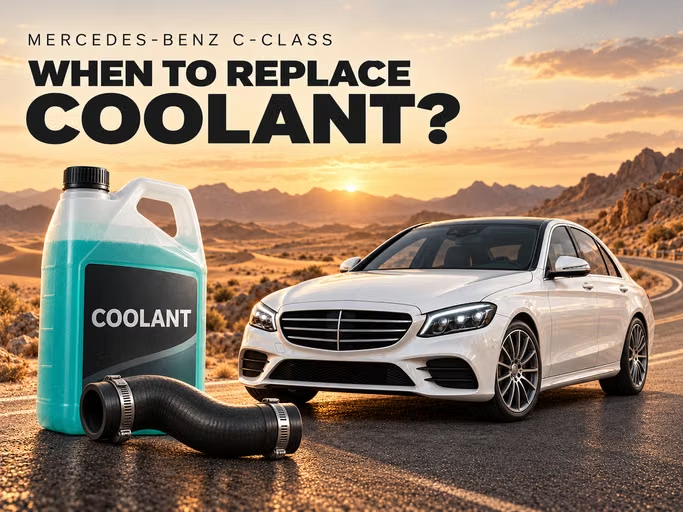
Mercedes-Benz C-Class coolant replacement should follow the service requirements for the specific vehicle. You need its generation, engine, build date and previous maintenance history. Leaks, contamination or overheating require attention before the scheduled service. This guide explains how to select the fluid, establish why replacement is needed and check the outcome with the workshop.
Official C-Class Coolant Replacement Requirements
Do not choose an interval using the model name alone. Service requirements can differ between generations and powertrains, while previous repairs may affect the next maintenance decision. First establish that the information applies to the car, then compare its requirements with the date and mileage of the last documented replacement. This matters particularly when a vehicle has changed owners several times.
Record the reason for the recommendation on the job order. If the workshop proposes replacement because of age, ask it to identify the applicable limit. If the reason is contamination or leakage, ask about the inspection findings. This helps distinguish scheduled maintenance from correcting an earlier repair or addressing a newly diagnosed fault.
What the W205 Manual Confirms
The October 2020 C-Class W205 manual, on printed page 439, specifies a 50–55% concentrate range and refers to operating-fluid requirements 310.1. The section calls for regular replacement by a specialist workshop but gives no numerical time or mileage interval. These details belong to that edition; they are not a schedule for every C-Class.
The reference 310.1 should not be treated as a sufficient bottle description for purchasing coolant. The workshop still needs to establish a suitable product for the actual car and its existing fill. Where technical information permits several materials, the selection should remain documented rather than depending only on whichever container happens to be available.
Versions That Need Separate Checks
Check W204, W205 and W206 vehicles individually. Sedan information should not automatically be extended to every coupe or estate bearing the C-Class name. Also confirm the engine, production date, AMG derivative and any hybrid system. The VIN, or vehicle identification number, helps select service information but does not replace checking the conditions under which that information applies.
| Detail | What to establish | Why it matters |
|---|---|---|
| Generation and body | Exact vehicle configuration | Select the correct document |
| Engine and build date | Engine code and production period | Check material requirements |
| Hybrid or AMG derivative | Cooling circuits and their purposes | Agree the appropriate procedure |
| Coolant history | Date, mileage, product and operations | Establish the basis for the next replacement |
Resolve conflicting information before the work begins. A listing may contain an incomplete trim description, while an old invoice may omit the fluid name. Passing those gaps to the next technician without explanation creates avoidable uncertainty. Ask the workshop to distinguish confirmed details from information that remains unknown.
Signs That Call for an Earlier Inspection
A scheduled replacement interval concerns maintenance of a functioning system. Leakage, overheating and contamination need a different sequence: establish the cause, then determine the repair and fluid work. Even recent coolant does not rule out a damaged hose or circulation problem. Consider the car’s behaviour and your observations as well as the date of the previous visit.
- The level repeatedly falls. Note top-up dates and approximate quantities; a continuing pattern matters more than one isolated reading.
- Fluid marks appear underneath the car or around connections. They help direct inspection, but the source may be above the point where the liquid collected.
- A temperature warning is displayed. Follow the vehicle instructions instead of trying to reach the workshop regardless of the warning.
- Foreign particles or an oily film are visible in the reservoir. Discuss contamination diagnosis before authorising a flush and refill.
- Cabin heating changes or unusual circulation noises appear after repairs. Explain when the symptom began and whether it returns.
One symptom does not prove a particular component has failed. A low-level message, for example, must be considered alongside the actual condition of the system. Avoid ordering an expensive part solely because someone described a similar incident online. Ask which test supports the diagnosis on your own vehicle.
Observing the Level Safely
Check a fully cooled car on level ground using its own manual. Compare photographs taken under equivalent conditions. A hot-fluid reading cannot be directly compared with a cold reading; doing so can create a misleading impression of loss. Do not fill above the prescribed mark simply to create a reserve.
Never open a hot cooling system. If steam appears or an overheating warning is displayed, stop safely and follow the vehicle message, arranging assistance when needed. On a hybrid, establish that the powertrain is switched off. A silent engine does not mean the car is fully inactive or ready for maintenance.
Selecting the Correct Coolant
Selection depends on the vehicle requirements and the exact product designation. Colour may help distinguish visible fluids but is not sufficient evidence of compatibility. A photograph of the reservoir cannot reliably identify an unknown mixture. If the previous owner kept a bottle, check whether that product was actually used for the most recent fill.
Ask the workshop to record its selected material before starting. This makes a later top-up easier to arrange and avoids an invoice containing only the word “coolant”. Keep a photograph of the label with the job record. A receipt for a bottle establishes its purchase, but does not, by itself, prove that its contents were installed in the car.
Concentrate and Ready-to-Use Fluid
Confirm the supplied form: concentrate and premixed coolant require different handling. Do not automatically dilute a ready-to-use product. For concentrate, agree the required water quality and final mixture. If the system was cleaned beforehand, retained water can also affect the resulting concentration and must be considered during filling.
Material preparation should reflect the complete agreed job. Simply adding new fluid to the reservoir may not be enough to restore the correct mixture. Decisions about draining and cleaning should account for the known fill and any contamination found. Experimenting with several products to achieve a particular colour is not an appropriate selection method.
Use in UAE Conditions
Traffic, high outside temperatures and extended air-conditioning use make cooling-system condition particularly relevant to the driver. However, they do not create a universal requirement for annual replacement in every C-Class. An earlier service should have a specific reason that the workshop can explain and document.
Inspection should also consider external contamination of the heat exchangers. Fresh coolant does not clean those surfaces or restore a faulty fan. Mention if the complaint mainly develops in slow traffic. Do not try to confirm that pattern yourself by leaving the vehicle stationary while its engine temperature continues to rise.
Consequences of an Old or Unsuitable Fill
Coolant provides protection that cannot be assessed from clarity alone. GLYSANTIN explains that corrosion-inhibiting additives gradually lose effectiveness. Its general guidance should not replace the service requirements for a C-Class. A vehicle-specific decision needs both those requirements and information about the product actually present in the system.
The table outlines possible consequences of different conditions. It does not mean that every old fill has already damaged the engine, and it cannot establish a repair from the reservoir’s appearance. Determine which condition has actually been found, how significant it is and what is needed to restore correct operation.
| Condition | Possible consequence | Inspection focus |
|---|---|---|
| Reduced corrosion protection | Internal corrosion | Maintenance history and system condition |
| Unsuitable or unknown fluid | Inadequate material protection | Product selection and renewal needs |
| Contamination and deposits | Disrupted cooling performance | Contamination source and cleaning method |
| Low level or trapped air | Unstable cooling and overheating risk | System leak-tightness and filling quality |
The service cost depends on more than the coolant. Diagnosing a leak, replacing a damaged component and repairing overheating damage are different scopes of work. Ask for them to be separated in the quotation. If substantial engine repairs are proposed, obtain the test results and a list of confirmed damage before comparing workshop offers.
Arranging Replacement and Checking the Result
Prepare a short history for the workshop: when you bought the car, whether warnings appeared, which repairs were performed and how much fluid was added. If only the most recent visit is known, say so. An accurate statement that records are missing is more useful than assuming the coolant must have been changed with everything else.
Agree the boundaries of the operation. In a system with several circuits, the job order should state which are included. Work involving cooling for high-voltage components needs appropriately qualified personnel. Owners should not have to remove protective parts or guess the purpose of reservoirs to help select a service.
System Capacity and the Actual Refill
The full reference capacity is not the quantity required for every replacement. Some fluid can remain inside the system during an ordinary drain. The technician must account for the procedure and the residue rather than adding the full published amount on top. A single litre figure for every C-Class would therefore be a misleading purchasing guide.
The completed job order should record the actual material quantity, product name and operations performed. Ask separately how leakage, air removal and the level after cooling were checked. Those details help assess the result and establish what to do if a dashboard message returns after collection.
Collection Checklist
☐ Match the vehicle and engine to the job-order details.
☐ Confirm the reason for replacement and the next due point.
☐ Obtain the product name and confirmation of its suitability.
☐ Check the circuits covered and the completed operations.
☐ Ask for the results of leak and level checks.
☐ Retain the date, mileage and actual material quantity.
☐ Establish whom to contact if a warning returns.
After service, observe the car during normal use. A returning warning, fresh leakage or a clear change in temperature behaviour warrants contact with the workshop. Do not begin by adding a different coolant yourself. Explain that the work was recently completed and agree a safe way to have the concern checked.
When shopping for a C-Class, compare current listings alongside the records for each individual car. Documented cooling-system maintenance is more useful than an assurance that the fluid lasts forever. A pre-purchase inspection can help establish whether the car needs routine replacement or an underlying fault must first be repaired.
Conclusion
Replace C-Class coolant according to the requirements for your version, its history and system condition. Confirm fluid suitability, retain the job record and monitor the cold level. Investigate leakage or overheating before deciding on further maintenance.